
The single dish every visitor to Uganda must try is the Rolex — a chapati rolled around a fried egg and fresh vegetables, sold at roadside stalls for next to nothing. Beyond the Rolex, Ugandan street food includes matooke (steamed green plantain), muchomo (roasted skewered meat), groundnut stew, posho, mandazi, and an abundance of tropical fruit. This guide covers the ten dishes worth seeking out, with notes from our repeated visits to Buhoma village in Bwindi — the gateway to mountain gorilla trekking in southwestern Uganda.
Quick Facts
- Cost per street snack:
- 500–2,000 UGX
- On-site visits by author:
- 14 documented visits
- Latest photos taken:
- June 2026
- Ingredients:
- Always local and fresh
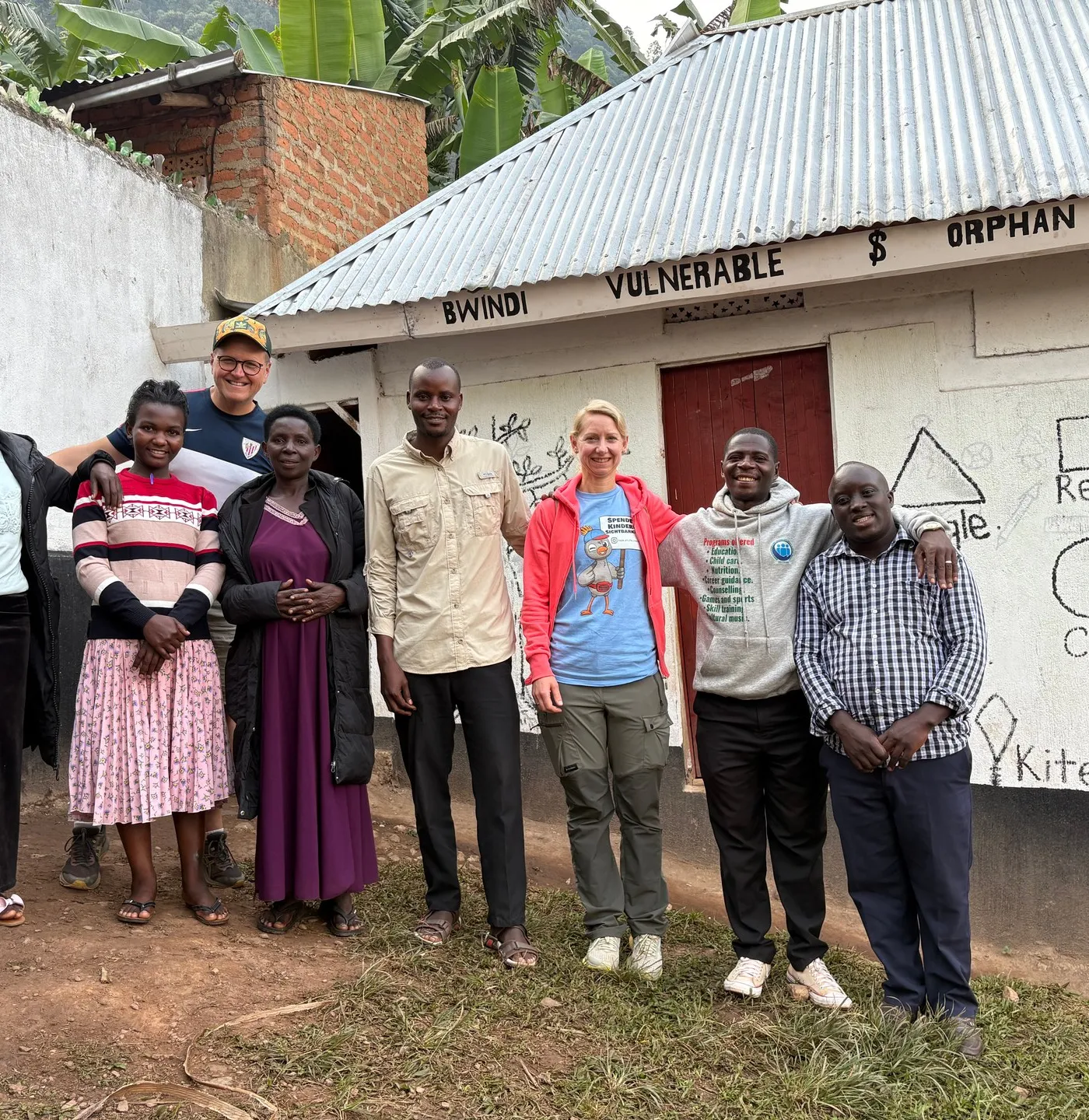
On a quiet morning in June 2026, we walked the red-dirt path out of Buhoma village to visit a local chicken farmer not far from the orphanage where Hope on the Road has been working for years. The farmer met us with easy pride — a man who has built a small but serious poultry operation at GPS coordinates -0.9713, 29.6142, raising chicks with remarkable care in a landscape where every resource demands intention. He showed us his coops, explained how he regulates the temperature for young birds, and described the cycle from hatching to market. We had bought chicks from him before, for the orphanage — some kept for eggs, others eventually for meat. Standing there, watching the birds peck and scramble in the morning light, it was impossible not to think about how food actually works in this part of Uganda: it begins here, close to the ground, in the hands of people who know the animals by name.
That visit captured something important about Ugandan food culture. It is not abstract. The connection between what grows or lives on this hillside and what ends up on a plate — or in a street-side pan — is direct and immediate. During fourteen visits spanning from October 2024 through June 2026, with extended stays of eleven to thirteen days at a time, we have eaten across this region in roadside stalls, village kitchens, and lodge dining rooms. What follows is an honest account of the dishes worth your attention, starting in Buhoma and extending to what you will find across the country.

1. Rolex: Uganda’s Defining Street Food
No dish defines Ugandan street food more completely than the Rolex. The name is a Ugandan invention — a contraction of “rolled eggs” — and the dish itself is both simple and quietly brilliant. A chapati, still warm from the griddle, is laid flat while a beaten egg mixed with shredded cabbage, tomato, and onion is fried directly on top of it. Once the egg sets, the chapati is rolled around the filling into a tight cylinder. The result is portable, filling, and costs somewhere between 1,000 and 2,000 Ugandan shillings depending on whether you add extra vegetables or a second egg.
In Kampala, Rolex stalls cluster around the taxi parks and along the main roads, particularly early in the morning and in the evening. In smaller towns and villages like those near Buhoma, you are more likely to find them sold by women operating small charcoal stoves at the roadside, often with a handful of plastic chairs nearby. The ingredients are almost always local — chapati wheat is milled in Uganda, eggs come from farms like the one we visited in Buhoma — which keeps the price stable and the quality consistent. A Rolex eaten at the roadside in the early morning, with the sound of motorcycles and minibuses accelerating past, is one of those travel experiences that stays with you.
2. Matooke and Posho: The Everyday Foundation
If the Rolex is Uganda’s street food calling card, matooke and posho are its daily bread — the foundation on which most meals rest. Matooke is green banana, specifically a starchy cooking variety that Ugandans have cultivated for generations. The bananas are peeled, wrapped in their own leaves, and steamed until the flesh softens to a dense, slightly sweet mash. The resulting texture is similar to thick mashed potato, pale yellow-green in colour, with a mild flavour that carries sauces and stews exceptionally well.
Posho — called ugali in neighbouring Kenya and Tanzania — is a stiff porridge made from white maize flour cooked with water until it thickens into a dense, solid mass. It is formed into mounds and served alongside beans, groundnut stew, or whatever vegetables or meat are available. In Buhoma and the surrounding villages, matooke grows in the gardens directly behind the houses. On the slopes below Bwindi Impenetrable National Park, the banana plants are everywhere, their broad leaves catching the mist that rolls down from the forest. The proximity of food production to food consumption is one of the reasons freshness is so reliably high in this region.
For travellers staying in lodges near Buhoma, both matooke and posho appear regularly on the lunch and dinner menus, usually served family-style alongside several accompaniments. Eating them here, in view of the forest where mountain gorillas move unseen, is a different experience from eating them in a city canteen. The context adds something.
3. Muchomo, Groundnut Stew, and the Protein Dishes
Muchomo is Uganda’s answer to street-grilled meat — skewers of pork, chicken, or beef cooked over open charcoal until the outside chars slightly and the inside stays moist. The meat is usually marinated simply in salt, onion, and spices before grilling. Around busy junctions and market areas, you will smell muchomo before you see it: the smoke carries that particular sweetness of wood charcoal and crisping meat fat. A portion of pork or chicken muchomo with a side of roasted cassava costs around 3,000 to 5,000 shillings, making it one of the more affordable sources of protein available at the roadside.
Groundnut stew — a rich, thick sauce made from roasted and ground peanuts cooked with tomatoes, onion, and often leafy greens or chicken — is arguably Uganda’s most complex and satisfying flavour. It is less a street food than a staple served in local restaurants and homes, but it appears in portable form in roadside eateries throughout the country. The stew has a depth that develops with cooking time, and the best versions have a slight bitterness from the roasted peanuts that balances the richness. Eaten with matooke or posho, it is the kind of meal that requires nothing else.
Beans deserve special mention. Ugandan bean dishes — typically slow-cooked kidney beans or black-eyed peas in tomato and onion sauce — are everywhere, filling, and consistently good. They are the default protein source in areas where meat is less available, and in Buhoma, beans form a significant part of the diet at the orphanage kitchen. We have watched them being sorted, soaked, and cooked in large pots over wood fires — a process that produces a result far more flavourful than anything a tin or a hurried preparation could achieve.
4. Mandazi, Chapati, and the Fried Breads
Mandazi — a lightly sweetened, deep-fried dough similar in texture to a doughnut but less sugary and closer to a beignet — is sold in the morning throughout Uganda. They are typically triangular or round, golden-brown on the outside with a slightly airy interior, and they pair well with a cup of strong, sweet Ugandan tea. In Buhoma, where mornings are cool and the air is heavy with moisture from the surrounding forest, a mandazi and tea is a particularly good combination before a gorilla trek.
Chapati arrived in Uganda via the Indian community that came during the colonial period and has since been completely adopted into local food culture. The Ugandan chapati is typically thicker and oilier than its South Asian ancestor, with a slightly chewy texture that makes it excellent for wrapping around fillings (as in the Rolex) or tearing to scoop up stew. Chapati vendors work at high speed — rolling, flipping, and stacking with practised efficiency. Watching a skilled chapati maker at a roadside stall is worth a few minutes of standing still.
Samosas — small triangular pastry pockets filled with spiced minced meat or vegetables — are another food with Indian origins that has become thoroughly Ugandan. They are fried to order and eaten hot, usually with a chilli sauce. You will find them at most market stalls and roadside food points. The quality varies considerably: the best samosas have a thin, crisp shell and a well-seasoned, slightly moist filling; the worst are thick-pastried and dry. When in doubt, buy from a vendor whose oil is fresh and whose samosas are clearly moving fast.
5. Fruit, Juice, and the Seasonal Bounty of Southwestern Uganda
Uganda is extraordinarily productive in terms of tropical fruit, and the area around Buhoma is no exception. Passion fruit, pineapple, mango, jackfruit, papaya, and multiple varieties of banana appear at roadside stalls according to season, typically at prices that require no bargaining and no deliberation. Passion fruit juice, squeezed fresh and diluted with water, is one of the most refreshing things available in the afternoon heat. Pineapples in southwestern Uganda are notably sweet, grown in the red volcanic soil that gives this region its fertility.
During our visits to Buhoma in June, we noticed that the market stalls along the main road carried passion fruit and small sweet bananas in particular abundance. These are not the thick, starchy cooking bananas used for matooke — they are the eating variety, thin-skinned and intensely flavoured, sold in small hands for a few hundred shillings. Jackfruit, when in season, is sold from wooden stalls in large pre-cut segments wrapped in banana leaves. The flesh is sweet and slightly fibrous, and the smell — unmistakably tropical — carries across a considerable distance.
Ugandan coffee, grown in the fertile highlands, deserves its own mention: properly prepared, it is world-class, though finding it served well in rural areas requires some effort. Most lodges near Buhoma now offer good filter coffee sourced from Ugandan farms. Fresh-squeezed sugarcane juice is common in larger towns but less reliably available in Buhoma village itself — worth seeking out if you see a vendor with a manual press on the road toward Kabale or Kisoro.
Eating in Buhoma: What to Expect Near the Gorilla Trek Gateway
Buhoma village sits at the northern boundary of Bwindi Impenetrable National Park, at roughly -0.9665 degrees latitude. It is a working village, not a tourist resort, and the food options reflect that reality. The lodges — ranging from basic bandas to more comfortable safari camps — all provide meals for guests, typically a combination of local dishes and simple international options. But the street food scene along the main track through the village and at the nearby trading centre offers something more immediate and more interesting.
Small wooden stalls and open-fronted shops sell roasted maize, chapati, mandazi, groundnuts roasted in their shells, and seasonal fruit. Boiled eggs appear frequently at trekking departure points — a quick protein source before the walk. Local restaurants serve standard Ugandan plates of matooke, posho, beans, and occasionally chicken for between 3,000 and 8,000 shillings per plate. These are not places with menus or table service — you look at what is in the pots and choose accordingly.
One thing worth noting: the food in Buhoma is genuinely local in origin. The chicken on your plate may well have come from a farm like the one we visited that June morning — the farmer at coordinates -0.9713, 29.6142, who treats his birds with a care that shows in the quality of the meat. The vegetables come from garden plots on the hillside. The connection between producer and consumer is short, transparent, and traceable in a way that few food systems in the world can match. During our January 2026 stay of eleven days in Buhoma, and again during our October 2024 twelve-day visit, we found this directness to be one of the most consistent and welcome features of eating in this part of Uganda.
Travellers with dietary restrictions should communicate clearly with lodge staff in advance. Vegetarian options — beans, matooke, posho, vegetables — are naturally available throughout Uganda, as plant-based eating is the norm rather than the exception for much of the population. Strict vegans should ask about cooking oils and the preparation of sauces, since some groundnut stews are made with chicken stock.