Beyond gorilla trekking, Buhoma holds quiet treasures that most visitors never discover. A sunrise viewpoint above the valley, a hidden waterfall on the forest edge, the sound of hornbills at dawn, a carpenter shaping wood by hand. These are not ticketed attractions. They are the everyday wonders of a village that sits at the border of one of Africa's most ancient forests. Stay an extra day or two, walk slowly, and let Buhoma show you what the guidebooks left out.
Quick Facts
- Region:
- Buhoma, Bwindi Impenetrable National Park
- Best Explored By:
- Foot
- Time Needed:
- 2-3 days
- Guide Recommended:
- Yes for forest trails
- Best Season:
- Dry: Jun-Sep
What else is there to do in Buhoma besides gorilla trekking?
Buhoma has hidden treasures beyond the gorillas: a sunrise ridge viewpoint, a forest waterfall trail, a Sunday market, ancient Batwa caves, coffee drying terraces, a carpenter's row, and evening veranda gatherings at local lodges.
Every visitor to Buhoma comes for the gorillas. And they should. An hour with a mountain gorilla family in the tangled depths of Bwindi Impenetrable Forest is worth every mile of the journey. But the gorilla trek takes one morning. What happens in the hours and days around it often matters just as much.
Buhoma is not a tourist village in any manufactured sense. It is a real place where people farm steep hillsides, walk to school on red-earth paths, dry coffee on stone terraces, and build houses by hand. The things that make it remarkable are not signposted. They happen at the edges of the day, along unmarked trails, and in the quiet rhythm of village life.
What follows is a collection of places and moments that we think deserve your time. None of them require a permit. Most of them are free. All of them are real.
The Ridge Above Buhoma
There is a ridge above the village that offers a view most visitors never see. It is not a lookout with a railing and a signboard. It is simply the point where the footpath crests the hill and the entire Buhoma valley opens up below you, with the dark canopy of Bwindi stretching to the horizon beyond.
The walk takes about thirty minutes from the village center, up a path that local farmers use every day. At sunrise, the valley fills with layers of mist that burn off slowly as the light strengthens. You can see the tin roofs of lodges, the green patchwork of banana plantations, and the sharp line where cultivation ends and the forest begins. It is one of those views that makes you understand why someone would build a life here.
There are no signs marking the way. Ask anyone in Buhoma for directions to the ridge and they will point you in the right direction, possibly with a look of pleasant surprise that you want to go up there at all. Bring a jacket for the early morning chill at this altitude.
The Waterfall Trail
Most gorilla trekkers spend their free afternoon resting at their lodge. Those who venture out along the forest edge may find themselves on a narrow trail that leads to a small waterfall, hidden in a fold of the hills where the forest canopy closes overhead and the air cools by several degrees.
The walk takes about two hours round trip and follows the boundary between farmland and the national park. Along the way, the vegetation shifts from cultivated gardens to wild forest undergrowth. You will hear birds you cannot identify and see butterflies in colors that seem excessive. The waterfall itself is not Niagara. It is a slender cascade over mossy rocks into a clear pool. But the setting, deep in green silence with spray on your face, is worth every step.
A community guide is recommended for this walk. They know where the trail forks, which sections can be slippery after rain, and they will name the trees and birds along the way. Ask at your lodge to arrange one.
The Sunday Market
The market is not in Buhoma itself but at a nearby trading center, a twenty-minute walk or short boda-boda ride away. Every Sunday morning, farmers from the surrounding hills gather to sell their produce: heaps of matoke bananas, sweet potatoes, tomatoes, onions, dried beans, and whatever is in season. There are secondhand clothes spread on tarps, plastic household goods, and sometimes a tailor working a hand-cranked sewing machine under a tree.
This is not a craft market arranged for tourists. There are no gorilla carvings, no woven baskets with price tags. It is where local families do their weekly shopping, where neighbors catch up on news, and where children run between the stalls with sugar cane sticks. You will likely be the only non-Ugandan there.
Bring small denominations of Ugandan shillings. Buy some fruit. Sit and watch for a while. You will see more of daily Ugandan life in one hour at this market than in a week at a safari lodge.
The Old Batwa Caves
Near the route of the Batwa Trail experience but rarely visited on their own, the old caves sit in the hillside above the village. These shallow rock overhangs served as shelter for the Batwa people, the indigenous forest dwellers who lived in and around Bwindi for thousands of years before the national park was gazetted in 1991.
The caves are not dramatic in a geological sense. They are modest hollows in the rock, darkened by centuries of fire smoke, with low ceilings that force you to crouch. But standing in them, looking out at the forest that was once the Batwa homeland, you begin to understand the scale of what was lost when the forest people were displaced to make way for conservation. It is a humbling, complicated place.
Visit with a Batwa guide if you can. They will tell stories that bring the stone to life. The formal Batwa Trail experience costs around $80 per person and includes the caves, but you can also ask a community guide to take you to the cave sites independently for a smaller fee. Either way, approach with respect.
The Coffee Drying Terraces
Small-scale coffee farming is woven into the hillsides around Buhoma. Walk along almost any path in the morning and you will pass terraces where arabica coffee cherries are spread on raised beds or concrete slabs, drying in the mountain sun. The fragrance is extraordinary, somewhere between fruit and chocolate and warm earth.
The farmers who tend these terraces are usually happy to explain what you are looking at. Coffee goes through multiple stages of processing between the tree and the cup, and seeing the cherries at different points in that journey, some bright red, some drying to dark brown, some already hulled to reveal the pale green bean inside, gives you an understanding that no coffee shop menu ever could.
If this piques your interest, the organized coffee experience tours in Buhoma take you through the entire process from seed to cup. But there is something special about stumbling upon a drying terrace by chance, without a guide or a schedule, and simply watching a farmer work.
The School Playground at 4 PM
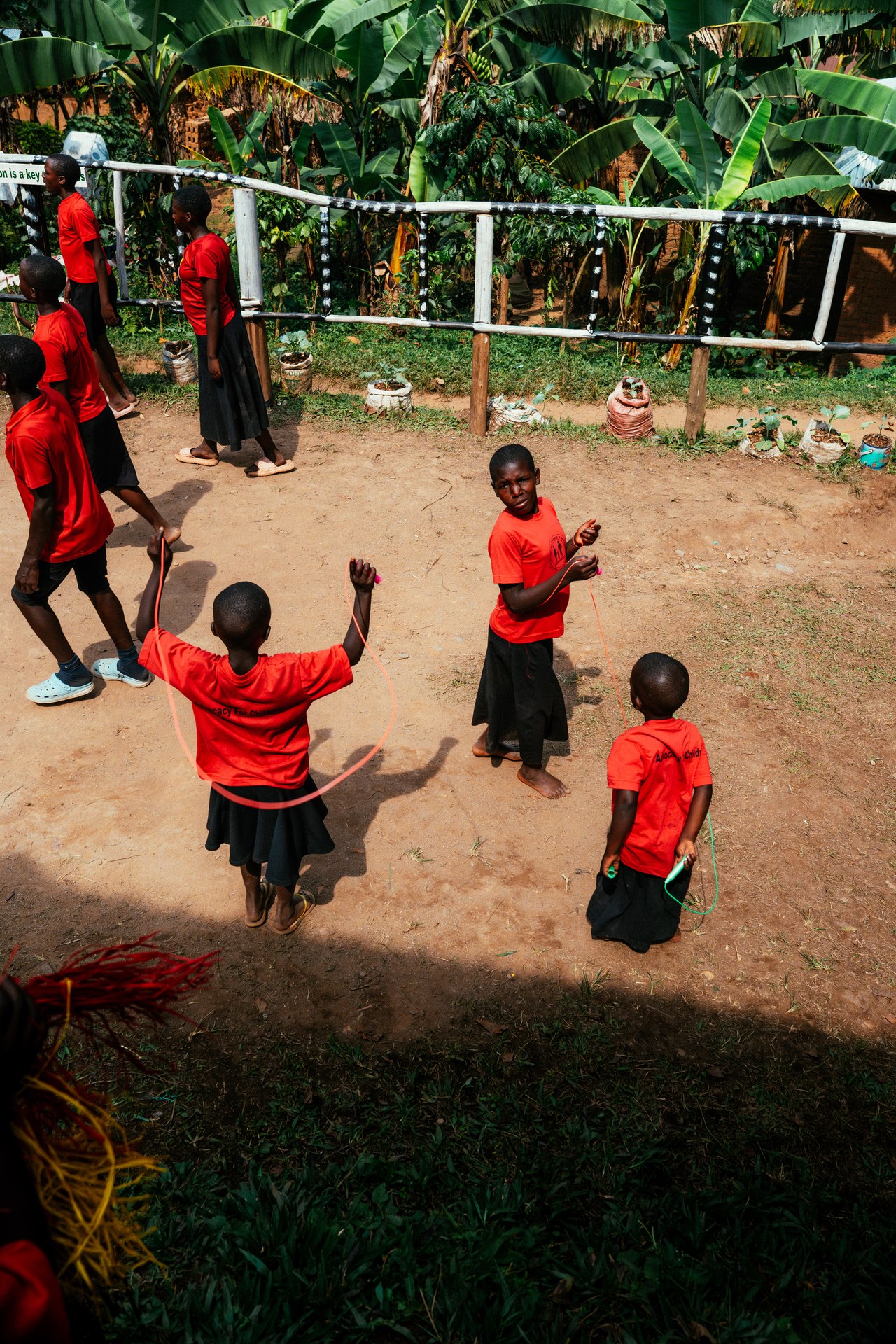
This is not a tourist attraction. It is just life. Around four in the afternoon, after the school day ends, the playground beside Buhoma Primary School transforms into a scene of pure, unrehearsed joy. Children play football with a ball that has seen better days, skip rope with vines, chase each other between the buildings, and shout with the kind of volume that only children at play can produce.
If you walk past and pause, you will almost certainly be noticed. Expect waves, shouts of greeting, and possibly an invitation to join the football match. Accept if you can. You will lose badly and it will be one of the highlights of your trip.
Be thoughtful about photography here. Ask before you point a camera at someone else's children, and consider whether the moment is better experienced than documented. If you want to support the school, ask at your lodge about their community programs or the social projects working in the area.
The Forest Edge at Dawn
Walk south from Buhoma village in any direction and within minutes you will reach the boundary where farmland meets Bwindi Impenetrable National Park. The transition is abrupt. One step you are on a dirt path between banana plants. The next, the vegetation thickens into something ancient and tangled and much, much older than anything humans have built here.
Come at first light. Stand still. The forest wakes up in layers. First the insects, a rising hum that fills the air before the sun clears the ridge. Then the birds: hornbills with their heavy wingbeats, turacos calling from the canopy, and dozens of smaller species you will hear but never see. If you are lucky, you may hear the deep, resonant call of a chimpanzee or the crash of a primate moving through the branches overhead.
You do not need a guide for this. You do not need to enter the park. Just walk to the edge and listen. Five minutes of standing quietly at the forest boundary will tell you more about Bwindi than any brochure.
The Carpenter's Row
Along a stretch of the main road through Buhoma, several woodworkers have their open-air workshops. They build furniture, window frames, doors, and coffins, working with hand tools under tin-roof shelters, surrounded by shavings and sawdust and the clean smell of freshly planed timber.
Stop and watch. In a world of factory furniture and flat-pack assembly, there is something deeply satisfying about seeing a person shape a chair leg with a hand plane, checking it by eye and feel. The carpenters are usually happy to have an audience. They will show you what they are building, explain the wood species they use, and demonstrate their tools. The morning is the best time to visit, when the light is good and the work is in full swing.
This is one of those moments where Buhoma feels most like a real working village rather than a staging post for gorilla treks. These men are not performing for tourists. They are earning a living, and the fact that a visitor cares to watch is usually met with genuine warmth.
The Evening Veranda
This is not a place you walk to. It is a practice. Every lodge in Buhoma has some kind of veranda, terrace, or outdoor seating area that faces the valley. In the late afternoon, as the sun drops toward the western hills, something happens to the light in Buhoma that stops you mid-sentence.
The valley fills with gold. The banana leaves glow. The forest canopy turns from green to bronze. Then the color drains and the darkness comes quickly, because this is the equator and there is no long twilight. And as the darkness arrives, the sounds change completely. The daytime birds fall silent and the night insects begin, a wall of sound that rises from the valley and the forest like a second orchestra tuning up.
Order a drink. Sit down. Do nothing. This is not wasted time. This is the experience that most rushed visitors miss entirely, and the one that many longtime travelers to Uganda remember most vividly. The gorillas are extraordinary. But the evening veranda is where Buhoma gets under your skin.
The Path to the River
A narrow trail leads down from the village center through banana plantations and small gardens to a river in the valley below. The walk takes about twenty minutes and drops steeply in places, so watch your footing. Along the way, you pass through the kind of lush, productive landscape that defines rural southwestern Uganda: every inch of soil is planted with something, and the air smells of earth and green growth.
At the river, you may find local women washing clothes on the flat rocks, children swimming in the shallows, or simply the sound of water running over stones. It is not a wilderness experience. It is a domestic one, a glimpse of the daily routines that sustain a community. The walk back up the hill is a good workout and a reminder of the physical strength required to live on these slopes.
Ask at your lodge for the best path down to the river. There are several routes and some are easier than others. A community guide can take you if you prefer company, but this is a walk you can do on your own if you are comfortable on steep, narrow paths.
How to Find These Places
None of these hidden gems have signposts, entrance fees, or visitor centers. That is precisely what makes them worth seeking out. Here is how to find them.
Ask Your Lodge
The staff at every lodge in Buhoma are from the local community and know every trail, viewpoint, and workshop. Tell them what interests you and they will point you in the right direction or arrange a guide. This is the single best resource you have.
Hire a Community Guide
For $10-20, a community guide will spend a half-day showing you places you would never find alone. They know the stories behind the places, they introduce you to people, and they navigate trails that are invisible to outside eyes. It is the best value experience in Buhoma. Guides can be arranged through your lodge or at the UWA office.
Walk Slowly
The most important advice we can give. Buhoma reveals itself to people who move at walking pace, who stop when something catches their eye, and who are willing to sit down and wait. If you are rushing between scheduled activities, you will miss everything on this list. Leave gaps in your itinerary. Wander without a destination. The hidden gems find you as much as you find them.
Greet People
A simple greeting in the local language opens doors. "Agandi" (how are you?) with a smile will earn you a warm "Nimarungi" (I am fine) in return. From that small exchange, conversations grow, directions appear, and invitations follow. Buhoma is a friendly place, but friendliness is a two-way exchange.
Buhoma in Photographs
Frequently Asked Questions
Continue Exploring Buhoma
Things To Do
All activities and experiences in Buhoma, from gorilla trekking to cultural encounters.
Stories from Buhoma
Photo essays and narratives about the people, places, and daily life of Buhoma village.
Community Walks
Guided walks through Buhoma village to meet families, visit schools, and experience daily life.
Travel Guide
How to get here, when to visit, what to pack, and everything you need to plan your trip.
Last updated: September 2026