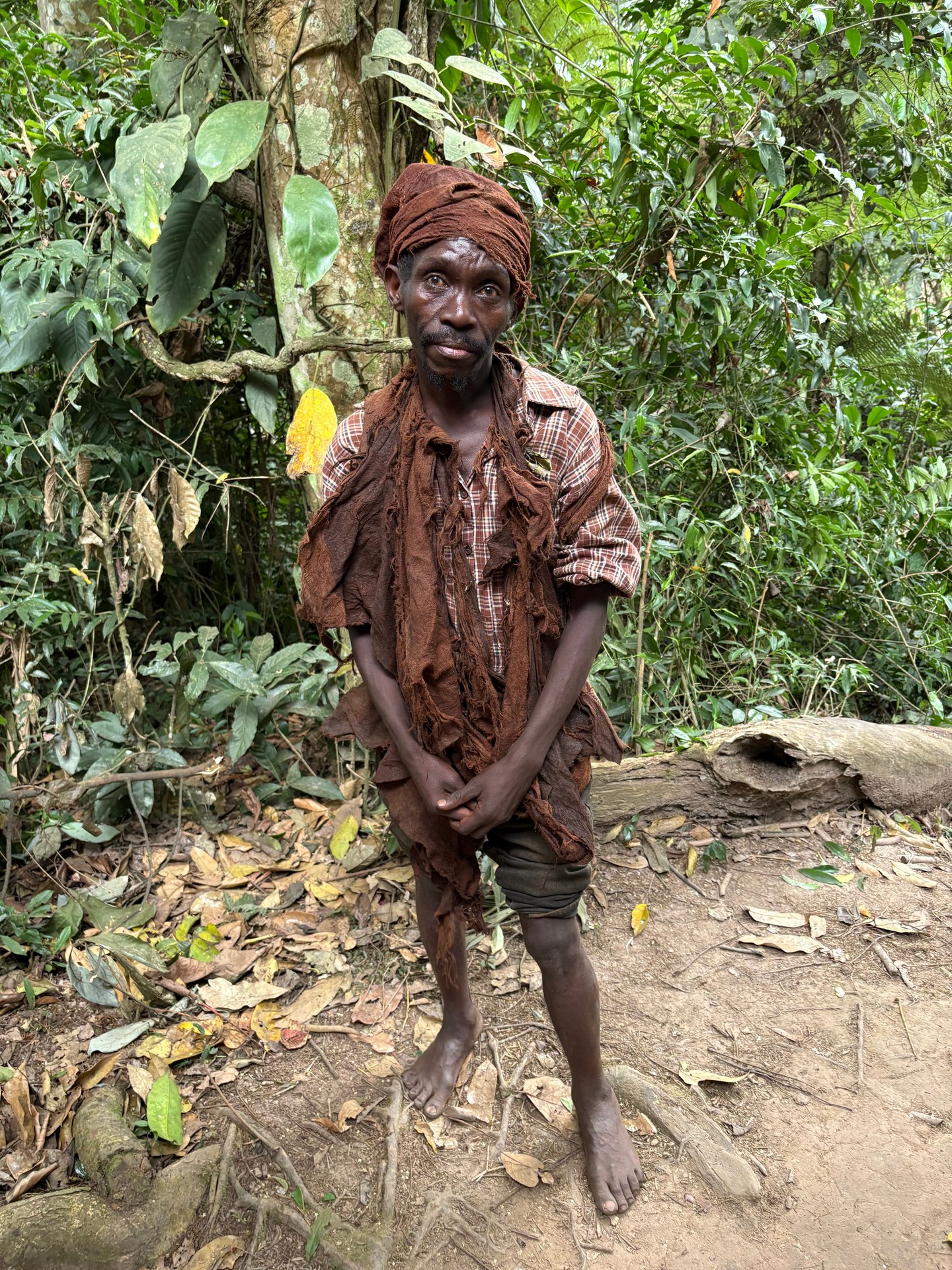
The Batwa are the indigenous forest people of Bwindi, who lived as hunter-gatherers alongside mountain gorillas for at least 60,000 years before being evicted in 1991 when the forest became a national park. They were displaced without compensation, losing their ancestral home overnight. Today, 1,403 Batwa live in 19 communities adjacent to Bwindi Impenetrable National Park — working to preserve their culture while rebuilding their lives on the edge of the forest that was once theirs.
Quick Facts
- People:
- Batwa (Twa)
- Population (Uganda):
- 3,857 (2024 est.)
- Adjacent to BINP:
- 1,403 in 19 communities
- Language:
- Orutwa (endangered); Runyoro-Rutooro in daily use
- Displaced:
- 1991, when Bwindi became a national park
- Cultural Experience:
- Batwa Trail ($80/person, launched April 2019)
Complete Guide to the Batwa of Bwindi
Every topic in depth — from population data and health statistics to cultural traditions and conservation ethics.
The 1991 Displacement
How the forest became forbidden overnight
Population Data
3,857 Batwa in Uganda — census figures
19 Settlements
All communities with population data
Health Statistics
HIV, maternal health, GBV — the numbers
Education
57.7% never attended school
Land Rights
The unresolved crisis after displacement
Culture
Identity, traditions, and what survives
Orutwa Language
A dying language carried in song
Music and Dance
The Rutwa tradition and its survival
Forest Knowledge
Fire-making, tracking, medicinal plants
Medicinal Plants
The herbal inventory project
Gorillas and the Batwa
60,000 years of coexistence
Crafts
Baskets, carvings, beeswax products
Livelihoods
Economic programs and beekeeping
Forest Access Today
8 CRM agreements with UWA
16 NGOs and CBOs
All organizations supporting the Batwa
Batwa Women
GBV, maternal health, and resilience
Conservation Ethics
Was the eviction justified?
Water Access
8 settlements without clean water, 2026 tanks
Sacred Sites
Ancestral places inside the park — unresolved access
Who are the Batwa people of Bwindi Forest?
The Batwa are the indigenous forest-dwelling people who lived in Bwindi Impenetrable Forest for at least 60,000 years. They were evicted in 1991 when the forest became a national park and now live in settlements near Buhoma.
The Oldest People in the Forest
Long before the first Bantu-speaking farmers cleared fields on the hills around Buhoma, long before the first European explorers heard rumors of apes in an impenetrable forest, the Batwa were already here. They are among the oldest continuous populations on Earth — a people whose ancestors walked into these forests when the last ice age still gripped the northern hemisphere.
The Batwa of the Bwindi area lived in small, mobile bands of 15 to 30 people. They built temporary shelters from bent saplings and broad leaves, moving every few weeks to follow seasonal food sources. They hunted small game with nets and traps. They gathered wild fruits, tubers, mushrooms, and medicinal plants. And they climbed into the highest canopy to harvest wild honey — a skill so dangerous and so revered that it carried spiritual significance.
Their knowledge of the forest was encyclopedic. A Batwa elder could identify hundreds of plant species by sight, smell, or taste and describe their uses: this bark for fever, this root for snakebite, this leaf to wrap meat for smoking. They could track an animal through dense undergrowth by reading bent stems and disturbed soil. They knew where the gorillas nested, where the elephants drank, where the bees built their hives when the forest flowers bloomed in October.
This was not primitive survival. It was a sophisticated, sustainable civilization adapted over millennia to one of the most complex ecosystems on the planet. The Batwa did not just live in the forest. They understood it at a depth that modern science is only beginning to appreciate.
The Gorillas Were Their Neighbors
The Batwa shared the forest with mountain gorillas for thousands of years. They did not hunt them. In Batwa oral tradition, the gorillas were regarded as close relatives — large, gentle beings who shared the forest peacefully. The Batwa knew their nesting sites, their feeding patterns, their family structures. When Western scientists first studied Bwindi gorillas in the 1980s, some of the most valuable early information came from Batwa informants.
This coexistence is significant. The fact that approximately 460 mountain gorillas survive in Bwindi today is not despite the Batwa — it is alongside a 60,000-year history of their presence. The forest was not degraded by the Batwa. It thrived. The gorillas were not threatened by the Batwa. They coexisted. Understanding this relationship is essential context for the moral complexity of what happened next.
1991: The Day the Forest Closed
In 1991, the Ugandan government, with support from international conservation organizations, gazetted Bwindi Impenetrable Forest as a national park. The goal was to protect the mountain gorillas and the extraordinary biodiversity of the forest. By any ecological measure, this was the right decision. The gorillas were critically endangered. The forest was under pressure from encroachment. Protection was urgently needed.
But the method was devastating. The Batwa were simply told to leave. There was no consultation, no negotiation, no compensation, and no plan for where they would go or how they would live. Families who had inhabited the forest for generations walked out with nothing. The forest that had provided everything — food, shelter, medicine, identity, spiritual life — was suddenly forbidden territory, patrolled by armed rangers.
Overnight, the Batwa became landless. They had no education in the formal sense, no familiarity with agriculture, no social networks in the farming communities on whose margins they now squatted. They went from being self-sufficient masters of one of the world's most complex ecosystems to being among the poorest and most marginalized people in Uganda.
The irony is sharp. The forest was protected because it was valuable. The gorillas were saved because they were precious. But the people who had lived with both for 60,000 years — who had, arguably, kept the forest intact — were deemed expendable.
Life Outside the Forest
Today, the Batwa near Buhoma live in small settlements scattered along the forest edge and on the hillsides above the village. Some families have received small plots of land through the work of organizations like the Batwa Development Program. Others remain in precarious situations, living on land they do not own, dependent on the goodwill of neighbors or the intermittent support of NGOs.
The transition from forest life to settled agriculture has been wrenching. The Batwa were not farmers. Their bodies, knowledge, and social structures were adapted to a mobile, forest-based existence. Learning to cultivate crops, raise livestock, and navigate a cash economy has been a generational process, and the older Batwa — those who remember the forest — carry a grief that younger members can only hear about in stories.
Education has become a lifeline. More Batwa children attend school now than at any point since displacement. Some have gone on to secondary school and vocational training. A small number have become community health workers, teachers, or guides. These individual successes matter enormously, but the community as a whole still lags far behind the surrounding Bakiga population in every development indicator.
Healthcare remains a challenge. The Batwa traditionally relied on forest plants for medicine — a pharmacopoeia developed over millennia and now largely inaccessible. Access to modern healthcare is limited by poverty, distance, and sometimes discrimination. Organizations like Bwindi Community Hospital serve the broader population, but targeted Batwa health programs are needed and underfunded.
What Survives
Despite everything, Batwa culture has not disappeared. It has adapted. Elders still teach traditional songs to children who have never set foot in the forest. Fire-making by friction, once a daily necessity, is now demonstrated with pride on the Batwa Trail. Knowledge of medicinal plants is passed on in conversation even when the plants themselves are out of reach. The stories — of the forest spirits, of the great honey trees, of the time before the boundary — are still told.
The Batwa Trail itself is perhaps the most significant cultural achievement of the post-displacement era. It gives the Batwa a context in which their traditional knowledge has value — economic, educational, and emotional. When a Batwa guide demonstrates honey-gathering techniques to visitors from Europe or North America, something shifts. The guide is not performing poverty. They are sharing mastery. And for a few hours, inside the forest that was once theirs, they are home.
Music remains a strong thread of continuity. Batwa songs — rhythmic, call-and-response, often accompanied by clapping and stamping — carry emotional and historical content that transcends the language barrier. Even visitors who understand no words feel the weight of what is being communicated. These songs are not entertainment. They are memory made audible.
The Question Conservation Must Answer
The story of the Batwa raises a question that the conservation world is still grappling with: can we protect nature without displacing the people who have lived with it the longest? Increasingly, the answer from ecologists, human rights organizations, and indigenous rights advocates is the same: not only can we, but we must. Conservation that excludes indigenous communities is both ethically wrong and practically less effective than conservation that includes them.
The Batwa case is now cited globally as an example of what not to do. Their displacement has become a cautionary tale in conservation policy circles, contributing to a shift toward community-based conservation models. In Uganda, the government has acknowledged that the Batwa were wronged, though concrete restitution has been slow.
For visitors to Buhoma, understanding the Batwa story adds an essential layer to the gorilla trekking experience. The forest you walk through to see the gorillas is not an untouched wilderness. It is a landscape shaped by tens of thousands of years of careful human habitation. The gorillas you photograph had human neighbors for longer than recorded history. And the people who knew the forest best are now standing on the outside, looking in.
Meeting the Batwa
The most meaningful way to engage with the Batwa near Buhoma is through the Batwa Trail, a community-owned experience costing approximately $80 per person. Batwa guides lead you through the forest, demonstrating traditional skills — fire-making, medicinal plant knowledge, shelter building, honey gathering — and sharing stories and songs. The fee directly funds community education, housing, and livelihood programs.
Approach the experience not as a tourist attraction but as an encounter with a living people navigating real and present challenges. Listen more than you speak. Ask questions. And when you return home, share what you learned. Visibility is one of the most valuable things the Batwa community receives from tourism.
Frequently Asked Questions
Last updated: September 2026