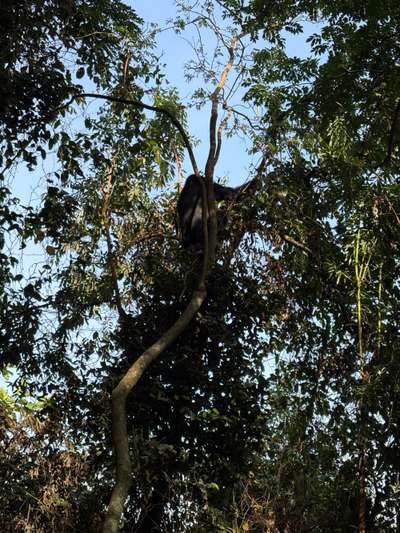
The Species
Melaenornis edolioides belongs to the family Muscicapidae — the Old World flycatchers — a large and ecologically diverse family that includes many of Africa's most familiar insect-eating birds. The genus Melaenornis contains a group of dark-plumaged flycatchers distributed across sub-Saharan Africa, several of which are difficult to distinguish in the field due to their similar all-dark appearance.
The Black Flycatcher is a medium-sized bird, slightly larger than a sparrow but with a longer tail and more upright posture. Adults are glossy blue-black across the entire body, distinguishing them from the similar Pale Flycatcher by their uniform colouration and from the Sooty Flycatcher by size and habitat preference. The species has a relatively wide distribution across the African continent, occurring in woodland, forest edge, and garden habitats from West Africa through East Africa and into southern Africa.
Quick Facts
- Scientific name:
- Melaenornis edolioides
- Family:
- Muscicapidae (Old World flycatchers)
- Sightings at Buhoma:
- 11 recorded individuals
- Habitat:
- Forest edge, woodland, gardens
- Foraging style:
- Aerial, from exposed perch
- Conservation status:
- Least Concern (IUCN global)
- Best time to observe:
- Early morning, 06:00–09:00
Identification in the Field
Identifying the Black Flycatcher in the field requires attention to a few key features. The overall plumage is uniformly dark — black to very dark brown depending on light conditions. The tail is moderately long and often held slightly cocked. In flight, the wing pattern is plain with no contrasting wing bars or patches. The bill is relatively broad and flat — the classic flycatcher shape adapted for catching flying insects.
Behaviour is a useful supplementary cue. Black Flycatchers perch upright on prominent, exposed branches — fence posts, the outer twigs of trees, roadside wires — and make short, clean sallies to catch prey before returning to the same or a nearby perch. This sallying behaviour, combined with the all-dark plumage, is usually enough for a confident identification once the observer knows the species is present at the site.
Note, however, that expertise is weak for specific population details of this species in the Buhoma area beyond the monitoring count data. Behavioural details such as breeding season, nest site preferences, and territory size in the local context are not well documented for this specific site and should not be assumed from general species accounts.
What 11 Sightings Tell Us
Eleven recorded individuals in a systematic monitoring count is a meaningful data point. It is enough to confirm consistent presence — not a one-off stray — and to suggest that the habitat at the monitored sites provides what the species requires: adequate perch sites, sufficient insect prey, and appropriate cover for nesting or roosting. The species is not so numerous as to be a habitat indicator for dense forest; rather, it is associated with the transitional and edge habitats where monitoring sites like those around Buhoma tend to be located.
The significance of this count becomes clearer when compared across years. If repeated monitoring at the same sites produces similar figures — 9 to 13 individuals in a given survey — the population is likely stable. A sharp decline would indicate a problem, whether with insect prey availability, vegetation change, or disturbance. This is the practical purpose of the Uganda Wildlife Authority's monitoring programme: not to celebrate biodiversity in a single snapshot, but to detect change over time.
During our multiple visits to Buhoma between October 2024 and 2026, we walked sections of the forest edge where conditions for species like the Black Flycatcher are clearly present: tall garden trees, fruit-bearing shrubs at the forest margin, and open areas interspersed with cover. Whether we personally observed the species on those walks is less important than the fact that the monitoring data places it here reliably.
Buhoma as Birding Territory
The Black Flycatcher is one of many insectivore species that make the forest edge around Buhoma productive for birdwatchers willing to slow down and look. Most visitors to the area focus, understandably, on gorilla trekking — a once-in-a-lifetime wildlife experience that dominates the schedule. But an additional morning or afternoon dedicated to birdwatching along the park boundary produces a different kind of encounter: patient, cumulative, building into an understanding of how the habitat works.
A local guide familiar with the monitoring sites and the species that inhabit them is the most efficient way to find the Black Flycatcher and the other forest-edge birds of the Buhoma area. Uganda's over 1,070 recorded bird species include many that can be observed with relatively little specialist equipment — binoculars, an early start, and a knowledgeable guide are the essentials.
54 Bird Species at Buhoma
Full monitoring dataset from the UWA 2019 bird survey of the Buhoma area.
Birdwatching in Bwindi
Practical guide to arranging birding walks from Buhoma.
White-headed Sawwing
The most numerous species in Buhoma monitoring data — 54 individuals recorded.
Birds of Bwindi
350+ species in Bwindi Impenetrable National Park including Albertine endemics.