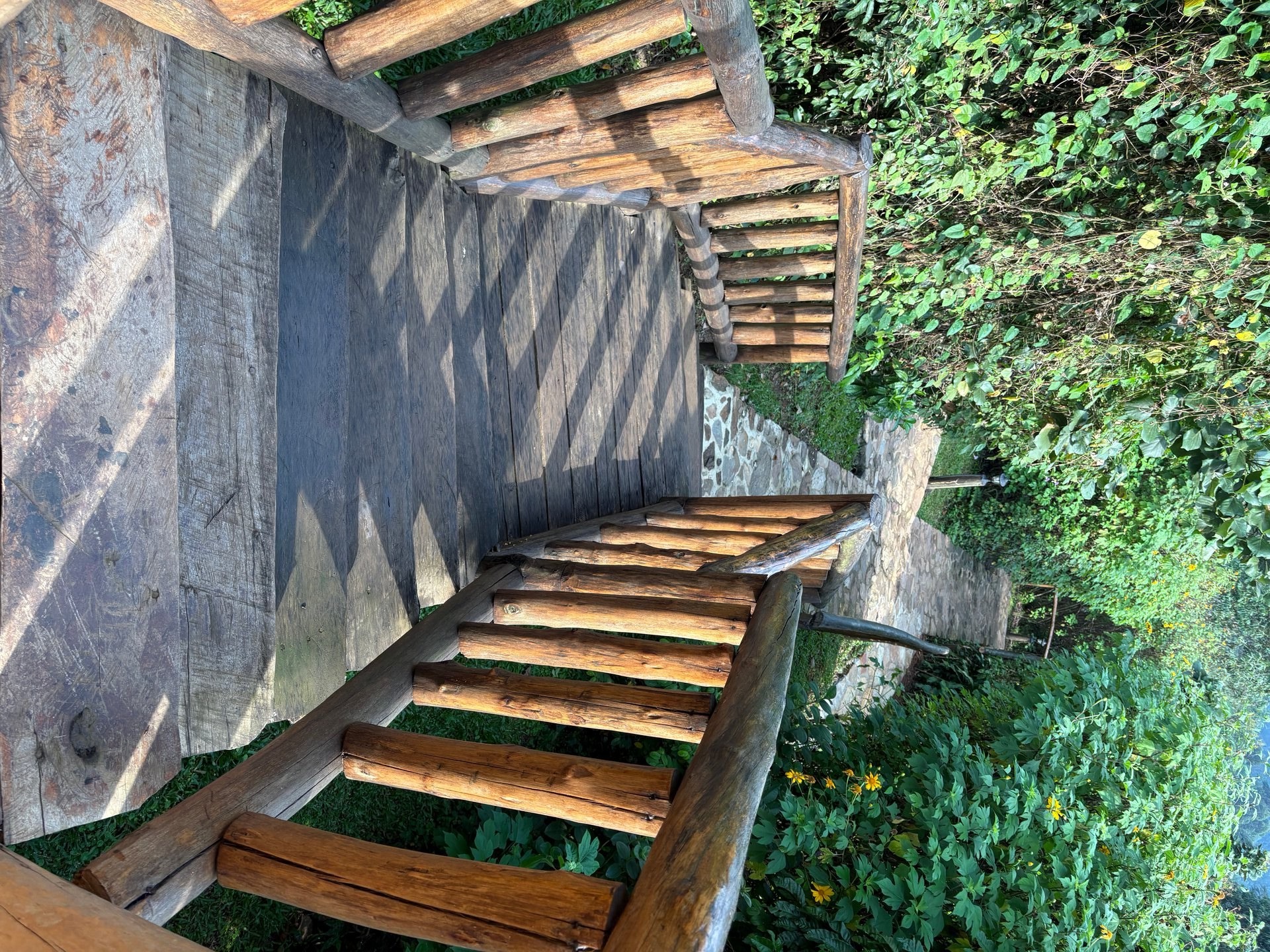
The choice of Buhoma lodge matters more than it does in most gorilla trekking destinations. Where you stay determines how close you are to the briefing point, how your money circulates in the local economy, and what you encounter beyond the park gate. A gorilla trekking permit costs 800 USD per person (Uganda Wildlife Authority, 2026) regardless of which property you choose. The lodge choice is about everything else.
Quick Facts
- Gorilla Permit:
- 800 USD / person (UWA, 2026)
- GHE Permit:
- 1,500 USD / person
- Inside-Park Lodges:
- Buhoma Lodge, Sanctuary Gorilla Forest Camp
- High Altitude:
- Clouds Mountain Gorilla Lodge (>2,000 m)
- Community-Owned:
- Amajambere Iwacu (1994), Community Rest Camp
- Mid-Range:
- Gorilla Bluff Lodge, Volcanoes Bwindi Lodge (2018)
- Budget / Village:
- Banana Village, Community Rest Camp
- Environmental Audit:
- Every 3 years — S.I. No. 47 of 2020
First Visit: A Hospital and a Lodge, 15 Minutes Apart
On the grounds of Buhoma's community hospital — founded by the German philanthropist known locally as Herr Braun — there is an intake building constructed partly from repurposed shipping containers. During my visit in January 2026, GPS-verified at -0.9684°N, 29.6166°E, I walked through this building and watched patients of all ages being received and examined in what is, by international standards, an extremely modest facility. Within a 15-minute walk of this intake area, guests at the nearest Buhoma lodge pay several hundred dollars per night for a bush-view cottage with organic meals and a private veranda overlooking the rainforest. That contrast is not an accusation. It is simply Buhoma as it is.
During my 11-day stay in January 2026, I visited most of the properties described below, spoke with lodge staff, local guides, and boda-boda drivers, and completed a gorilla trek into Bwindi Impenetrable National Park. The following is a complete account of what each option actually is — not marketing copy, but the kind of assessment that comes from being on the ground.
Inside the Park: The Two Lodges Within Bwindi's Boundary
Two Buhoma lodge properties sit inside Bwindi Impenetrable National Park itself. Being inside the park boundary means the gorilla trekking briefing point is walkable from either property, eliminates the morning vehicle transfer, and places guests in an environment where the rainforest is an immediate presence rather than something visible across a road. Both properties are subject to environmental compliance audit every three years under the National Environment (Audit) Regulations S.I. No. 47 of 2020 — covering waste management, energy systems, water use, and forest impact.
Buhoma Lodge — Uganda Exclusive Camps
Buhoma Lodge, operated by Uganda Exclusive Camps, is the benchmark eco-luxury Buhoma lodge. Eight cottages built from local timber, stone, and thatch are positioned inside the park boundary so that the UWA briefing point is accessible on foot on trek mornings. The lodge maintains its own guiding service and sources meals in part from local producers. It operates at the premium end of the Buhoma market — rates are not published here as they vary by season, but this is one of Uganda's more expensive gorilla trekking bases.
Sanctuary Gorilla Forest Camp
Sanctuary Gorilla Forest Camp is the second inside-park option and offers a different experience entirely. Large permanent safari tents with hard floors and open decks allow the sounds and temperature of the forest to pass through the structure without mediation. There is no conventional lobby — guests move through the camp on raised timber walkways. The camp is part of the Sanctuary Retreats portfolio, accessible to independent travellers, and in the quieter months its inside-park position can be booked with reasonable advance notice.
Above the Village: Mid-Range and Specialist Options
Gorilla Bluff Lodge
Gorilla Bluff Lodge sits on the high ground above Buhoma at GPS -0.9794°N, 29.6168°E, with each room accessing a private timber terrace looking over the surrounding forest and valley. During my January 2026 stay, the morning ritual — coffee and African tea served on the terrace before the 07:30 trekking briefing — gave each gorilla trek day a specific quality: early light, forest sounds, a slow cup before the walk. Gorilla Bluff positions itself between the inside-park luxury camps and the community rest camps in both price and character.
Volcanoes Bwindi Lodge
Volcanoes Bwindi Lodge has eight bandas comprehensively renovated in 2018. It is operated by Volcanoes Safaris, which also has properties in Rwanda's Virunga Conservation Area — a 434 square kilometre cross-border zone spanning Uganda, Rwanda, and the Democratic Republic of Congo — giving guests the option of combining Uganda gorilla trekking with a Rwanda extension through a single operator.
Clouds Mountain Gorilla Lodge
Clouds Mountain Gorilla Lodge is the highest-altitude Buhoma lodge in Uganda — positioned above 2,000 metres in the Bwindi highlands, a partnership between Wildplaces Africa and the African Wildlife Foundation. Evenings require a fire. Views in clear weather extend across the highlands in a way no lower-altitude property can match. On misty days — common at this elevation — the lodge sits inside cloud, with the forest visible only as a dark green outline through moving white.
Banana Village
Banana Village is a budget-oriented village resort with cottages, camping, a swimming pool, and an activity programme that includes cooking classes, hair-braiding demonstrations, and guided walks. The swimming pool — unusual for a rural property in south-western Uganda — makes it a practical choice for families or mixed groups where not every member is focused primarily on wildlife.
Community-Owned Options and the Revenue-Sharing Model
The community-owned accommodation options in Buhoma are not a budget compromise. They are the product of one of Uganda's most significant conservation decisions: the conversion of households displaced when Bwindi was gazetted as a national park in 1991 into active stakeholders in its tourism economy.
Amajambere Iwacu Community Camp — Founded 1994
Amajambere Iwacu Community Camp was established in 1994, three years after the park's gazettement, for households that had been displaced from land absorbed into Bwindi's boundaries. Community-owned, with profits distributed to member households rather than to private investors. It sits approximately two minutes' walk from the UWA permit office — the closest Buhoma lodge option to the gorilla trekking briefing point outside the park boundary itself. The Uganda Community Tourism Association (UCOTA) has long supported this model as a template for community-based ecotourism across Uganda.
Buhoma Community Rest Camp
Buhoma Community Rest Camp is at the park entrance gate, with bandas, dormitory options, and camping at the most accessible price points in Buhoma. Facilities are simple and honest. Uganda Wildlife Authority's revenue-sharing mechanism distributes a portion of gorilla permit fees to adjacent communities — in Buhoma, this community share, alongside the rest camp's direct revenue, funds services including school construction, road maintenance, and the kind of healthcare infrastructure that the hospital founded by Herr Braun represents at its most resource-constrained.
The Village Economy Around Every Buhoma Lodge
Norman Noel, a boda-boda driver who has worked in Buhoma for several years, described his economic situation with clarity during a conversation in January 2026:
"If I can get a chance of getting a driving licence, I will have to expand my business of driving. At least I advance from a motorcycle to a car. I meet my friends from USA, UK, Germany, everywhere. I start exploring Uganda as my dream for exploring."
— Norman Noel, boda-boda driver, Buhoma
The global connections Norman describes exist directly because Buhoma lodge stays generate demand for local transport. Every morning transfer from a lodge to the UWA briefing point, every run to the main street for supplies — these are the transactions that constitute his daily income. He also described what happens when that income stops, referencing the 2022 Ebola border case that temporarily suppressed visitor numbers:
"We as people here in Buhoma, we survive on tourism, and we have got a problem here. Tourists are few because of the Ebola, and as me, Norman, I lack enough capital to start with, because I have no support at all."
— Norman Noel, boda-boda driver, Buhoma
The Uganda Safari Guides Association, whose deputy chairperson is Lilian Kamusime, provides training and professional standards for guides operating across Uganda's national parks. Gorilla Conservation Coffee — whose Gorilla Conservation Café on Portal Road in Entebbe opened in 2018 — provides a tourism-linked income stream for Bwindi-area coffee farmers that is more resilient than per-visit revenue. These organisations represent the ecosystem around each Buhoma lodge that makes a stay here more than just an accommodation transaction.
A Critical Booking Rule: Buhoma Is Not Rushaga, Ruhija, or Nkuringo
Bwindi Impenetrable National Park has four gorilla trekking sectors: Buhoma (north-west), Ruhija (north-east), Rushaga (south), and Nkuringo (south-west). These sectors are geographically separated — in some cases 60 kilometres or more apart by road — and a permit for one sector cannot be used in another. This is the most consequential booking error a Buhoma lodge guest can make. Confirm the sector on your permit at the time of booking, not on arrival.
The Buhoma sector's gorilla families include the Mubare family, habituated since 1993 — Uganda's first gorilla family made accessible to tourism. More than thirty years of habituation have produced a family that moves through its home range with calm predictability, making Buhoma's trekking experience among the most reliably settled in the park.