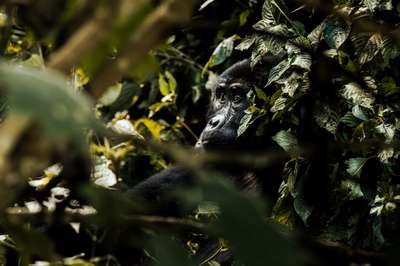
Gorillas belong to the genus Gorilla and are divided into two species: the western gorilla (Gorilla gorilla) and the eastern gorilla (Gorilla beringei). Each species contains two subspecies, giving four recognised subspecies in total. The mountain gorilla — Gorilla beringei beringei — is the subspecies living in Bwindi Impenetrable National Park, and it is one of the rarest primates on earth, with fewer than 1,100 individuals surviving across Uganda, Rwanda and the Democratic Republic of Congo.
Quick Facts
- Genus:
- Gorilla (I. Geoffroy Saint-Hilaire, 1852)
- Number of species:
- 2 (western and eastern gorilla)
- Number of subspecies:
- 4 recognised subspecies
- Bwindi subspecies:
- Gorilla beringei beringei (mountain gorilla)
- Uganda mountain gorilla population:
- 459 individuals (2018–2020 count)
- Conservation status:
- Critically Endangered (mountain gorilla)
- Gorilla permit price:
- USD 800 per person (standard); USD 1,500 (GHE)
- Author visits:
- 5 documented visits to Buhoma (January & June 2026)
The Gorilla Genus and Its Two Species
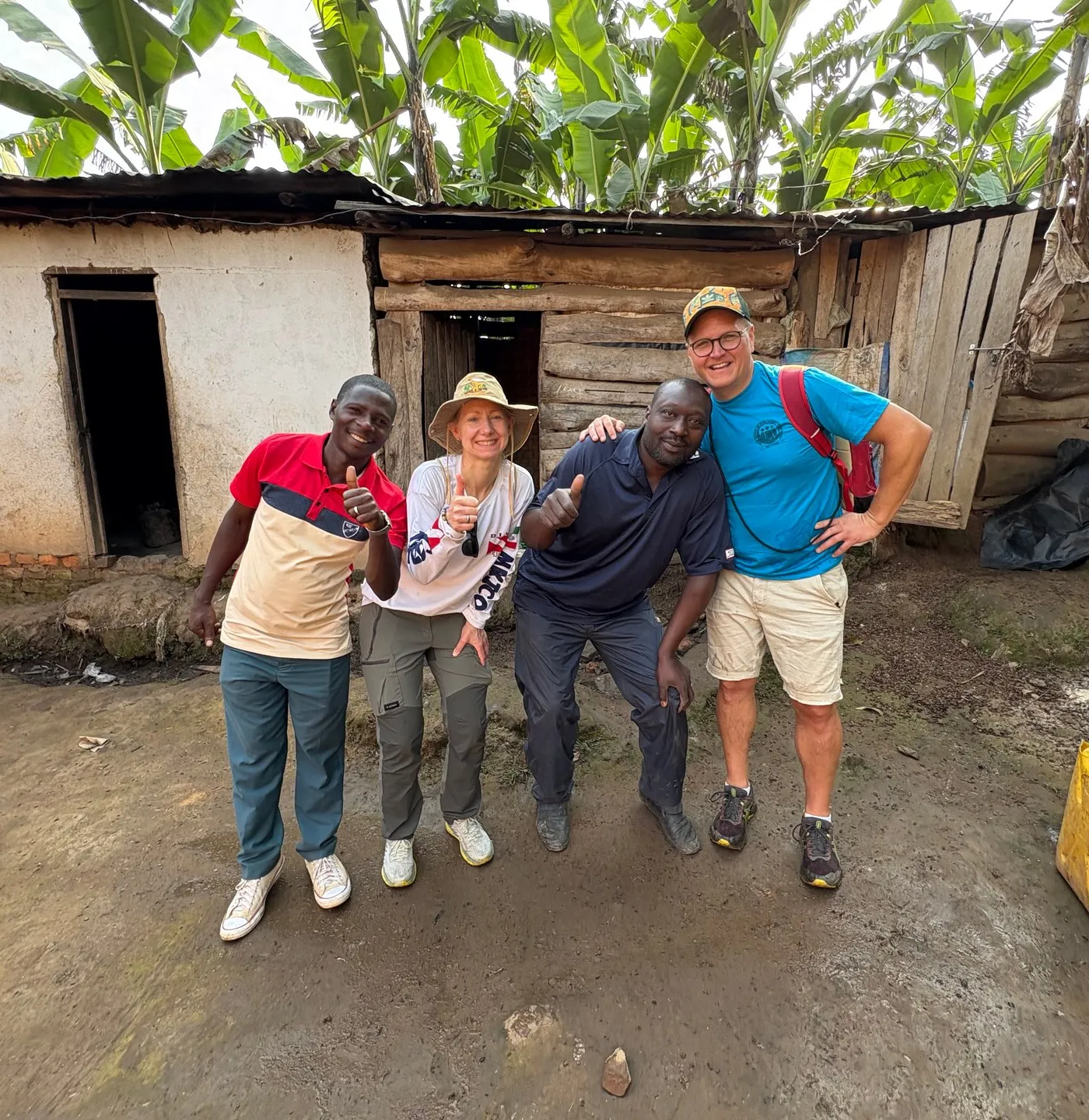
Early in my June 2026 visit to Buhoma — one of five documented visits I have made to this village, including stays in January 2026 — I stopped at a small chicken farm on the edge of the settlement at GPS coordinates -0.9713, 29.6142. The farmer, a man who raises his poultry with quiet dedication, showed me how he keeps his chicks warm through the cool mornings that settle over the lower slopes of Bwindi. We have bought chickens from him on more than one occasion to supply the nearby orphanage, where the birds are raised for both eggs and meat. Standing in that yard, watching something so ordinary and so essential at the same time, I found myself thinking about how every living thing carries a name, a lineage, a place in the order of things — and that thought is where this classification guide begins.
Gorillas are the largest living primates. They belong to the family Hominidae — the great apes — alongside chimpanzees, bonobos, orangutans and humans. The genus Gorilla was formally described by Isidore Geoffroy Saint-Hilaire in 1852, and scientific understanding of gorilla diversity has evolved considerably since then. For most of the twentieth century, all gorillas were treated as a single species. It was not until 2003 that mainstream taxonomy recognised two full species, a division now standard in primate biology.
The western gorilla (Gorilla gorilla) inhabits the forests of west and central Africa, spanning Cameroon, Gabon, the Republic of Congo, the Central African Republic, Equatorial Guinea and Angola. The eastern gorilla (Gorilla beringei) lives in the montane and lowland forests of east-central Africa — primarily in Uganda, Rwanda and the Democratic Republic of Congo. These two species are separated by roughly 1,000 kilometres of forest and have been genetically distinct for an estimated two million years. Despite their shared genus, they differ in body size, coat density, facial morphology and habitat preference.
Four Subspecies — Scientific Names and Their Ranges
Within the two species, four subspecies are currently recognised. Understanding these distinctions matters practically for travellers, because the subspecies encountered during gorilla trekking depends entirely on where you trek. Bwindi is home to one specific subspecies, and confusing it with others — as many travel articles do — misrepresents both the animals and the conservation context.
The western lowland gorilla (Gorilla gorilla gorilla) is the most numerous subspecies and the one most commonly seen in zoos worldwide. Its range covers Cameroon, Central African Republic, Gabon, Republic of Congo, Equatorial Guinea and the western DRC. Its coat is brownish-grey, and adult males develop a distinctive reddish-brown crown. Population estimates are uncertain due to habitat inaccessibility, but figures suggest more than 100,000 individuals, making this subspecies by far the most numerous.
The Cross River gorilla (Gorilla gorilla diehli) is the rarest of all four subspecies, restricted to a small cluster of forest fragments on the Nigeria-Cameroon border. Fewer than 300 individuals are believed to survive, placing this among the most endangered mammals on earth. It was only formally described as a distinct subspecies in 2000, based on differences in skull and tooth morphology identified from museum specimens.
The eastern lowland gorilla, or Grauer's gorilla (Gorilla beringei graueri), is the largest of all gorilla subspecies by body mass and inhabits the lowland and montane forests of eastern DRC. Males can weigh over 200 kilograms. Its population has collapsed sharply due to armed conflict, mining activity and bushmeat hunting; recent estimates suggest fewer than 4,000 individuals remain.
The mountain gorilla (Gorilla beringei beringei) is the subspecies encountered in Bwindi Impenetrable National Park and in the Virunga massif shared by Uganda, Rwanda and DRC. It was first described scientifically in 1903 by the German officer Friedrich Robert von Beringe, who collected two specimens on Mount Sabinyo — hence the species epithet beringei. Mountain gorillas are distinguishable from Grauer's gorillas by their thicker, longer fur — an adaptation to cooler montane temperatures at elevations between roughly 2,200 and 4,500 metres. They are also more terrestrial than western gorillas, spending most of the day on the ground foraging.
One nuance worth noting: some researchers have proposed that the Bwindi gorilla population may represent a distinct group from the Virunga mountain gorillas, with subtle morphological and genetic differences. This question remains open in the scientific literature. For practical and conservation purposes, both populations are classified as Gorilla beringei beringei.
The Mountain Gorilla Population in Uganda
Uganda's mountain gorilla population is counted through periodic census surveys combining direct observation, nest counts and DNA analysis from faecal samples. The 2018–2020 survey recorded 459 mountain gorilla individuals in Uganda — a figure that represents a meaningful recovery from the population lows of the 1980s, when the entire species was estimated at fewer than 250 animals across all three range countries combined.
This recovery is directly linked to sustained conservation investment: anti-poaching enforcement, veterinary monitoring and, critically, the economic model provided by gorilla tourism. A standard gorilla permit generates USD 800 in fees; the Gorilla Habituation Experience, available at a small number of groups, costs USD 1,500 per person. These revenues fund Uganda Wildlife Authority operations, ranger salaries and community conservation programmes in the parishes surrounding Bwindi.
Bwindi holds roughly half the world's remaining mountain gorillas. The park is divided into four trekking sectors — Buhoma in the north, Ruhija in the northeast, Rushaga in the south, and Nkuringo in the southwest — each managing its own habituated gorilla families. Buhoma, where I have made five documented visits, is the original trekking sector, established when gorilla tourism first began in Uganda in 1993. Walking trails that guides and rangers have walked for over three decades gives the place a particular depth that is difficult to find elsewhere.
What population numbers alone cannot convey is the individual character of each gorilla family. Each habituated group has a name, a dominant silverback, a documented social history. Guides in Buhoma know the animals as individuals — the silverback's particular posture, which females are nursing young, which juvenile is currently the most curious. That depth of familiarity, built over years of daily contact during the habituation process, is what makes an encounter in Bwindi different from a wildlife sighting in a savanna park.
Biological Characteristics That Define the Mountain Gorilla
Understanding the biology of mountain gorillas puts the classification in practical context. These are not simply oversized chimpanzees; they occupy a distinct ecological niche and have evolved traits well-suited to life in cool, wet, high-altitude forest.
Diet. Mountain gorillas are exclusively herbivorous, feeding on leaves, shoots, bark, pith and tubers. In Bwindi, their diet includes wild celery, nettles, thistles and various fig species. Bamboo shoots become a seasonal favourite when available. Because their food is low in calories relative to its bulk, gorillas spend five to seven hours daily foraging, and their digestive systems process large quantities of fibrous vegetation.
Social structure. Mountain gorillas live in stable family groups, typically comprising one dominant silverback male, several females and their offspring. Occasionally a group contains two or more adult males, but hierarchy is maintained through display rather than sustained physical conflict. Home ranges of 10 to 25 square kilometres are managed through the silverback's presence and collective movement patterns rather than territorial aggression.
Reproduction. The gestation period is 250 to 290 days, producing a single infant — twins occur rarely. Newborns weigh between 1.5 and 2 kilograms and are entirely dependent on their mothers. Nursing continues for two to four years, meaning females reproduce at relatively long intervals; a female mountain gorilla may raise four or five offspring in her lifetime. Sexual maturity is reached at seven to eight years. Life expectancy in the wild is 30 to 40 years, though individuals approaching 50 have been recorded.
Physical adaptations. The thick, dark fur of mountain gorillas is longer and denser than that of other gorilla subspecies — a clear adaptation to cold nights at high elevation. Adult males develop the characteristic silver-grey saddle on their backs as they mature, giving them the name silverback. Both sexes possess small bony protuberances on the skull, but the pronounced sagittal crest of mature males supports powerful jaw muscles needed to process tough vegetation. Subspecies differ in facial morphology; experienced researchers can distinguish a mountain gorilla from a Grauer's gorilla by the shape of the nose — a feature as individual as a human fingerprint and used in field identification.
Nesting behaviour. Every evening, gorillas construct fresh sleeping nests from bent branches and vegetation. Juveniles and females typically nest in trees; adult males, too heavy for most branches, build their nests on the ground. Locating these nests is a primary field survey method used to estimate population size in areas where direct observation is difficult.
Why Classification Matters for Conservation and Travel Planning
Taxonomy is not a purely academic exercise. The way scientists draw boundaries between species and subspecies directly determines which populations receive legal protection, how conservation funding is allocated, and which data inform permit quotas for wildlife tourism. When the mountain gorilla was recognised as a distinct conservation unit, it became substantially easier to focus resources and measure recovery progress — and recovery has followed.
For travellers, understanding the classification resolves a question that appears frequently in online planning: are gorillas in Bwindi the same as gorillas in Rwanda's Volcanoes National Park? Biologically, yes — both are Gorilla beringei beringei. The experience differs because of terrain, vegetation density, group composition and habituation history, not because of any subspecies difference. Rwanda's higher Virunga gorillas occupy more open bamboo zones; Bwindi's forest is denser and the terrain more demanding. The animals, however, are the same subspecies in each location.
The classification also shapes how Uganda Wildlife Authority manages the tourism quota. Each habituated gorilla group may receive no more than eight visitors per day, for a maximum of one hour in the presence of the animals. This limit reflects welfare considerations — minimising disease transmission risk, which is significant because mountain gorillas are genetically close to humans and susceptible to many of the same respiratory illnesses — and decades of veterinary and behavioural research applied specifically to this subspecies in this conservation context.
During my visits to Buhoma between January and June 2026, I observed how thoroughly local ranger and guide teams understand the animals under their care. The morning briefings before each trek describe where the target group was last sighted, the current family composition, and any recent changes — a new infant, a young male approaching maturity, a silverback's interaction with a neighbouring group. This is not generic wildlife tourism; it is the active management of a known population of a classified subspecies, with each individual tracked across years and decades by people who have devoted their working lives to its survival.
For anyone planning a trek from Buhoma, the classification context also gives the permit price meaning. At USD 800 for a standard permit, the cost may appear high in isolation. Measured against the conservation infrastructure it funds — ranger patrols, veterinary interventions, community revenue sharing and ongoing habituation programmes — it is an investment in the continued existence of Gorilla beringei beringei as a living subspecies, rather than a specimen in an archive.