There are two gorilla species — the eastern gorilla and the western gorilla — divided into four recognized subspecies. The mountain gorilla (Gorilla beringei beringei), which lives in Bwindi Impenetrable National Park and the Virunga Massif, is the subspecies encountered on a gorilla trek from Buhoma. It is one of the most critically endangered large mammals on the planet, yet its population has grown steadily thanks to intensive conservation efforts.
Quick Facts
- Gorilla species:
- 2 (Eastern & Western gorilla)
- Subspecies:
- 4 recognized
- Mountain gorilla population (Uganda):
- ~459 individuals (2018–2020 census)
- Trekking permit (Bwindi):
- USD 800 per person
- Conservation status:
- Critically Endangered (all subspecies)
- Buhoma sector:
- Bwindi Impenetrable National Park
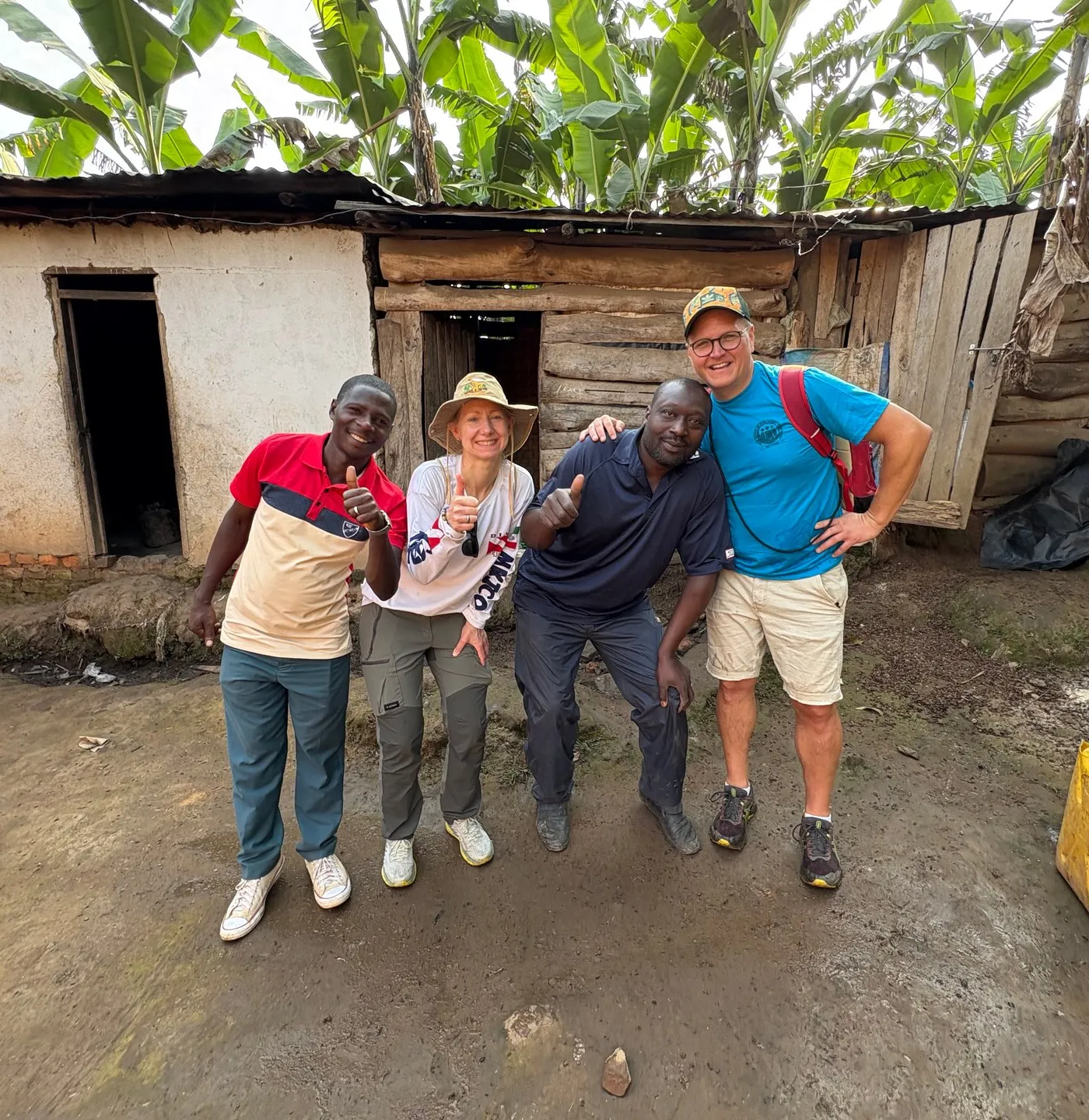
Early on the morning of 21 June 2026, before the mist had lifted from the hills above Buhoma, we stopped at a small holding on the edge of the village to visit a local chicken farmer. The visit had nothing to do with gorillas at first glance — the farmer kept chicks in careful wooden pens, raising them with a level of attention and pride that immediately impressed me. We have bought chicks from him several times for the orphanage nearby; they are raised either for eggs or for meat, a direct line between his small enterprise and the nutritional needs of children a few minutes' walk away. My GPS-tagged photos from that morning confirm the location at -0.9713, 29.6142 — the same forested hills that frame Bwindi's boundary.
What strikes you in Buhoma is how tightly the village and the forest are woven together. The children from the orphanage's neighbourhood live within earshot of one of the most biodiverse rainforests on the continent. The gorillas in those trees — specifically the mountain gorillas of Gorilla beringei beringei — are the reason international travellers pay USD 800 for a single hour in the forest. During my visits to Buhoma in January 2026 and June 2026, I found that few trekkers arrive with a clear understanding of which gorilla they are about to meet, or how that animal fits into the broader picture of gorilla taxonomy. This guide aims to close that gap.
Two Species, Four Subspecies: The Gorilla Family Tree
The genus Gorilla contains two species that were formally recognized as distinct only in 2001, after decades of debate among taxonomists. The first is the eastern gorilla (Gorilla beringei), found in the forests of Uganda, Rwanda, the Democratic Republic of Congo, and adjacent highland regions. The second is the western gorilla (Gorilla gorilla), which occupies a broad band of lowland and coastal forest across central and west Africa, from Cameroon and Gabon to Angola.
Within the eastern gorilla, two subspecies are recognized. The mountain gorilla (Gorilla beringei beringei) inhabits the high-altitude forests of Bwindi Impenetrable National Park and the Virunga Massif, a chain of volcanoes straddling Uganda, Rwanda, and the DRC. The second eastern subspecies is the Grauer's gorilla, also known as the eastern lowland gorilla (Gorilla beringei graueri), which lives in the lowland and montane forests of eastern DRC. Grauer's gorillas are larger in body size than mountain gorillas but carry the same species designation.
The western gorilla is likewise divided into two subspecies. The western lowland gorilla (Gorilla gorilla gorilla) is by far the most numerous and the subspecies most commonly seen in zoos worldwide. The Cross River gorilla (Gorilla gorilla diehli) is confined to a small cluster of forests along the Nigeria-Cameroon border and is considered the rarest of all four subspecies, with fewer than 300 individuals remaining.
All four subspecies are classified as Critically Endangered on the IUCN Red List, though the trajectories differ. Mountain gorillas are the only great ape subspecies whose numbers are increasing — a result of sustained ranger protection, veterinary intervention, and carefully managed habituation programs that have turned Buhoma into a model for community-based conservation.
Mountain Gorillas in Bwindi: Population and Range
The mountain gorilla population is divided between two geographically separate blocks. The Virunga Massif population — shared between Uganda's Mgahinga Gorilla National Park, Rwanda's Volcanoes National Park, and the DRC's Virunga National Park — represents roughly half of all mountain gorillas. The other half live in Bwindi Impenetrable National Park, and Buhoma is the oldest and most established entry point for trekking in Bwindi.
The most recent comprehensive census conducted between 2018 and 2020 recorded approximately 459 mountain gorillas in Uganda alone. The global total for the subspecies, combining both the Virunga and Bwindi populations, has exceeded 1,000 individuals — a number that would have seemed impossibly optimistic in the 1980s, when the population had fallen to roughly 250 animals. The recovery represents one of the more remarkable conservation turnarounds in modern wildlife management.
Mountain gorillas do not thrive in captivity. Unlike western lowland gorillas, which are the subjects of successful breeding programs in zoological collections around the world, no mountain gorilla has ever survived long-term in a zoo. The implication for travellers is significant: Bwindi and the Virunga Massif are the only places on earth where it is possible to see a living mountain gorilla. There is no alternative.
What Makes Mountain Gorillas Physically Distinct
Visitors often arrive in Buhoma expecting gorillas to resemble the animals they have seen in documentaries — which typically feature the more numerous western lowland gorilla, or its close relative Grauer's gorilla. Mountain gorillas are noticeably different in several respects.
The most immediate distinction is the fur. Mountain gorillas have longer, denser coats than any other gorilla subspecies, an adaptation to the cold, high-altitude forests where they live. Bwindi's elevations range from roughly 1,160 to 2,607 metres above sea level, and morning temperatures near the park boundary can drop low enough to require a warm layer even in June. The gorilla's fur absorbs and retains heat in a way that the shorter coat of a western lowland gorilla does not.
Mountain gorillas are also, on average, slightly smaller in body length than Grauer's gorillas but comparable in weight. An adult male silverback can weigh between 140 and 200 kilograms and stand over 1.7 metres when upright. Their facial structure tends to be broader, with a more pronounced sagittal crest — the bony ridge along the crown of the skull that anchors powerful jaw muscles. This crest is especially visible in older silverbacks and is one of the features that makes adult males immediately recognizable in the field.
Diet also differs significantly across subspecies. Mountain gorillas in Bwindi feed primarily on leaves, stems, bark, and roots — a diet rich in cellulose and relatively low in fruit, partly because Bwindi's fruiting patterns are less predictable than in the lowland forests where western gorillas live. Grauer's gorillas and western lowland gorillas consume larger quantities of fruit when available, which has implications for seed dispersal and forest structure. The mountain gorilla's more fibrous diet means it must spend a large portion of each day feeding, and trekking groups often encounter family units in the middle of long feeding bouts.
Social Structure and the Habituation Process
All gorilla subspecies live in stable social groups, but the composition and dynamics of those groups vary. Mountain gorillas in Bwindi typically form one-male or multi-male family units led by a dominant silverback. Multi-male groups — where two or more adult males coexist within the same family — are more common in Bwindi than in the Virunga population, a distinction researchers attribute to Bwindi's denser, more productive forest habitat providing enough food to support larger groups.
Habituation — the process by which a wild gorilla family is gradually accustomed to human presence — takes between two and five years and involves daily contact between the group and a team of rangers and researchers. Only a fraction of Bwindi's gorilla families are habituated for tourism at any given time. The Buhoma sector currently hosts several habituated groups, and trekking permits are allocated by the Uganda Wildlife Authority to specific families each day.
The one-hour rule that applies to all gorilla trekking in Bwindi — visitors are permitted a maximum of one hour in the presence of a gorilla family — exists because of what research on mountain gorillas has shown about stress responses in the animals. Extended human contact, even with fully habituated groups, elevates the animals' stress hormones and disrupts normal social behaviour. The rule is enforced consistently in Buhoma, and any group that arrives at the family before the allocated trekking party departs must wait.
Silverbacks lead through social memory and conflict mediation as much as through physical dominance. They decide when the group moves, where it feeds, and how it responds to perceived threats. Watching a silverback manage the interactions between juveniles, females, and younger males during a trek provides a brief window into a social world that has fascinated primatologists for decades.
Conservation Status and the Road to Recovery
The IUCN classifies all four gorilla subspecies as Critically Endangered, but the mountain gorilla's situation is distinct from the others in one important respect: it is the only subspecies where the population trend is consistently upward. The 2018–2020 census data recorded approximately 459 individuals in Uganda, and the combined Virunga and Bwindi total has surpassed 1,000 for the first time in recorded history. This is widely regarded as one of the most significant conservation achievements in Africa over the past four decades.
The recovery has not been accidental. It rests on a combination of anti-poaching ranger patrols, a veterinary monitoring program that treats injured and sick gorillas in the wild, strict tourism protocols that limit visitor numbers and require health screenings before entering the forest, and revenue-sharing arrangements that direct a portion of permit fees to communities living around the park. The community around Buhoma has been part of this model since tourism began in the late 1980s.
Grauer's gorillas, by contrast, have declined sharply. Habitat loss from artisanal mining activity and armed conflict in eastern DRC has reduced their population significantly over the past two decades, and their status is considered far more precarious than that of mountain gorillas despite their larger original range. Cross River gorillas face comparable pressures from agricultural encroachment in the Nigeria-Cameroon borderlands. Western lowland gorillas, while the most numerous subspecies, have been hit hard by the bushmeat trade and by Ebola outbreaks in the forest zones of Gabon and the Republic of Congo.
Understanding which subspecies a traveller is visiting — and the specific conditions that threaten each one — adds a layer of meaning to a gorilla trek that goes beyond the visual experience. In Buhoma, the presence of the mountain gorilla in the forest above the village is not a given. It is the product of sustained political will, international funding, and the daily work of Ugandan rangers and community members who have chosen to value the living animal over short-term alternatives.