A Murchison Falls safari combines three distinct experiences: game drives through Uganda's largest national park (for elephants, giraffes, buffalo, and lions), a boat safari on the Nile to the foot of the falls, and a walk to the top of the falls itself at GPS 2.2751°N, 31.6762°E. Uganda's largest park covers 3,840 square kilometres in northern Uganda and is accessible in approximately 4.5 to 5 hours from Kampala. October 2024 conditions — dry season, active game drives, clear water visibility — are described throughout this guide.
Quick Facts
- Location:
- Northern Uganda — approx. 5 hrs from Kampala
- Park Size:
- 3,840 km² — Uganda's largest national park
- Falls GPS:
- 2.2751°N, 31.6762°E
- Gorge Width:
- 7 metres at the narrowest point
- Key Wildlife:
- Elephant, Nile crocodile, buffalo, Rothschild's giraffe
- Boat Safari:
- Paraa to falls base — 3 hours return
- Best Season:
- December-February and June-September (dry)
- Upstream Dams:
- Karuma (600 MW), Isimba (183 MW) — NSOER 2024
First Encounter: Elephants on the Savanna
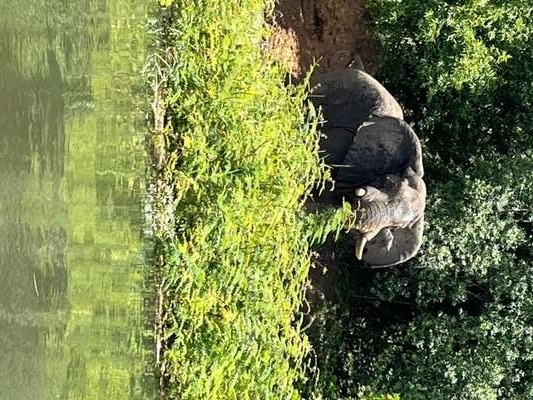
The opening moment of our October 2024 game drive in Murchison Falls National Park — photographed by Mark Suer at GPS 2.2771°N, 31.6698°E — was a group of elephants moving across open savanna toward a cluster of acacia trees. This is elephant observation at its most immediate: large, unhurried animals in their actual habitat, without enclosure or managed proximity. Murchison Falls supports one of Uganda's largest elephant populations, estimated at several thousand individuals, and encounters on the north bank circuit are frequent enough that game drives rarely pass a full morning without at least one sighting.
The game drive circuit north of the Nile is the primary wildlife area of Murchison Falls National Park — a mixed landscape of savanna grassland, riverine woodland, and the Nile floodplain. Uganda kob are present in large numbers year-round; their territorial males are visible on open ground throughout the circuit. Rothschild's giraffe, one of the most endangered giraffe subspecies globally, was reintroduced to Murchison Falls and is now a reliable sighting. Buffalo herds move through the western sections of the circuit. Lions are present but require more patience and a local tracking guide's knowledge to locate reliably.
The Nile Boat Safari: Crocodiles, Hippos and the Falls Approach
The boat safari from Paraa — the park's main hub, accessible by ferry from the south bank — runs upstream along the Nile to the base of Murchison Falls. The journey takes approximately 90 minutes each way and covers a stretch of the Nile that is one of Uganda's most productive wildlife viewing corridors. During the October 2024 boat safari, Nile crocodiles were visible on every sand bar — some individuals of considerable size, motionless in the sun at GPS 2.2771°N, 31.6698°E, with the characteristic stillness of a cold-blooded animal thermoregulating. Hippos were present in groups of 10 to 30 in the shallower sections, surfacing and submerging with minimal attention paid to the boat.
The falls reveal themselves gradually as the boat rounds the final bend. The sound arrives before the sight — a sustained roar that builds over several minutes. At the base, the spray is substantial; a waterproof layer for your camera equipment is not optional. The boat stops at the closest safe approach point, and the scale of the falls — the full volume of the Victoria Nile forced through a 7-metre gorge — registers in a way that photographs do not fully capture. The walk to the top of the falls, from the small jetty at the base, takes approximately 45 minutes on a steep path with good footing.
The Sunrise Game Drive and Predator Sightings
A sunrise game drive — departing Paraa at approximately 06:30 — offers the best conditions for predator sightings in Murchison Falls. Lions are most active in the early morning hours before the heat of the day drives them into shade. During our October 2024 visit, a tracking guide from the park's wildlife team described the territorial behaviour of the resident pride in the Albert Nile sector: the western circuits before 08:00, working east as the day heats up. The guides' local knowledge is not a polite extra — without it, a lion sighting in 3,840 square kilometres of open savanna is a matter of luck.
The light conditions at sunrise on the Murchison savanna are, for photography, among the best in Uganda. The flat, open terrain allows long-distance shots with clean backgrounds. The golden hour before 08:00 illuminates the grass and the animals in a way that midday conditions never replicate. Bring a telephoto lens with a minimum reach of 300 mm; 500 mm or more is preferable for lions at distance.
The Hydropower Controversy: What Has Been Built and What Was Stopped
Murchison Falls sits at the centre of Uganda's most contentious energy-versus-conservation debate. A proposed hydropower dam directly at the falls site — which would have submerged the gorge and ended the falls as a natural feature — was shelved following sustained opposition from conservation organisations, tourism operators, and a significant portion of Uganda's public. The falls remain intact.
However, the river system upstream has already been transformed. The Karuma Dam (600 MW, completed), located upstream on the Victoria Nile, and the Isimba Dam (183 MW) have altered the flow regime, sediment transport, and fish migration patterns of the river below. Uganda's National State of the Environment Report 2024 (NSOER 2024) documents cumulative hydropower impacts on freshwater ecosystems. The report also notes that Uganda's forest cover stood at 12% in 2021, with a national target of 21% by 2030 — a gap that reflects decades of deforestation that the energy sector alone cannot account for.
For visitors, this context matters. The Murchison Falls you see today is a falls whose upstream hydrology has changed. The volume and seasonality of flow is different from what it was before the Karuma and Isimba projects. The gorge itself, and the falls, remain — but they exist now within an engineered river system rather than a natural one.
Lodges, Getting There and Practical Notes
Paraa Safari Lodge is the most established property in the park, on the north bank of the Nile with direct boat access for falls runs and game drives. Chobe Safari Lodge, also within the park, offers a more intimate setting. Red Chilli Hideaway, near the south gate, is the most popular budget and mid-range option and the starting point for the south bank game drives. All lodges operating within the national park boundary are subject to environmental compliance audit every three years under National Environment (Audit) Regulations S.I. No. 47 of 2020.
The drive from Kampala to Murchison Falls takes approximately 4.5 to 5 hours via the Gulu Road or the Masaka Highway to Mbarara route. The Ziwa Rhino Sanctuary, approximately midway on the Gulu Road, is worth a stop for white rhino tracking — the only place in Uganda where rhinos can be seen in the wild, as part of a reintroduction programme. An alternative is the January 2026 Masaka Highway route, though road conditions vary by season. Four-wheel drive with ground clearance is recommended for park tracks in any season.
Uganda food guide note: the Nile Special beer, brewed in Uganda, is the standard choice at most park lodges. Matoke (steamed green bananas), posho (maize porridge), groundnut stew, and the Rolex (egg omelette rolled in chapati — a Kampala street staple) are available at most south gate establishments. Waragi, Uganda's locally produced spirit, is widely available at lodges.