Bwindi Impenetrable National Park is home to 13 primate species, making it one of the most primate-diverse forests in East Africa. The roster includes mountain gorillas, chimpanzees, four species of Old World monkeys commonly seen near Buhoma, rare mangabeys and colobus, olive baboons, and three nocturnal species. The park is one of the few places in Africa where both gorillas and chimpanzees coexist.
Quick Facts
- Total Primate Species:
- 13
- Great Apes:
- Mountain gorilla & chimpanzee
- Diurnal Monkeys:
- 8 species
- Nocturnal Primates:
- 3 species (2 galagos, 1 potto)
- Albertine Rift Endemics:
- L'Hoest's monkey, red colobus (regional)
- Most Common Near Buhoma:
- L'Hoest's, colobus, red-tailed, blue monkey
- Main Predator:
- Crowned eagle (Stephanoaetus coronatus)
- Best Viewing:
- Forest-edge trails and canopy gaps
A Primate Paradise
Bwindi Impenetrable National Park owes its extraordinary primate diversity to a combination of geological history, altitudinal range, and habitat complexity. The forest survived the Pleistocene glaciations as a refugium — an island of forest in a landscape that otherwise dried to savanna — and thus retained primate lineages that disappeared from much of East Africa.
The result is a forest where 13 primate species coexist, occupying different ecological niches from the forest floor to the upper canopy, and from the lowest valleys at 1,160 metres to the highest ridges at over 2,600 metres. This vertical and horizontal stratification allows species with overlapping diets to minimise competition.
For visitors to Buhoma, primate encounters are almost guaranteed. Even without a gorilla trekking permit, a walk along the forest trails near the park gate will likely yield sightings of several monkey species. The forest edge at Buhoma is particularly productive, as monkeys often venture into the transition zone between the park and surrounding cultivation.
The Great Apes
Mountain Gorilla Gorilla beringei beringei
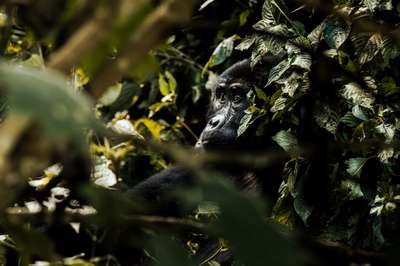
The flagship species of Bwindi and the primary reason most visitors come to Buhoma. Approximately 459 mountain gorillas live in Bwindi, in about 50 social groups. Several habituated families are tracked from the Buhoma sector, including the historic Mubare group. Mountain gorillas are the largest living primates — silverback males can weigh 200 kg — and are exclusively terrestrial except for juveniles who climb trees to play. They are strict vegetarians, consuming over 140 plant species.
Mountain gorillas exist only in two isolated populations: Bwindi and the Virunga Massif. They have never been successfully kept in captivity. Every encounter with them is, by definition, a wilderness experience.
Chimpanzee Pan troglodytes schweinfurthii
Bwindi's chimpanzee population is estimated at several hundred individuals, making the park one of the few places where both African great ape genera coexist. The Bwindi chimps belong to the eastern subspecies (P. t. schweinfurthii). Unlike the gorillas, chimpanzees in Bwindi are highly arboreal, spending much of their time in the canopy where they feed on fruits, leaves, and occasionally hunt smaller monkeys.
Chimpanzees at Bwindi are not habituated for tourist tracking at the Buhoma sector. Their fission-fusion social structure — where group composition changes daily — makes habituation more complex than with gorillas. Visitors can sometimes hear their distinctive pant-hoot calls echoing through the forest during nature walks.
Diurnal Monkeys
Six species of diurnal monkeys inhabit Bwindi, ranging from common and conspicuous to rare and elusive. Most are arboreal, spending their lives in the canopy, though some species regularly descend to the ground.
L'Hoest's Monkey
Allochrocebus lhoesti
An Albertine Rift endemic and one of the most frequently seen primates near Buhoma. Distinguished by a prominent white bib against dark fur, L'Hoest's monkeys are predominantly terrestrial — unusual for guenons. They travel in groups of 5-15 individuals led by a single adult male. They are often encountered at the forest edge, where they forage for fallen fruits, mushrooms, and herbaceous vegetation. Listed as Vulnerable by the IUCN.
Black-and-White Colobus
Colobus guereza
Perhaps the most visually striking monkey in Bwindi. Their jet-black fur is framed by a flowing white mantle along the flanks and a dramatic white tail tuft. Colobus are specialist leaf-eaters with a multi-chambered stomach for fermenting cellulose — a convergent adaptation with ruminant mammals. They live in groups of 3-15 and prefer the upper canopy. Often spotted sitting motionless in tall trees near the Buhoma park gate.
Red-Tailed Monkey
Cercopithecus ascanius
Identified by their chestnut-red tail and a distinctive white heart-shaped nose spot. Red-tailed monkeys are among the most common primates in Bwindi, found at all altitudes. They are highly social and frequently form mixed-species groups with blue monkeys. Their diet is varied — fruits, insects, flowers, and young leaves. Groups of 10-35 individuals forage noisily through the mid-canopy.
Blue Monkey
Cercopithecus mitis
Despite its name, the blue monkey is more grey-brown than blue, with a dark face and sometimes a pale diadem of fur on the forehead. Also known as Sykes' monkey, it inhabits the mid-canopy and lower storeys. Groups of 10-40 individuals are led by a single adult male. They feed primarily on fruits and leaves and are regular associates of red-tailed monkey groups.
Grey-Cheeked Mangabey
Lophocebus albigena
A large, dark-furred monkey with a distinctive mantle of long shoulder hair. Mangabeys are powerful-jawed frugivores capable of cracking hard seeds and nuts that other monkeys cannot access. They travel in large, noisy groups of 10-30, communicating with deep, resonant “whoop-gobble” calls that carry for several kilometres. Less commonly seen than other Bwindi monkeys, they are a prized sighting on forest walks.
Red Colobus
Piliocolobus tephrosceles
The Ugandan red colobus is one of Africa's most endangered primates, listed as Endangered by the IUCN. In Bwindi, they are found primarily in the southern sectors and are rarely encountered near Buhoma. Like their black-and-white relatives, red colobus are leaf specialists with fermentative digestion. They live in large groups of up to 80 individuals. Their reddish-brown cap and whitish underparts distinguish them from other Bwindi monkeys.
Olive Baboon
Papio anubis
The largest monkey in Bwindi — adult males can weigh over 25 kg. Baboons at Bwindi are found primarily at the forest edge and in surrounding agricultural areas rather than deep inside the park. They are highly intelligent, opportunistic omnivores that can become agricultural pests. Their large canine teeth and troop organisation make them formidable, though they generally avoid confrontation with humans.
Vervet Monkey
Chlorocebus pygerythrus
Vervets are typically savanna and woodland monkeys, and at Bwindi they are found along the forest periphery and in surrounding villages rather than inside the dense forest. They are highly adaptable, gregarious, and omnivorous. Vervet troops near Buhoma are habituated to human presence and are often seen around lodges and along roads.
Nocturnal Primates
Three nocturnal primate species inhabit Bwindi. All belong to the infraorder Lorisiformes and are rarely seen without a deliberate night walk with a knowledgeable guide.
Demidoff's Galago
Galagoides demidovii
One of the smallest primates in the world, weighing just 60-100 grams. This tiny, enormous-eyed galago (bushbaby) forages for insects and tree gum in the lower canopy and undergrowth. Its high-pitched calls are a common nighttime sound in Bwindi, though the animal itself is extremely difficult to spot.
Thomas's Galago
Galagoides thomasi
Slightly larger than Demidoff's galago, Thomas's galago produces a piercing, distinctive call that is one of the most recognisable sounds of the Bwindi night. It occupies the lower and mid-canopy, feeding on insects, fruits, and gum. Its large eyes and ears are adaptations for nocturnal life, providing excellent night vision and the ability to detect insect prey by sound alone.
Potto
Perodicticus potto
The potto is an extraordinary creature — a slow-moving, almost silent primate that creeps through the canopy with a deliberate, hand-over-hand gait. It has vestigial index fingers, a reinforced skull, and bony projections from its neck vertebrae that may serve as defensive weapons. Pottos are rarely seen even on dedicated night walks. A sighting is considered a highlight of any Bwindi visit.
Ecological Relationships
Bwindi's primates do not exist in isolation — they are embedded in a web of ecological relationships that shapes the forest itself. As seed dispersers, frugivorous primates like mangabeys, red-tailed monkeys, and chimpanzees are critical for forest regeneration. Seeds that pass through primate guts often germinate more successfully than those that simply fall beneath the parent tree.
Mixed-species associations among the diurnal monkeys are driven largely by predation pressure. The crowned eagle (Stephanoaetus coronatus) is the primary predator of Bwindi's monkeys and is capable of taking primates weighing up to 20 kg. When multiple monkey species travel together, more eyes scan for aerial predators, and the likelihood of any individual being taken is reduced.
Gorillas, as the largest herbivores in the forest, play a role analogous to ecosystem engineers. Their feeding creates light gaps in the understory that promote growth of pioneer plant species. Their nests, abandoned daily, provide habitat for insects and small vertebrates. Their dung deposits nutrients and seeds throughout their home range. The forest of Bwindi is, in many ways, shaped by its primates.
Explore More
Mountain Gorillas
Deep dive into the biology, behaviour, and conservation of Bwindi's mountain gorillas.
Birds of Bwindi
Over 350 species including 23 Albertine Rift endemics — Bwindi is a world-class birding destination.
Biodiversity of Bwindi
The full picture of Bwindi's extraordinary ecosystem — trees, butterflies, mammals, and more.