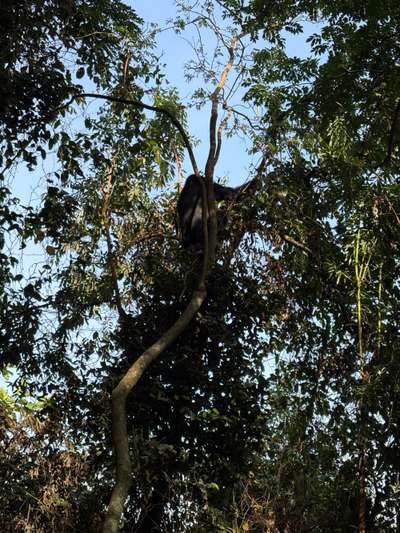
What Kasyoha Kitomi Represents
The name Kasyoha Kitomi refers to a specific site used for standardised bird monitoring in the broader Buhoma area. It is not a single location visible on tourist maps; rather, it is a monitoring unit — a defined area where trained observers count birds using point-count protocols on a regular schedule. The Uganda Wildlife Authority's 2019 report aggregated data from dozens of such sites across Uganda, representing a national-scale snapshot of bird population distribution.
The choice of Kasyoha Kitomi as a monitoring site reflects its position in the landscape: close enough to Bwindi Impenetrable National Park to be influenced by forest biodiversity, but also incorporating modified land where forest-edge dynamics play out. This dual character — forest proximity, habitat transition — is what makes the site ecologically interesting and also what produces a high species count.
During our multiple visits to Buhoma between October 2024 and 2026, we walked the forest edge extensively — the same kind of transitional zone that monitoring sites like Kasyoha Kitomi represent. The variety of birds detectable even on a casual walk along these margins suggests that the 87-species figure is credible and that systematic effort would produce even more. Uganda is, by any measure, an exceptional country for birds, and the land around Bwindi concentrates that richness in a relatively accessible form.
Quick Facts
- Site name:
- Kasyoha Kitomi (Buhoma area)
- Species recorded:
- 87
- Data source:
- UWA Bird Monitoring Report, 2019
- Habitat type:
- Forest edge, modified land near Bwindi
- Bird categories:
- Forest specialists, generalists, visitors
- Uganda national total:
- 1,070+ species (50% of Africa)
- Nearest landmark:
- Bwindi Impenetrable National Park
Forest Specialists: The Benchmark Species
In Uganda Wildlife Authority monitoring methodology, forest specialists are birds that are entirely dependent on intact, continuous forest. They cannot survive in isolated tree patches, farm woodlots, or heavily modified landscapes. Their presence at a monitoring site is therefore the strongest possible indicator that the site maintains a meaningful connection to functioning forest habitat.
The inclusion of forest specialists in the Kasyoha Kitomi count is significant. It indicates that the site, despite being categorised as a modified landscape in some respects, retains sufficient forest cover or connectivity to Bwindi's interior that these demanding species can access it. This kind of landscape permeability — the ability of forest birds to move between the park and its surroundings — is critical for maintaining population viability in a fragmented landscape.
Conservation planning in and around Bwindi depends partly on knowing which species use which habitats outside the park boundary. Monitoring data that captures forest specialists at sites like Kasyoha Kitomi contributes directly to this knowledge, informing decisions about where to prioritise habitat restoration and where corridor maintenance would have the greatest impact.
Forest Generalists and the Edge Economy
Forest generalists are species that move between intact forest and modified land without difficulty. They use both habitat types for different purposes — roosting in forest, foraging in cultivation, drinking from streams in cleared land — and their flexibility makes them more resilient to habitat change than specialists. They are also often the species that birdwatchers encounter most readily along the forest edge, precisely because they are comfortable in the transitional zone.
A site like Kasyoha Kitomi, with its combination of native cover and modified landscape, provides excellent conditions for forest generalists. The monitoring data captures this diversity, showing that the site supports not just the rarest and most demanding species, but also a rich middle layer of birds that make the edge habitat productive for birdwatching visits.
For a visitor spending a morning along the forest edge near Buhoma, this is the category of birds that forms the core of what they see: hornbills, sunbirds, weavers, bulbuls, and the larger forest visitors that perch visibly in garden trees and fruiting shrubs. These species do not require deep-forest access to encounter; they are present throughout the transition zone and reward even a short walk before the gorilla trekking briefing begins.
The Bigger Picture: Uganda's 1,070+ Species
The 87-species count at Kasyoha Kitomi exists in the context of Uganda's national bird list, which exceeds 1,070 recorded species — roughly half of all species documented across the African continent. This density is a product of Uganda's position at the intersection of several major biogeographical zones: East African savanna, the Albertine Rift montane forest, central African rainforest, and Lake Victoria's riparian and wetland habitats. No single site captures the full national diversity, but the accumulation of monitoring data from dozens of sites like Kasyoha Kitomi builds a national picture that is invaluable for conservation planning.
Bwindi Impenetrable National Park alone has recorded over 350 species, including 23 Albertine Rift endemics found nowhere else in the world. The monitoring sites in its vicinity — including Kasyoha Kitomi — extend this diversity outward into the modified landscape, documenting which forest species can use the wider environment and which are confined to the park itself.
This pattern — high diversity in the park, meaningful spillover into the surrounding landscape — is what makes the Buhoma area genuinely rewarding for birdwatching beyond the park boundary. A visitor who combines gorilla trekking inside Bwindi with early-morning birding walks along the forest edge can, over several days, encounter species from multiple functional groups and habitat types without ever needing to repeat the same route.
Monitoring as a Long-Term Commitment
The 87-species figure from the UWA 2019 report is a baseline — a single data point in what should be a continuous time series. The value of monitoring data is not the snapshot but the trend: whether species numbers at a given site are stable, increasing, or declining across successive survey rounds. A stable 87-species count over five years indicates that the habitat is maintaining its quality. A decline to 60 species would signal a problem requiring investigation and response.
The Uganda Wildlife Authority's monitoring programme represents this long-term commitment. Sites like Kasyoha Kitomi are not visited once and forgotten; they are revisited on a regular schedule, with consistent methods, by trained observers who can identify species by sight and sound under field conditions. The community bird monitoring programmes that train local guides to contribute to these counts extend the monitoring capacity beyond what a small team of professional ornithologists could cover alone.
Understanding this system helps visitors to the Buhoma area see birdwatching guides in a different light. They are not simply leading pleasant walks for curious tourists — they are participants in a monitoring network that generates conservation knowledge with genuine value. When you hire a locally trained guide for a morning walk along the forest edge, you are supporting that network directly.
54 Species at Birinzi
Another Buhoma-area monitoring dataset — 54 species, 384 individuals, White-headed Sawwing most numerous.
Bwindi Birdwatching Guide
Practical guide to birding in Bwindi — species, seasons, and how to arrange a guided walk.
Community Monitoring
How local guides participate in bird monitoring and what this means for visitors.
Birds of Bwindi
350+ species overview including Albertine Rift endemics and forest specialists.