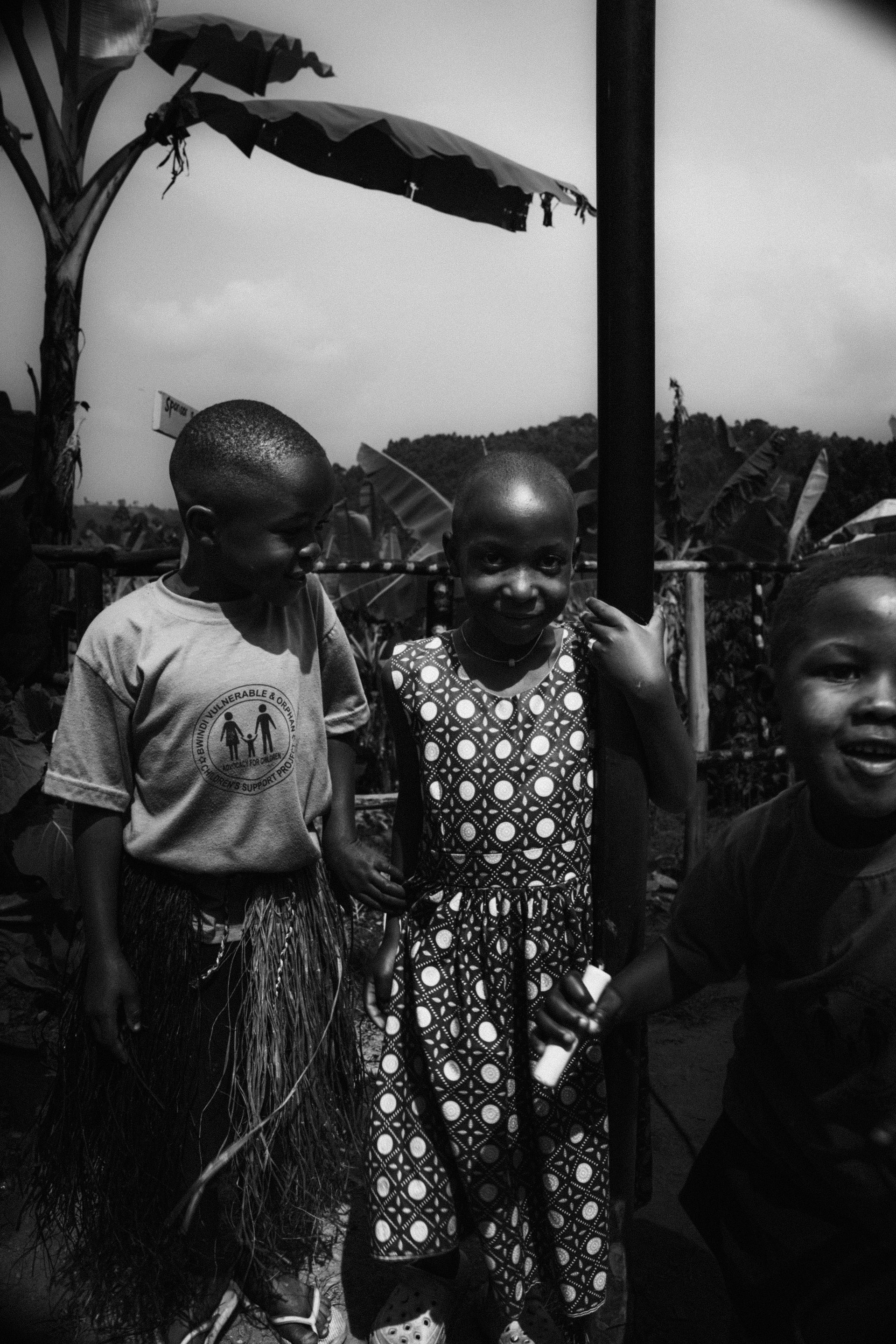
A Boy Beside the Road
On a walk through Buhoma in January 2026, we passed a ten-year-old boy sitting at the roadside, methodically breaking stones with a small hammer. He was producing gravel — the kind used as foundation material for construction — a task performed by children and adults alike in this part of Uganda. It is one of the few ways to earn cash without equipment, capital, or formal employment. The boy worked steadily, without complaint, in the way that work becomes ordinary when it has always been ordinary.
The scene is relevant to bird monitoring not because ornithology can replace stone-breaking, but because the question of what kinds of work become available in a place like Buhoma is exactly what capacity building programmes try to address. Training local guides to lead birdwatching tours, to identify species by sound and silhouette, to navigate the forest independently — this is a different kind of investment. It does not produce gravel. It produces expertise, and expertise attracts visitors willing to pay for it.
What Bird Monitoring Actually Involves
Systematic bird monitoring is not casual birdwatching. It follows protocols: fixed routes walked at fixed times, species and individuals counted using standardised methods, data recorded consistently so that results from one year can be compared with another. The Uganda Wildlife Authority's 2019 report on bird monitoring for selected sites in Uganda documented counts across dozens of locations — protected areas, forest reserves, cultivated land, and wetlands — using trained observers.
In the Bwindi region, the forest structure itself creates specific monitoring challenges. The dense canopy means many species are heard rather than seen. Forest specialists — birds adapted entirely to interior forest conditions — require patience and experience to locate. Forest generalists, which move between forest and agricultural land, are easier to count but require knowledge to distinguish from similar-looking species. Both categories are important for understanding how the forest is changing over time.
Training local monitors to conduct these counts reliably is a multi-year process. Species identification, call recognition, and data recording protocols all need to be learned and practised. The investment is not trivial — but it produces guides who are genuinely qualified, not simply knowledgeable in a general sense.
NatureUganda and Site Support Groups
Bird monitoring in Uganda is not solely a government activity. NatureUganda, a national conservation organisation, has conducted monitoring at specific sites — including Ssele Islands, where it has been active since 2006. NatureUganda also coordinates with community-based Site Support Groups (SSGs), grassroots groups that have been operating since the 1990s to support Important Bird Areas and other conservation sites.
SSGs bring a dimension that government monitoring programmes often lack: local presence, local knowledge, and community buy-in. Members of an SSG know their area in ways that visiting researchers cannot quickly replicate. They know which fruit trees attract flocks in February, which pools hold wading birds in the dry season, and which paths through the cultivated buffer zone lead to the best morning positions. This knowledge, combined with monitoring training, produces observers who are both methodologically sound and spatially expert.
Tourism Benefits from Monitoring Expertise
The practical outcome of monitoring training is a pool of guides capable of leading productive birdwatching tours. Uganda attracts serious birders: the country has over 1,070 recorded bird species — roughly 50 percent of Africa's total — and Bwindi is one of the most important destinations within Uganda for Albertine Rift endemics, species found only in the narrow corridor of highland forest running from the DRC through Rwanda, Uganda, and into Tanzania.
Ornithologists visiting Bwindi are typically willing to spend multiple days and significantly more money than standard gorilla trekking visitors. They require a different kind of guidance — someone who can identify calls, find specific target species, and explain what they are seeing in ecological context. A guide trained through a monitoring programme is equipped to provide this. A general nature guide, however experienced, is not.
The economic case is straightforward. Gorilla trekking brings a single large revenue event per visitor — the permit. Birdwatching, done properly, can fill multiple days with activities that do not require UWA permits and that pay local guides directly. For a village economy as dependent on a single product as Buhoma is, this kind of diversification matters.
Conservation Data Beyond Tourism
The data produced by monitoring programmes serves conservation purposes that extend well beyond guiding. Population trend data for species of conservation concern — including globally endangered species that appear in the Bwindi region — informs management decisions at the park level and contributes to Uganda's national biodiversity reporting obligations. When a species declines at a monitored site, the data exists to show it; without monitoring, the decline goes undetected until it is severe.
In our visits to Buhoma across October 2024, January 2026, and subsequent trips, the intensity of human activity at the forest edge has been consistently visible — new construction, expanding cultivation, motorcycles on tracks that were previously footpaths. Whether this activity is affecting bird populations in the buffer zone is exactly the kind of question that monitoring data, collected consistently over time, can answer. The guides who conduct that monitoring are therefore not just tourism assets. They are the people through whom the forest speaks.
Site Support Groups in Bwindi
Community-led groups that have supported bird conservation sites in Uganda since the 1990s.
Birdwatching in Bwindi
Species, seasons, and how to arrange a guided birdwatching walk from Buhoma.
Birdwatching Activities
Practical guide to arranging birdwatching walks and half-day tours from Buhoma.
Community Conservation
How the communities around Bwindi are involved in protecting the forest they live next to.