The Encounter That Settles the Question
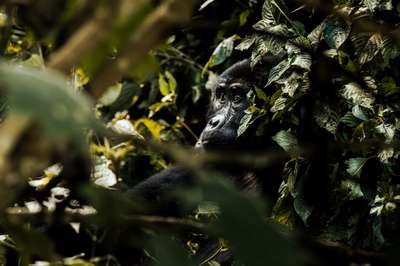
After three hours of trekking through the dense understorey of Bwindi Impenetrable National Park in January 2026, we stopped in a small clearing and the ranger ahead of us raised his hand. Through the tangle of vines and broad-leafed plants, a face was watching us. A mountain gorilla, completely still, peering through the foliage with an expression that was simultaneously curious and entirely indifferent to our presence. We stood there — eight visitors, two rangers, one guide — and nobody spoke.
That moment does not happen in a building or on a screen. It happens in a specific forest, in a specific country, reached only on foot after hours of uphill walking. Whether that forest is Bwindi or the slopes of the Virunga volcanoes on the Rwandan side is a question worth thinking about before you book.
Quick Facts
- Bwindi permit:
- USD 800
- Volcanoes permit:
- USD 1,500
- Uganda gorilla population:
- 459 (2018–2020 census)
- Habituated families at Bwindi:
- Multiple — divided across 4 sectors
- Minimum age:
- 15 years, both parks
- Trek duration at Bwindi:
- 1–8 hours (variable)
- Trek duration at Volcanoes:
- 2–4 hours (typical)
- Time with gorillas:
- 1 hour maximum (standard permit)
The Parks at a Glance
Bwindi Impenetrable National Park sits in the Albertine Rift in southwestern Uganda, bordering the Democratic Republic of Congo. It covers roughly 331 square kilometres of ancient montane forest — one of the most biologically diverse areas in Africa — and is divided into four gorilla trekking sectors: Buhoma, Rushaga, Nkuringo, and Ruhija. The Buhoma sector, in the north, is where most first-time visitors base themselves. It has the highest concentration of lodges and the best infrastructure.
Volcanoes National Park, known in French as Parc National des Volcans, lies in northwestern Rwanda near the towns of Musanze and Kinigi. It protects the Rwandan portion of the Virunga mountain range — a chain of extinct and dormant volcanoes stretching across Rwanda, Uganda, and the DRC. The park is considerably smaller than Bwindi, but the open bamboo forest and volcanic terrain make for different walking conditions.
Permit Costs: A Significant Difference
The most immediate factor for most travellers is the permit cost. Uganda charges USD 800 per person for a standard gorilla trekking permit. Rwanda charges USD 1,500. For a couple, that is a difference of USD 1,400 — enough to cover two or three additional nights at a mid-range lodge.
Uganda also offers the Gorilla Habituation Experience (GHE) at USD 1,500. This permit gives you four hours with a gorilla family that is still in the multi-year habituation process — longer than the standard one-hour visit and a substantially different experience, since the gorillas are less accustomed to human presence and behaviour accordingly more natural.
Rwanda justified its higher permit price partly as a conservation and premium-positioning strategy, aiming to attract high-spend, low-volume tourism. In practice, both parks limit visitors to eight people per gorilla family per day, so the conservation impact per visit is roughly comparable. The cost difference largely reflects national tourism policy rather than the quality of the encounter itself.
The Trek: Forest vs. Volcano
Bwindi is a rainforest. The vegetation is dense, the slopes are steep, and the path is often improvised — rangers use machetes to clear the way when needed. Our trek in January 2026 took three hours to reach the gorilla family, moving through areas where the canopy closed almost completely overhead and the ground was slick with moisture. The rangers and guides were essential, not optional.
Volcanoes National Park involves ascending through bamboo forest on volcanic slopes. The terrain is more open and, on most trails, more predictable underfoot. The ascent is still physically demanding — the volcanoes rise to significant elevation — but the experience of the forest itself is different. There is more sky, more visibility, and generally a shorter distance to cover.
Neither park is accessible to those with serious mobility limitations, but Volcanoes is sometimes described as slightly more manageable for visitors who are less experienced with off-trail walking. Bwindi is worth every step, but if the physical challenge is a concern, the terrain in Rwanda is worth factoring into your decision.
Gorilla Families and Population
The mountain gorilla population has recovered from the brink of extinction over the past four decades. The most recent comprehensive census, conducted across 2018 to 2020, recorded 459 individuals in Uganda alone. Globally, the total mountain gorilla population now exceeds 1,000 animals — a figure that would have seemed impossible in the 1980s when fewer than 300 individuals were estimated to survive.
Bwindi hosts the majority of the world's mountain gorillas, with multiple habituated families spread across its four sectors. Each family has its own personality, size, and range. Some families are relatively compact with eight to twelve members; others are large, multigenerational groups with dominant silverbacks, juveniles, and infants that provide a richer visual experience during the one-hour visit.
At Volcanoes National Park, the gorilla groups tend to be somewhat easier to observe because the vegetation is less dense — you can see more of the family at once. This can make for better photography and a less spatially limited encounter. In Bwindi, the dense forest can mean you are very close to a gorilla but can only see part of it through the undergrowth.
Combining Both Parks
Travellers with enough time and budget sometimes combine both parks. The road distance between Buhoma in Uganda and Musanze (gateway to Volcanoes) in Rwanda is roughly eight to ten hours by road, crossing the border at Cyanika or Katuna. It is a long day of driving but a feasible multi-country itinerary.
For most visitors, however, the choice is one or the other. If budget is the primary constraint, Uganda offers comparable quality at a lower permit price. If you are already planning time in Rwanda for other reasons — Kigali, Lake Kivu, Nyungwe Forest — Volcanoes fits naturally into that itinerary. If you want the most forest-immersive experience on the continent, Bwindi and the village of Buhoma at its northern entrance are the right answer.
Where to Base Yourself in Bwindi
The Buhoma sector in the north of Bwindi Impenetrable National Park is the most developed and most visited entry point. Lodges here range from community guesthouses to mid-range and upscale properties, all within a short distance of the park headquarters where morning briefings begin.