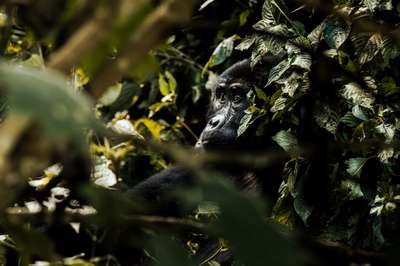
A population that came back
The 2018 census — the most comprehensive count conducted — tallied 1,063 mountain gorillas alive worldwide. This is the entire global population of the subspecies. There are no mountain gorillas in captivity; every individual alive exists in the wild, within two connected landscapes: Bwindi Impenetrable National Park in Uganda, and the Virunga Massif shared by Uganda, Rwanda, and the Democratic Republic of Congo.
Bwindi accounts for roughly 459 of these, distributed across approximately 25 habituated gorilla families. The Buhoma sector — the park's oldest and most accessible trekking area — is home to three of them: the Mubare family, the first ever habituated in Uganda (1991), as well as Habinyanja and Rushegura. The Mubare family's habituation was the beginning of what would become one of the most successful conservation stories in Africa.
When the gorilla population fell to its low point in the 1980s, the causes were familiar: expanding agriculture, snaring, and a park that offered local people no economic reason to protect it. What reversed the decline was a deliberate strategy linking gorilla survival to local economies — specifically, to high-value tourism. The gorilla trekking model did not just protect gorillas. It changed the calculation for the communities who live beside them.
For a full profile of the mountain gorilla — biology, behaviour, and status — see Mountain Gorillas of Bwindi.
What you see on the trail
On a gorilla trek from Buhoma, you walk with one tracking guide and two Uganda Wildlife Authority rangers. The rangers are armed. It is the detail that surprises most visitors first — this is a forest walk, not a military operation. On our trek in October 2024, the rifles were visible from the start. Within an hour of walking, they made complete sense.
The rangers are not there primarily for tourist safety, though they contribute to it. They are part of UWA's active gorilla protection infrastructure. The same men and women who guided us through Bwindi's undergrowth also patrol the park boundaries after dark, respond to snare reports, and track gorilla movements throughout the week. They were excellent company, too — knowing exactly which slope to take, helping up the steepest sections of the climb, and pointing out things in the forest that would otherwise have passed unseen.
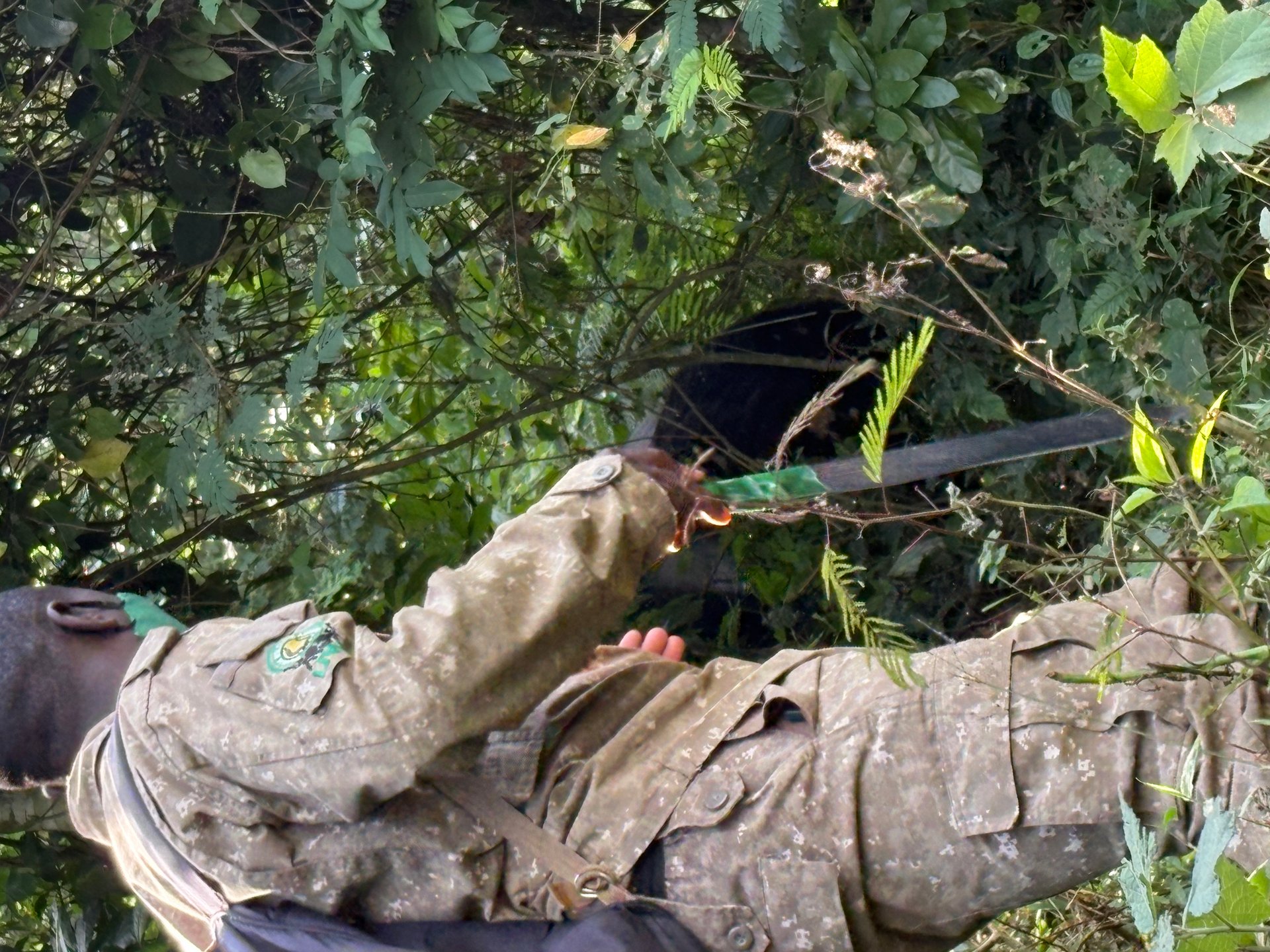
A ranger leads the trail through Bwindi. Rangers are the backbone of gorilla protection — on the trek with visitors and patrolling the park boundaries after hours.
When Susanne reached the gorilla family, she photographed them with her phone — one of the gorillas close enough to fill the frame. Like every visitor, she wore a face mask throughout. The mask rule is not bureaucracy. Mountain gorillas share approximately 98% of their DNA with humans, close enough that a common cold can be dangerous for them. Respiratory disease protocols are among the strictest conservation measures in place at Bwindi, and they are part of why gorilla health in habituated families has remained stable.
What the $800 permit actually pays for
A gorilla trekking permit costs $800 USD for foreign non-residents (Uganda Wildlife Authority, 2026). For most visitors, this is the single largest cost of the trip. The fee flows to UWA and covers:
- —Ranger and tracking guide salaries — the people who protect and monitor gorilla families year-round
- —Veterinary monitoring — regular health checks of habituated gorilla families, disease surveillance, and emergency veterinary response
- —Anti-poaching patrols along park boundaries and across the broader landscape
- —Park infrastructure — trails, ranger stations, ranger housing, and community interface points
- —Community Revenue Sharing — a programme that returns a portion of park income to the communities bordering Bwindi
Uganda's Statistical Abstract 2025 (Uganda Bureau of Statistics) records gorilla trekking as among the most significant revenue-generating tourism activities in Uganda. Bwindi and Mgahinga are listed among the top national parks by visitor numbers and associated park fees. Without this consistent revenue stream, the staffing and operational costs of managing a park of Bwindi's size and biodiversity would be extremely difficult to sustain.
Communities as conservation partners
The relationship between Bwindi's gorillas and the communities that live alongside the park is not natural harmony — it is a deliberate economic construction. Before gorilla trekking developed, the forest represented land that could not be farmed. Snaring, encroachment, and poaching were the default responses to a park that provided nothing in return.
Tourism changed the calculation. Norman Noel, a BodaBoda driver in Buhoma, has worked alongside the tourism economy for years. During the 2018 Ebola outbreak in Uganda — when tourist numbers collapsed — he described the impact plainly: “We survive on tourism. Tourists are few because of the Ebola, and we have got a problem here.”
The inverse is equally true. When tourism thrives, the entire village has an economic stake in the gorillas' continued presence. BodaBoda drivers, guides, lodge staff, market traders, porters, and craft sellers all depend on a functioning gorilla population drawing visitors to Buhoma. That alignment between local livelihood and conservation outcome is central to why Bwindi's gorilla families have continued to grow even as other great ape populations elsewhere have declined.
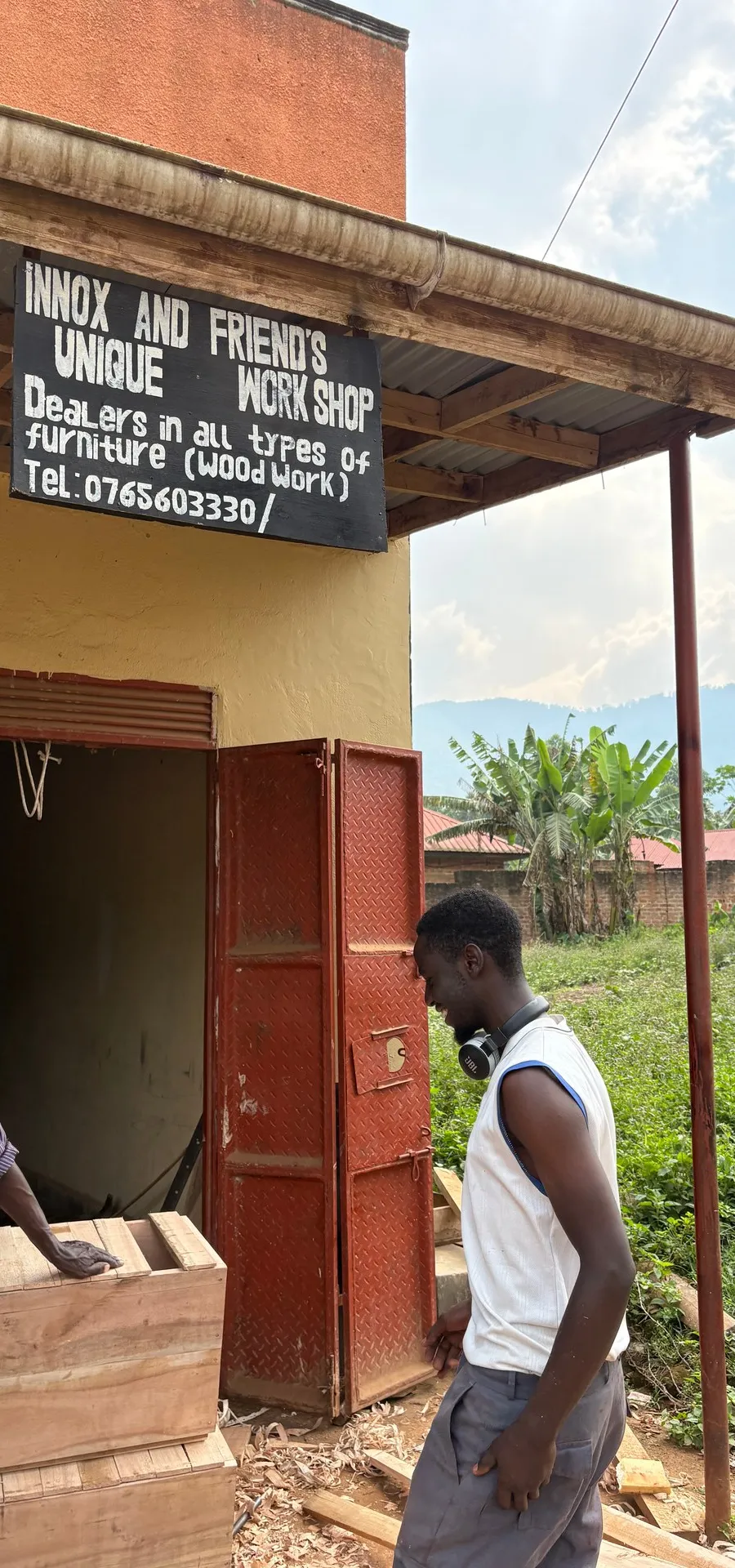
Outside the Innox woodwork workshop in Buhoma — one of many small businesses that depend on the wider tourism economy that gorilla trekking sustains.
The Batwa — first in the forest
Any account of Bwindi's conservation must include the Batwa. They are the indigenous forest people of Bwindi — a community that lived within the park boundaries for centuries before the forest was gazetted as a national park in 1991. Their knowledge of the forest was unmatched: medicinal plants, animal behaviour, seasonal patterns, the precise locations of gorilla nesting sites. They were not visitors to Bwindi. It was their home.
When the park was designated, the Batwa were required to leave. The conservation that protected the gorillas also displaced the people who had coexisted with them longest. This history is not absent from modern Bwindi — it is present in every Batwa cultural experience offered in Buhoma today.
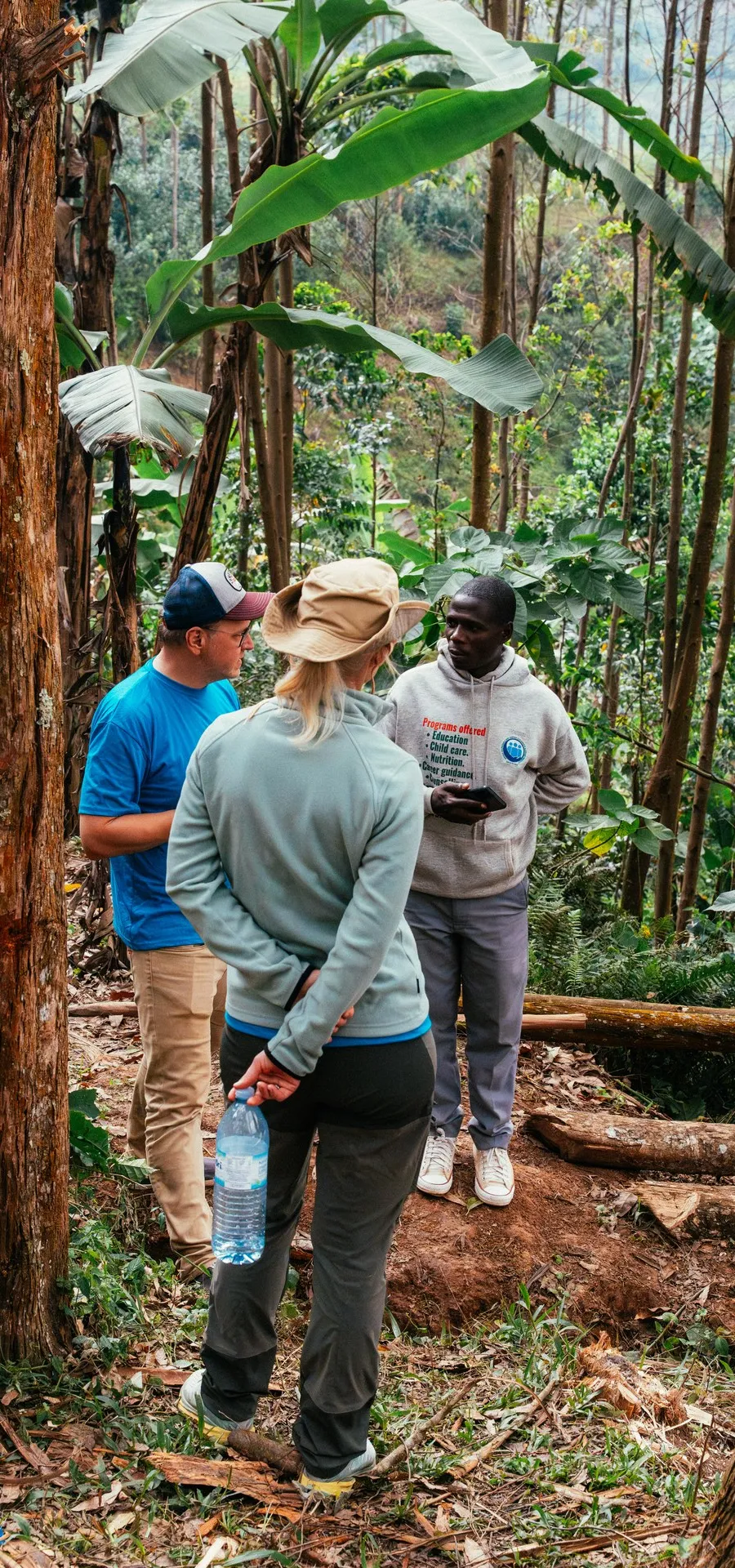
The Batwa have a relationship with the Bwindi forest that goes back generations. Their cultural experiences in Buhoma are led by community members — not performances, but personal histories.
During a visit to a Batwa community near Buhoma, the guide moved through the forest with a quiet certainty. Simply dressed, unhurried, he was someone for whom the forest was not a backdrop but a context. The Batwa cultural experiences offered in Buhoma are led by community members who share their own traditions, their knowledge of plants and animals, and the story of what the park has meant for their people. They are among the most honest encounters available to a visitor in Bwindi.
Why the population is still rising
The mountain gorilla's recovery is real, documented, and ongoing. But it remains fragile. The threats that almost eliminated the subspecies — disease, habitat pressure, political instability in the region — have not disappeared. They have been managed. The 2018 IUCN downlisting from Critically Endangered to Endangered was a recognition of genuine progress, not a declaration of safety.
What sustains that progress is the same mechanism that began it: consistent revenue from gorilla trekking, channelled into active conservation and community benefit. Each visit to Buhoma — each $800 permit — is a direct contribution to the infrastructure that has kept this population alive and growing. The gorillas in Bwindi are not there despite tourism. They are there, in these numbers, because of it.
Questions about gorilla conservation in Bwindi
Mountain Gorillas of Bwindi
Full profile: biology, behaviour, population data, and the three gorilla families you can track from Buhoma
How to Book a Gorilla Permit
When to book, how to book through UWA, and what to know before your trek
Full Cost Breakdown
Permit, porter, transport, lodge — everything you need to budget a gorilla trekking trip to Buhoma
Batwa Cultural Experiences
How to book a Batwa experience in Buhoma and what the visit involves
Last updated: September 2026