Gorilla Trekking Guide — Updated June 2026
Mgahinga vs Bwindi
Same permit price. Very different experience. Here is what actually separates Uganda's two gorilla trekking parks.
At a Glance: Key Differences
| Mgahinga | Bwindi (Buhoma sector) | |
|---|---|---|
| Permit price | $800 USD | $800 USD |
| Gorilla families | 1 (Nyakagezi) | Multiple families |
| Permit availability | Limited (8 people/day) | Higher availability across sectors |
| Risk of cancellation | Higher — family may cross into Rwanda/DRC | Lower — gorillas stay within Uganda |
| Trek difficulty | Moderate to strenuous (volcanic terrain) | Moderate (dense rainforest) |
| Extra wildlife | Golden monkeys, volcano hiking | 13 primate species, birdwatching |
| Nearest town | Kisoro (~15 km) | Buhoma village (at gate) |
| Drive from Kampala | ~9–10 hours | ~8–9 hours |
| Altitude | Starting ~2,200m | Starting ~1,400m |
Mgahinga Gorilla National Park — What to Expect
Mgahinga Gorilla National Park sits in the extreme south-west corner of Uganda, in the Kisoro district, at the convergence of three countries: Uganda, Rwanda, and the Democratic Republic of Congo. The park is part of the Virunga Conservation Area — a transnational protected zone covering 434 square kilometres — which also includes the Volcanoes National Park in Rwanda and the Parc National des Virunga in the DRC (source: Reiseführer Uganda, 2020).
Three extinct volcanoes define the park's landscape and its identity: Muhavura (4,127 m), Sabinyo (3,645 m) and Gahinga (3,474 m). The gorilla trekking takes place in the montane forest on their lower slopes, which merges into bamboo and then afro-alpine vegetation as the altitude rises.
The single habituated gorilla family in Mgahinga is the Nyakagezi family. Because gorillas move freely across the international borders within the Virunga ecosystem, there is a genuine — if infrequent — risk that the Nyakagezi family will be in Rwanda or the DRC on your trekking day. In that situation, permits are either cancelled or rescheduled. This is the primary practical argument against choosing Mgahinga when your visit window is short.
Border crossing risk: Mgahinga's Nyakagezi family sometimes moves into Rwanda or the DRC for days at a time. Always confirm the family's location with your lodge or tour operator the evening before your trek.
Mgahinga's unique advantage is its combination of activities. Beyond gorilla trekking, it is the only park in Uganda where you can track golden monkeys — a vivid, charismatic primate found only in the Virunga volcanic forests. The three volcanoes are all hikeable as day treks: Muhavura is the most demanding (elevation gain of roughly 1,500 metres from the park headquarters), Sabinyo offers a dramatic ridge walk along the three-country border, and Gahinga is the most accessible. The Batwa Trail — a cultural experience with the Batwa community who lived in these forests before the park was gazetted — is also available.
Bwindi Impenetrable National Park — What to Expect
Bwindi Impenetrable National Park is a different kind of place: denser, darker, and more complex than Mgahinga. Stretching across the steep hills of south-west Uganda, it is a UNESCO World Heritage Site and one of the oldest and most biodiverse forests in Africa. According to the 2016 census, approximately 400 mountain gorillas live in Bwindi — isolated from the Virunga population some 50 kilometres to the south (source: Reiseführer Uganda, 2020).
Trekking takes place across four sectors, each with its own habituated gorilla families, character and access routes:
- BuhomaThe northern gateway and the most established sector. Buhoma village sits directly at the park entrance — the only sector where the village and the gate are one place. Multiple families are habituated here, including several with researchers present which allows extended observation time.
- RushagaThe southern sector with the highest number of habituated families. Popular with visitors combining Bwindi with Mgahinga, as it is closer to Kisoro.
- NkuringoSouth-west sector on a dramatic ridge. Harder to reach, with steep descents into the forest. The views over the valley towards Congo are exceptional.
- RuhijaThe eastern, highest-altitude sector. Less visited, with a quieter atmosphere and excellent birdwatching alongside gorilla trekking.
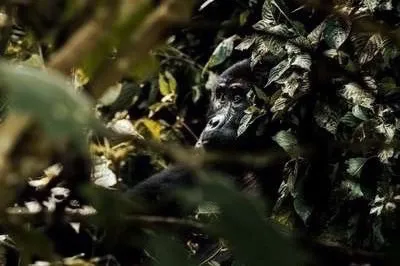
The moment of encounter — a gorilla's expression is almost human in its calm curiosity. This kind of proximity is available in both Mgahinga and Bwindi, regulated to one hour per group.
The Gorilla Population: Context Behind the Numbers
Mountain gorillas exist in two separate, isolated populations. The first lives in the Virunga Conservation Area — the interconnected parks spanning Uganda, Rwanda and the DRC — where the 2016 census counted 604 individuals, the largest number ever recorded for mountain gorillas (source: Reiseführer Uganda, 2020). Mgahinga's Nyakagezi family is part of this population.
The second population lives in Bwindi, genetically distinct and geographically separate, approximately 50 kilometres north of Mgahinga. These roughly 400 gorillas cannot interbreed with the Virunga population — the gap between the two forests is too wide for the gorillas to bridge. Both populations are classified as Endangered on the IUCN Red List, though gorilla numbers have risen steadily since the 1990s thanks to sustained conservation efforts by the Uganda Wildlife Authority, the Dian Fossey Gorilla Fund, and Mgahinga park director Emmanuel de Merode's counterpart initiatives across the border in Virunga National Park.
What the Trek Actually Feels Like
We have trekked gorillas in Bwindi's Buhoma sector twice — most recently in June 2026, and before that in January 2026. Both experiences were anchored by the same rhythm: an early morning briefing at the park gate, a walk into the forest with a tracking guide and two armed rangers, and then a specific hour with a gorilla family.
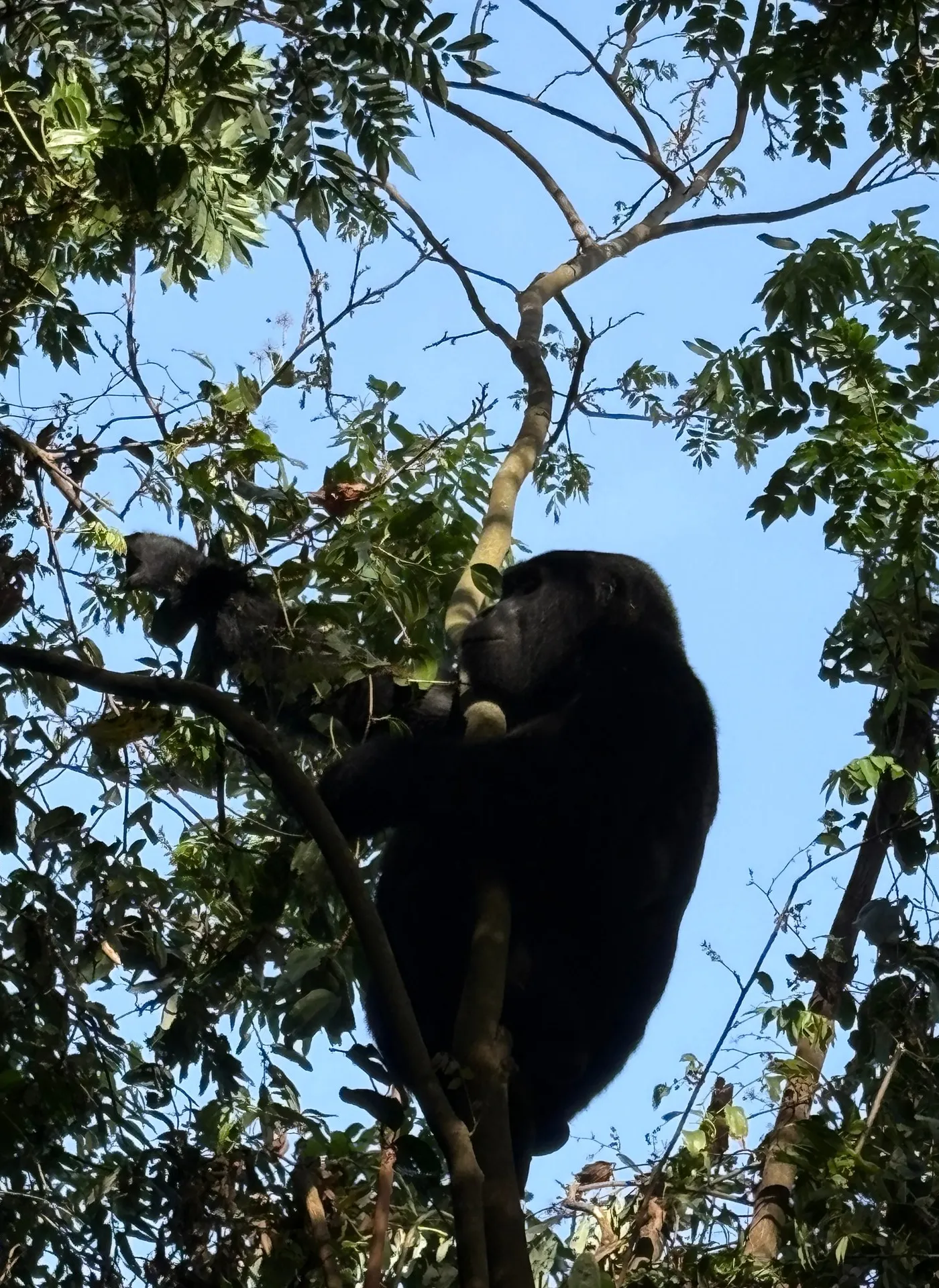
In January 2026, the walk to the family took just under an hour — unusually short, a function of where that particular family had slept the night before. In June 2026, with a different family higher in the canopy, we watched a silverback move through the tree crowns while feeding. Both times the hour went by faster than felt reasonable.
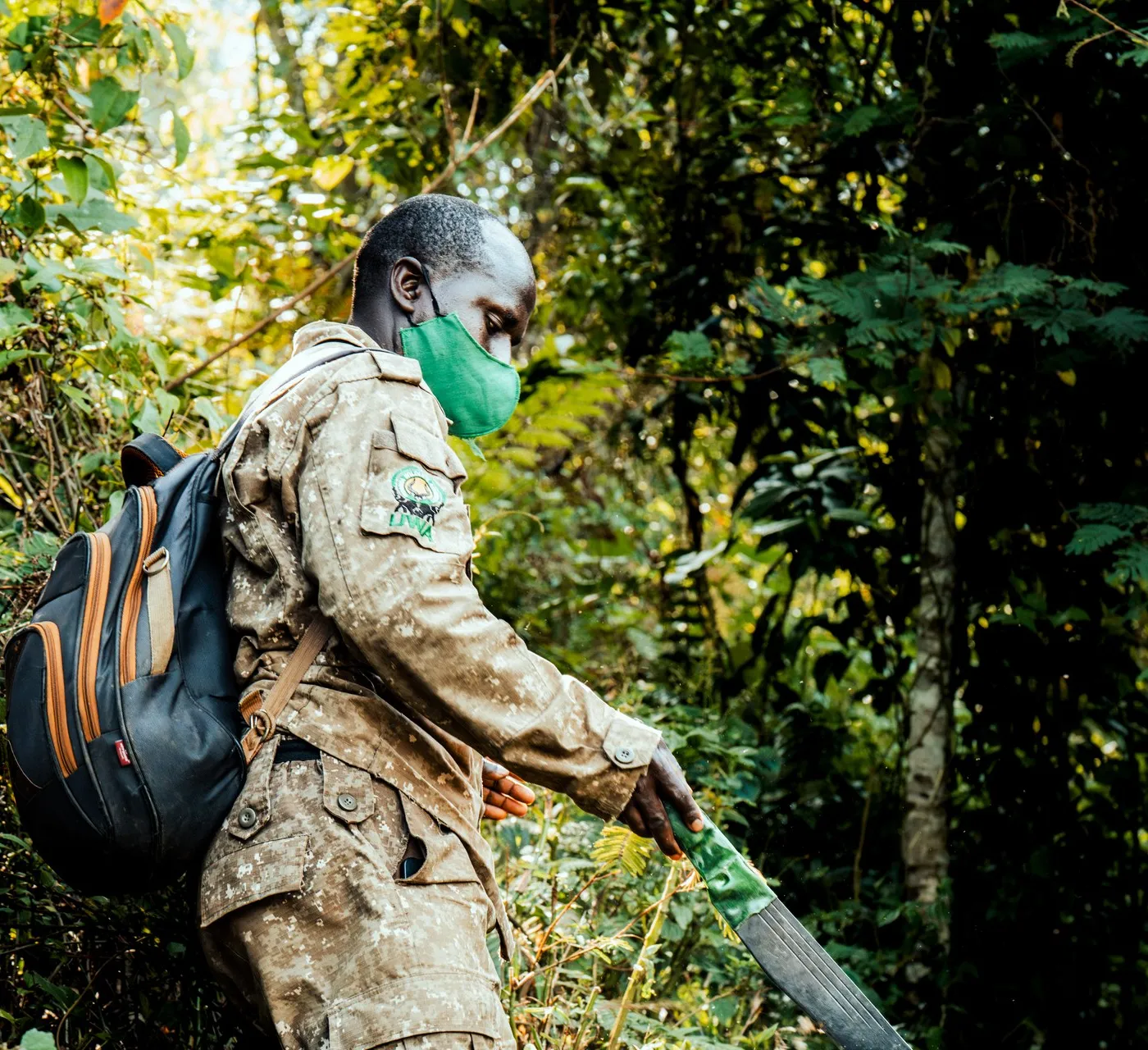
Two rangers accompany every trekking group — for safety, and to help cut a path through sections of dense vegetation. Buhoma sector, January 2026.
The rangers in our group were armed — which felt unusual at first and completely unremarkable by the end of the first hour. They were relaxed, helpful on the steep sections, and clearly comfortable in the forest. The guide tracked the family by following their trail of feeding debris — broken stems, bent vegetation, fresh dung. This is what made both treks feel genuine rather than staged: the gorillas were exactly where their own instincts had taken them, not where the schedule had put them.
Which Park Should You Choose?
Choose Mgahinga if:
- •You want to hike the Virunga volcanoes as well as trek gorillas
- •You specifically want to track golden monkeys (unique to MGNP in Uganda)
- •You are already based near Kisoro or combining with Rwanda
- •You want a smaller, quieter park experience
- •You have flexible dates and can absorb a border-crossing postponement
Choose Bwindi if:
- •This is the centrepiece of your trip and permit certainty matters
- •You want to base yourself in Buhoma and immerse in the community
- •You prefer the largest possible choice of gorilla families
- •You want birdwatching, nature walks and community activities alongside trekking
- •You are travelling from Kampala with limited time
Permits: Same Price, Different Process
The Uganda Wildlife Authority sets the permit price at $800 USD per person for both parks (2026). Each permit covers one trekking session with one gorilla family, with a maximum of eight visitors per family per day, for exactly one hour of contact time.
For Bwindi, permits across all four sectors can be booked through the UWA directly or through a licensed tour operator. Buhoma sector permits sell out months in advance in peak season (June–September and December–February). For Mgahinga, permits are fewer in total — with only one family, availability is structurally lower — but so is demand. Last-minute Mgahinga permits are occasionally available, which almost never happens at Bwindi's Buhoma sector.
Common Questions
Is Mgahinga or Bwindi better for gorilla trekking?
For most visitors, Bwindi is the stronger choice because it has multiple habituated gorilla families and higher permit reliability. Mgahinga is better if you specifically want to combine volcano hiking, golden monkey tracking and gorilla trekking in one place.
Can gorillas from Mgahinga cross into Rwanda?
Yes. The Nyakagezi family roams freely across Uganda, Rwanda and the DRC within the Virunga Conservation Area. When the family is outside Uganda, trekking permits may be cancelled. This happens infrequently but is a real risk for visitors with fixed itineraries.
How far is Mgahinga from Buhoma?
Approximately 80 to 100 kilometres by road via Kabale and Kisoro — roughly three to four hours depending on conditions. The road through Kabale is tarmac; the final stretch to Kisoro and MGNP is a mix of surfaces.
Can I do both Bwindi and Mgahinga gorilla trekking on the same trip?
Yes, and it's an excellent combination. Most visitors spend three to five nights in Buhoma for Bwindi, then move to Kisoro for Mgahinga. The two parks are complementary rather than competing — the gorilla families, the terrain and the surrounding activities are all different.
What is the Virunga Conservation Area?
The Virunga Conservation Area is a transnational protected zone covering 434 square kilometres across Uganda (Mgahinga Gorilla National Park), Rwanda (Volcanoes National Park) and the DRC (Parc National des Virunga). It is the primary range of the Virunga mountain gorilla population, which numbered 604 individuals in the 2016 census.
Plan Your Trek
Gorilla Permit Guide
Everything you need to know about booking a $800 UWA gorilla trekking permit — when to book, how, and what to watch out for.
Buhoma vs Nkuringo vs Rushaga
Choosing between Bwindi's four sectors. Which one suits your budget, timeline and trekking style?
What to Expect on the Trek
The briefing, the walk, the hour with the gorillas — a detailed account of what gorilla trekking in Bwindi actually involves.