
Norman is a local motorcycle guide based in Buhoma village, the northern entrance to Bwindi Impenetrable National Park. He offers half-day and full-day tours to surrounding villages, community projects, forest viewpoints and cultural sites — a slower, more personal alternative to driving through. He can be found near the park gate most mornings and is best contacted through lodges in Buhoma.
Quick Facts
- Tour length:
- Half-day (3–4 hrs) or full-day (6–8 hrs)
- Base:
- Buhoma village, near the park gate
- Gorilla permit:
- USD 800 per person (standard); USD 1,500 GHE
- Best season:
- Year-round; dry seasons Jun–Aug and Dec–Feb preferred
- GPS (Buhoma gate):
- 0.6518°N, 30.8963°E
- Author visits:
- October 2024, January 2026, June 2026
The Road to Buhoma: Where the Journey Begins
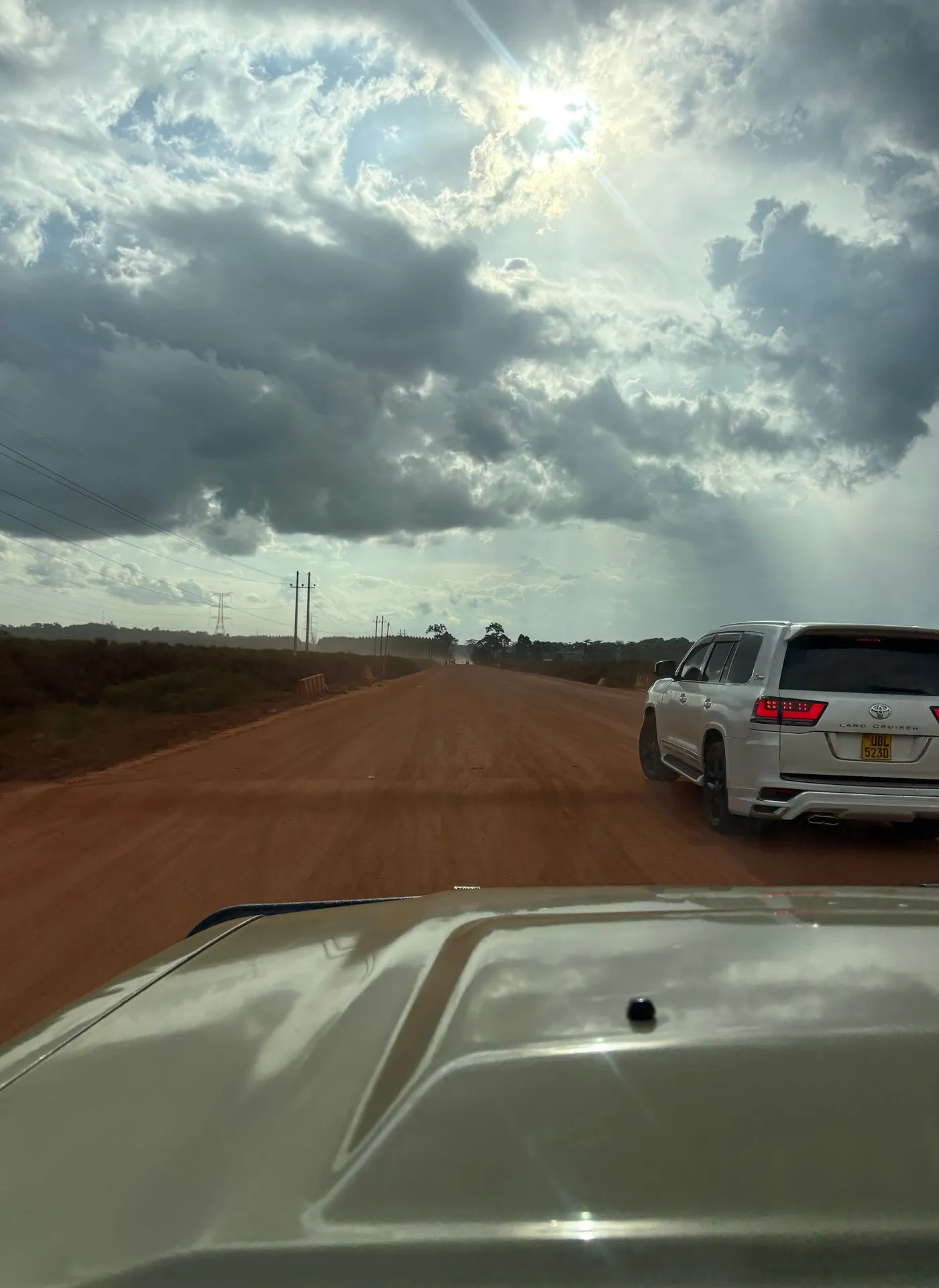
The Masaka Highway does not promise comfort. In January 2026, we drove it in a white safari jeep, cutting through Butambala's flat, open terrain — red laterite dust billowing behind us, a sky broken only by thin shafts of sunlight pressing through low cloud. The road has been in poor condition for years, a long stretch of corrugated dirt that tests both vehicles and patience. That is changing: 2026 marks the start of a major rehabilitation project, though work on a road this long takes time. For now, you settle into the rhythm of it — the dust, the distance, the occasional village appearing at the roadside — and you understand that Uganda's most remarkable destinations rarely come with easy access.
Buhoma is that kind of place. It sits at the end of a long drive through the Kigezi highlands, at the northern boundary of Bwindi Impenetrable National Park, and it rewards the effort completely. On multiple visits between October 2024 and June 2026, I found a village that operates at its own pace — small guesthouses and community lodges clustered near the park gate, children walking forest paths to school, guides gathering early in the morning. The GPS coordinates 0.6518 degrees North, 30.8963 degrees East mark where the road ends and the forest begins. That threshold is where you first hear about Norman.
Norman is a name that comes up quickly in Buhoma. Ask a lodge manager about exploring the area beyond the gorilla trail, ask a ranger where to find a local guide who can show you the community — and Norman's name surfaces. He is a motorcycle guide, one of a small number of boda-boda operators in the village who have made guiding a profession rather than simply a means of transport. What distinguishes him from casual motorcycle taxis is knowledge: he has spent years on the tracks and roads around Buhoma, and he understands what a traveller from outside Uganda actually wants to see.
Norman: A Guide Who Grew Up at the Forest Edge
To understand what Norman offers, it helps to understand Buhoma itself. The village has grown up almost entirely around the park. Before gorilla tourism became significant, the communities living along Bwindi's boundary relied on farming and forest resources. Tourism changed that calculus, bringing employment, income, and — eventually — a generation of local young men who built livelihoods around it. Norman is part of that generation. He grew up close to the forest, learned the surrounding landscape the way rural Ugandans learn it: by moving through it, repeatedly, over years.
His motorcycle is his tool. In a place where formal tour infrastructure is still developing, a boda-boda is often the most practical way to reach small communities on unpaved tracks, to stop at a viewpoint that a vehicle cannot access, to take a ten-minute detour to a roadside market that a driver would not know to suggest. Norman uses this mobility deliberately. He has mapped, over time, a set of routes that show visitors Buhoma and its surroundings in a way that a gorilla trek alone cannot. Gorilla trekking is extraordinary — an hour in the forest with a habituated mountain gorilla family remains one of the most affecting wildlife encounters on the continent — but it lasts one morning, and it takes place entirely inside the park boundary. The life of Buhoma happens outside that boundary, in the villages and on the hills.
What Norman brings to a day tour is not a script. He does not recite memorised facts about the park or the gorillas; there are plenty of official guides for that. What he provides is access — to people, to places, to moments that are not on any itinerary. He knows which homestead keeps the best local coffee, which hillside gives you an unobstructed view over the forest canopy at the right time of morning, and which community project is worth visiting if you want to understand how Bwindi's communities have shifted from forest dependence to tourism-based income. That kind of knowledge cannot be learned from a guidebook. It comes only from being present in a place for a long time.
What a Day Tour Covers: Villages, Viewpoints, and the Forest Edge
A half-day tour with Norman typically starts after breakfast — around eight or nine in the morning — and returns to the lodge by early afternoon, in time for those with gorilla trekking permits to prepare for a late-afternoon briefing. A full-day tour extends further, reaching communities that are a significant distance from the gate on unpaved roads where a standard vehicle would struggle. The specific route depends on what you want to see, and Norman adjusts it accordingly.
The immediate surroundings of Buhoma include small farming communities whose fields press up against the forest boundary. This edge is worth understanding: Bwindi's communities live in close proximity to one of Africa's most significant remaining areas of montane forest, and the relationship between human activity and conservation is a live question here, not an abstract one. Norman can take you to community-managed projects that address this relationship directly — small cooperatives, craft groups, and income-generating initiatives that were established in part to reduce pressure on the forest. Visiting them adds a layer of context to the gorilla trekking experience that park briefings do not always have time to provide.
The viewpoints around Buhoma are less well-known than they deserve to be. On clear mornings — and June 2026 produced some remarkable ones during my visit — the ridgelines above the village offer unobstructed sightlines over the forest interior. Bwindi does not have the dramatic volcanic profiles of the Virunga range to the west, but it has a density and depth that registers differently: a vast, dark-green mass of ancient trees with no visible clearings, a forest that looks exactly as impenetrable as its name suggests. From a hillside trail on a motorcycle, with the engine off and the village sounds carrying up from below, it is a quietly overwhelming view.
In October 2024, arriving in Buhoma for the first time, the scale of the surrounding landscape took time to absorb. The village is small, and the park gate is close, and within minutes of arriving you are standing on the edge of something that has been here for an estimated 25,000 years. A motorcycle tour makes that scale tangible in a way that a lodge veranda does not. You move through it at a pace that allows observation — the birdlife in the roadside trees, the morning light on the hills, the school children in their yellow uniforms, the farmers heading into their plots before the day gets warm.
Gorilla Trekking and the Buhoma Context
Buhoma is the oldest and most established of Bwindi's four gorilla trekking sectors. The habituated gorilla families assigned to this sector were among the first in the park to be made accessible to visitors, and the trails here are well-maintained. A standard gorilla trekking permit costs USD 800 per person and is booked through the Uganda Wildlife Authority. The Golden Hour Experience, which offers extended time with the gorillas and additional amenities, is priced at USD 1,500 per person. Both require advance booking, particularly for the dry season months when demand is highest.
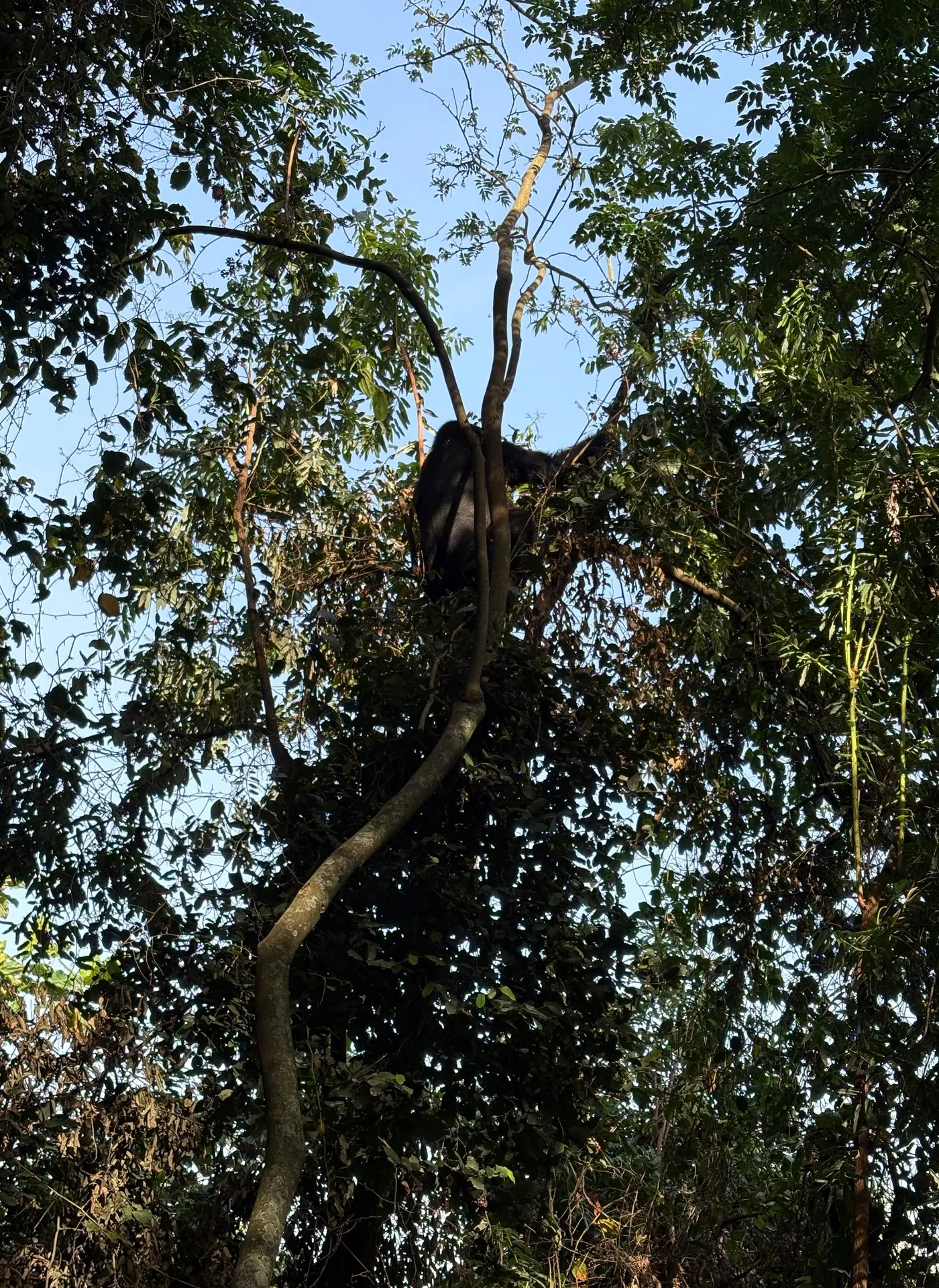
In January 2026, we trekked from Buhoma on a morning when the trail was wet from overnight rain. After approximately one hour of walking, we found the first gorilla family in the upper branches of a large tree, feeding on leaves. Watching a mountain gorilla move through the canopy — something that looks impossible given the animal's size — is a moment that does not diminish with repetition. The one-hour allocation passes quickly. What Norman's tours do is extend your engagement with Bwindi beyond that single, contained hour: they put the gorillas into a landscape, and the landscape into a community, and the community into a story you can carry home.
For visitors who have multiple days in Buhoma — which is strongly advisable; one night is not enough to understand this place — combining a gorilla trek with a Norman tour on a separate day produces a more complete picture. The park briefing on the evening before your trek tells you where the gorillas were last seen. A motorcycle tour the following morning can show you the community context that surrounds the park from the outside. Together, they make for a more honest account of Bwindi than either experience provides alone.
Finding Norman and Planning Your Visit
Norman operates independently, which means there is no booking website or advance reservation system. The most reliable way to arrange a tour is to ask at your lodge on arrival — most guesthouses and lodges in Buhoma know him by name and can either contact him directly or tell you where to find him. He is typically near the park gate area in the morning hours, when trekkers are gathering for their briefing. Approaching him directly is also straightforward if you see him there.
Pricing is negotiated directly. Discuss the route and duration clearly before setting out. Carry some small-denomination Ugandan shillings; while USD is widely accepted in Buhoma, local guides prefer local currency for small transactions. Bring water, sunscreen, and a light layer — mornings in the Bwindi highlands are cool, particularly in the June–August dry season, even though midday can become warm.
The physical experience of a boda-boda tour is worth a word of preparation. These are single-seat motorcycles; you ride pillion, holding the frame or a handle bar at the back. Tracks outside Buhoma's main road are unpaved and sometimes steep. The riding is rarely dangerous — Norman knows the roads — but it is active, and it is not suitable for travellers with limited mobility. If you are uncertain, discuss the terrain with him before committing to a full-day route. He will tell you honestly what a given track involves.
The best months to visit Buhoma align with Uganda's dry seasons: June through August, and December through February. During the wet seasons — March through May, and September through November — forest trails become slippery and unpaved roads more difficult, though gorilla trekking is permitted year-round. On my October 2024 visit, the rains had mostly cleared by mid-month, and the forest was extraordinarily green — a different kind of beauty from the clearer dry-season light of June. Both have their character. What changes between seasons is access, not worth.
Buhoma is a small community. Its economy depends significantly on tourism, and the network of local guides, lodge staff, and community operators is tightly connected. A day with Norman is a contribution to that network — a way of spending that goes directly to someone who has built a livelihood at the forest edge, in a village that has chosen to make room for visitors rather than close the gate. That is worth something beyond the tour itself.