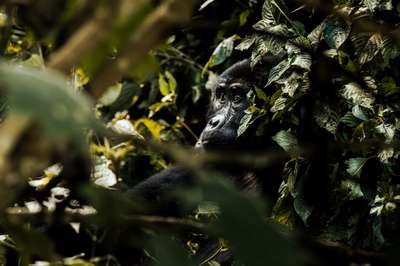
Uganda holds more than half of the world's remaining mountain gorillas, concentrated in Bwindi Impenetrable National Park and Mgahinga Gorilla National Park in the southwest. The most recent census recorded 459 gorillas in Bwindi across the 2018–2020 counting period, alongside 77 documented silverbacks. Beyond gorillas, Uganda's protected areas shelter chimpanzees, forest elephants, Rothschild's giraffes, Nile crocodiles, and over 1,000 bird species — one of the highest biodiversity densities of any country in Africa.
Quick Facts
- Mountain gorillas in Bwindi:
- 459 (2018–2020)
- Silverbacks in Bwindi:
- 77
- Uganda's share of world gorilla pop.:
- More than half
- Mgahinga group (Nyakagezi):
- 11 members, 2 silverbacks
- Chimpanzees in Uganda:
- ~5,072
- African elephants in Uganda:
- 6,464 (2021–2023)
- Rothschild's giraffe:
- 2,414 (up from 880 in 2011)
- Uganda kob:
- 174,037
- Virunga Conservation Area:
- 434 km²
- Gorilla trekking permit (2026):
- USD 800
- Bird species in Uganda:
- 1,000+
- Bwindi endemics (birds):
- 23 species
The Gorilla Numbers — What the Census Actually Shows
Mountain gorillas (Gorilla beringei beringei) are among the rarest large mammals on earth. Unlike many endangered species whose populations are estimated using modelling, gorillas are counted individually — each animal in each habituated family is known to researchers by appearance, age, and social role. The census conducted across 2018 to 2020 documented 459 gorillas in Bwindi Impenetrable National Park. Combined with the Virunga population shared between Uganda, Rwanda, and the Democratic Republic of Congo, the total number of mountain gorillas alive anywhere on earth exceeds 1,060 individuals.
To understand what these numbers mean, it helps to compare them with other large mammals. Uganda's Nile buffalo population stands at around 37,840 according to the same wildlife survey period. Uganda kob — the antelope on the national coat of arms — number over 174,000. The mountain gorilla, by contrast, exists in a population smaller than a mid-sized town. Every individual matters to the count. Every death from disease, every poaching incident, every habitat intrusion is measurable at the population level.
What makes the gorilla's situation unusual in African conservation is that the population is actually growing. Decades of protection, habituation research, and tourism revenue have reversed a decline that, in the 1980s, threatened to bring the total below 300. The count of 459 for the 2018–2020 period represented an increase from around 400 in both the 2011–2014 and 2015–2017 surveys. The gorilla is not saved — the population is still critically small and geographically restricted — but it is moving in the right direction.
Bwindi's 77 silverbacks — the mature dominant males whose silver-grey saddles signal full adulthood — are a particularly important demographic indicator. Silverbacks are the reproductive core of each family and the social anchor around which the group organises. Their count, tracked across surveys, gives researchers a signal about population structure and reproductive health that simple headcounts alone cannot provide.
What a First Encounter Actually Looks Like
During the January 2026 gorilla trekking visit from Buhoma, the trek to the gorilla family took just under an hour of walking through the lower forest. The terrain was steep and the vegetation dense — Bwindi forest has little of the open visibility that makes game-watching easy in savannah environments. You follow a path cut by rangers, pushing through undergrowth, climbing over roots, occasionally using a machete-cut gap in the vegetation.
Then the ranger in front stopped and pointed upward. The first gorilla of the family was sitting in a tree — not at canopy height but in the mid-storey, perhaps eight metres above the path, methodically pulling leaves from a branch and eating them. Mark Suer photographed it at GPS coordinates -0.9735°N, 29.6281°E. The animal was entirely unhurried. It was aware of the human group below, turned its head to look once, and continued eating. That quality of indifference — not fear, not aggression, simply the calm of an animal that has decided humans are not a threat — is what the multi-year habituation process produces, and it is what makes the encounter so extraordinary to witness.
The gorilla's bulk is something photographs fail to communicate. A mature silverback weighs between 140 and 200 kilograms. Even the juveniles in the family, climbing and dropping through the lower branches, have a heaviness of movement that makes their intelligence and dexterity more striking, not less. Gorillas communicate through a repertoire of vocalisations — low grumbles, short barks, and the occasional full chest-beat that carries through the forest at considerable distance. On the January visit, the silverback beat his chest twice, a sound less like a drum than like a large wooden door slammed hard. The sound was close enough to feel as vibration.
Beyond the Gorilla — Uganda's Wider Wildlife Landscape
Uganda's reputation is built on gorillas, but its wildlife is significantly broader than a single species. The country's position at the convergence of East African savannah and Central African rainforest gives it an ecological range that most countries its size cannot match. The result is a list of large mammals, birds, and reptiles that stretches across every major African wildlife category.
Chimpanzee populations in Uganda are estimated at around 5,072 individuals — a number that has remained stable across multiple survey periods. Kibale National Park in western Uganda holds the highest density of chimpanzees on the continent, but chimpanzees also live in Bwindi and in several other forest patches. Like gorillas, chimpanzees are subject to habituation programmes that enable tourism, and like gorillas, their survival depends on the continued integrity of the forest habitat they occupy.
The African elephant population in Uganda tells a more complex story. The 2021–2023 survey period recorded 6,464 elephants — a significant decline from the 7,975 counted in the 2018–2020 period. The reasons are not yet fully documented, but they likely include habitat encroachment, human-wildlife conflict at park boundaries, and movement of elephants into neighbouring countries. The elephant number matters not only for its own sake but because elephants are keystone species whose movement through the landscape shapes the vegetation structure that other animals depend on.
Rothschild's giraffe, by contrast, represents one of Uganda's genuine conservation success stories. From 880 individuals in the 2011–2014 survey, the population grew to 2,414 by the 2021–2023 count — a near-tripling over a decade. Murchison Falls National Park, where the majority of Uganda's giraffes live, has benefited from sustained anti-poaching investment and habitat management. The giraffe population growth is a tangible return on that investment.
The bird list is where Uganda's biodiversity becomes genuinely extraordinary. With over 1,000 recorded species — including the prehistoric-looking shoebill stork, the rare Rwenzori turaco, and at least 180 species in and around Mgahinga Gorilla National Park alone — Uganda represents one of the world's premier birding destinations. Bwindi Impenetrable National Park has twenty-three bird species found nowhere else in the country, reflecting the forest's status as a refugium that survived the African ice age and preserved species that were lost elsewhere.
Mgahinga and the Virunga System — The Other Gorilla Population
Bwindi's gorilla population is genetically isolated from the gorilla population of the Virunga volcanoes. The two groups diverged thousands of years ago and are separated by approximately fifty kilometres of transformed landscape. The Virunga population — shared between Uganda's Mgahinga Gorilla National Park, Rwanda's Volcanoes National Park, and the Democratic Republic of Congo's Virunga National Park — operates as a connected metapopulation across the Virunga Conservation Area, which covers 434 square kilometres of protected mountain forest.
Uganda's contribution to the Virunga population is concentrated in Mgahinga, where a single habituated family known as the Nyakagezi group provides the basis for gorilla trekking from the Ugandan side. The Nyakagezi family is notably mobile — the group regularly crosses the boundaries between Uganda, Rwanda, and DRC, following the habitat and the social dynamics of its members. As of early 2019, the family had eleven members including two silverbacks. Its composition and location fluctuate seasonally, which is why rangers confirm the group's position each morning before trekking begins.
The Virunga volcanoes — Muhavura at 4,127 metres, Gahinga at 3,475 metres, and Sabinyo at 3,645 metres within Uganda's borders — provide the ecological structure for this population. Their slopes are covered in afro-montane forest that transitions at higher elevation into afro-alpine zones where giant lobelias and giant senecios grow. These high-altitude habitats are home to species found nowhere else at lower elevations. The summit of Muhavura sits on the border with Rwanda; the summit of Sabinyo marks the meeting point of three national borders.
How Conservation Actually Works in Bwindi — The Human Dimension
The recovery of the mountain gorilla population is not the result of wilderness untouched by human intervention. It is the result of sustained, costly, often dangerous human effort to protect a species living in a landscape surrounded by dense and growing human populations. Understanding how this works requires understanding the relationship between the national park, the tourism revenue it generates, and the communities that live along its boundaries.
Gorilla trekking permits — priced at USD 800 per person in 2026 for standard season — generate revenue that flows in several directions simultaneously. A portion funds the Uganda Wildlife Authority's operational costs: ranger salaries, patrol equipment, veterinary support for injured or sick gorillas, and habitat monitoring. A further share is allocated to community revenue sharing programmes that fund boreholes, school buildings, roads, and clinics in the villages adjacent to the park. The economic logic of conservation here is concrete: the gorillas are worth more alive, in their forest, generating tourism income, than they would be as poached animals or as cleared land.
The habituation process that makes trekking possible is itself a form of conservation intervention. Habituating a gorilla family takes two to three years of daily, patient visits by rangers and researchers — gradually reducing the family's fear response until human presence is accepted without alarm. This process requires significant investment in skilled people, and the families that result from it serve double duty: they generate the tourism revenue that funds the park, and they serve as reference populations for the veterinary and reproductive monitoring that tracks population health.
The African Wildlife Foundation has been involved in Bwindi since the early years of the habituation programme, contributing to the research infrastructure and community engagement frameworks that underpin the current conservation model. The organisation's work in the broader Great Apes conservation landscape — across Uganda, Rwanda, DRC, and the Congo Basin — reflects the understanding that species operating across national boundaries require coordination that no single country can provide alone.
History at the Forest Edge — How the Southwest Was First Documented
The southwest corner of Uganda that now holds Bwindi and Mgahinga has a colonial and mission history that runs alongside its wildlife history. The most notable figure in the human story of this corner of the country is Leonard Sharp, a Scottish missionary and physician who arrived in the region in the early twentieth century. In 1921, Sharp established a hospital for leprosy patients on Bwama Island in Lake Bunyonyi, a few hours' drive from what is now Buhoma. The island hospital operated for decades, providing care to patients isolated there — as was standard practice for leprosy treatment in that era — and the physical structures of the original mission remain visible on the island today.
Sharp's work was conducted in the same landscape and at roughly the same period that early Western naturalists were first documenting the mountain gorilla. The species was formally described to science only in 1902, when a German officer named Robert von Beringe shot two individuals on the slopes of Sabinyo and brought specimens back to Europe. The gorillas that visitors now trek to see from Buhoma had no formal scientific identity until the twentieth century — and for much of that century, their survival was far from assured.
The trajectory from the first scientific description to a recovering population of over 1,000 individuals runs through the work of researchers like Dian Fossey in the Virungas, the establishment of Bwindi Impenetrable National Park in 1991, and the decision to open gorilla trekking from Buhoma in 1993 — a decision that linked the survival of the species directly to the economic interests of the surrounding community for the first time.
What Buhoma Sees — The Forest on the Doorstep
From Buhoma, Bwindi is not abstract. The forest is visible from the village. When it rains in the forest — which happens on most afternoons — you can hear it in the village below before the rain arrives. The evening calls of birds from inside the forest are audible on the village paths. The boundary between the protected area and the community is a physical line that every resident of Buhoma crosses mentally every day, understanding intuitively where the park ends and the village begins.
The gorillas occasionally cross that boundary themselves. The Rushegura family, which ranges at lower elevations than the other Buhoma families, has been known to come close to the park boundary, and on rare occasions their movements bring them into view of lodge guests or village residents. When this happens, UWA rangers move to create space and guide the gorillas back into the forest. It is a reminder that the boundary, however clear on a map, is not ecological. The gorillas do not experience it as a limit.
Uganda's biodiversity, seen from Buhoma, is not a statistic or a table. It is the thing that makes the village possible in its current form — the reason that lodges exist on the hillside, that rangers walk into the forest every morning, that an international tourism economy reaches this remote corner of southwestern Uganda. The 459 gorillas in Bwindi are not just a conservation number. They are the reason the children at the table that morning had a community around them that was capable, however imperfectly, of inviting them in.