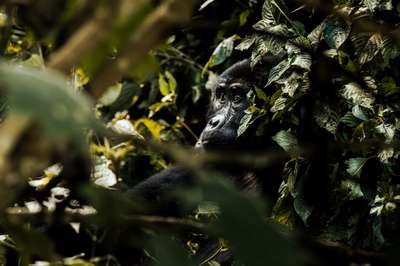
Both parks charge USD 800 for a gorilla trekking permit in 2026. Bwindi is the stronger choice for most visitors: twelve or more habituated families across four sectors, well-developed infrastructure, and permit availability across the year. Mgahinga has a single habituated family (Nyakagezi, 11 members, 2 silverbacks) in the smallest national park in Uganda — but it adds volcanic landscape, golden monkey trekking, and summit hiking on three Virunga volcanoes that Bwindi cannot offer. Mgahinga is right when Bwindi is unavailable, or when volcanic terrain and broader wildlife variety matter as much as gorilla encounter certainty.
Bwindi at a Glance
Quick Facts
- Standard permit (2026):
- USD 800
- Habituated families:
- 12+
- Trekking sectors:
- Buhoma, Rushaga, Ruhija, Nkuringo
- Park area:
- 321 km²
- UNESCO World Heritage Site:
- Since 1994
- GHE permit (Rushaga only):
- USD 1,500
- Peak-season booking lead time:
- 3–6 months
Mgahinga at a Glance
Quick Facts
- Standard permit (2026):
- USD 800
- Habituated gorilla family:
- Nyakagezi (1 family)
- Nyakagezi family:
- 11 members, 2 silverbacks (as of 2019)
- Park area:
- 33.7 km² (Uganda's smallest NP)
- Cross-border movement:
- Uganda / Rwanda / DRC
- Additional wildlife:
- Golden monkey, 3 volcano summits
- Permit booking window:
- Maximum 2 weeks in advance
Two Parks, One Permit Price — How They Ended Up This Way
Uganda's two gorilla trekking destinations are ecologically distinct and geographically separate. Bwindi Impenetrable National Park occupies the central Bwindi forest complex in the southwest — a 321-square-kilometre rainforest that represents one of the most biodiverse patches of montane forest in Africa. Mgahinga Gorilla National Park sits at the southwestern tip of Uganda, covering 33.7 square kilometres of volcanic slope in the Virunga chain — the smallest national park in the country. The two parks are separated by approximately fifty kilometres of agricultural land, and their gorilla populations are genetically distinct, having diverged thousands of years ago.
The Uganda Wildlife Authority manages both parks and has set the same standard permit price for both: USD 800 per person in 2026. This standardisation creates a useful planning simplicity but can be misleading. The two experiences are not equivalent. Booking a Bwindi permit guarantees access to a specific sector on a specific date with a choice of multiple gorilla families. Booking a Mgahinga permit for a specific date is a partial commitment — if the Nyakagezi family has crossed into Rwanda or DRC by that morning, the trek may be cancelled or postponed.
The parks became part of the same tourism system gradually over the late 1990s and 2000s, as the success of Bwindi's habituation programme and its economic returns for the UWA demonstrated the model's viability. Mgahinga, originally designated as a national park in 1991 alongside Bwindi, had its gorilla trekking programme developed as a complement to Bwindi's — offering an alternative for visitors who could not secure Bwindi permits and a destination that combined gorillas with the unique volcanic landscape of the Virunga chain.
Gorilla Families — Choice vs. Certainty
The fundamental difference between Bwindi and Mgahinga, for anyone planning gorilla trekking, is this: Bwindi gives you choice across multiple gorilla families; Mgahinga gives you one family if it is currently in Uganda.
Bwindi's twelve or more habituated families are distributed across four sectors. Each sector has between three and six families, and each family can host a maximum of eight visitors per day. On any given Bwindi trekking day, the allocation process assigns each group of eight trekkers to a specific family based on the advance permit booking. You do not choose which family you trek to — that assignment is made by the ranger post — but the fact that multiple families are available means that when one family is in a remote or difficult-to-reach position, another family might be close to the briefing point.
Mgahinga's Nyakagezi family has one significant advantage over any Bwindi family: its mobility. The Nyakagezi group moves freely between the three national parks of the Virunga chain, meaning that on any given day it could be in the Ugandan sector, the Rwandan sector (Volcanoes National Park), or the Congolese sector (Virunga National Park). On the days when it is in Uganda, trekking proceeds. On the days when it is not, permits are typically postponed or refunded. The family's cross-border movements are tracked by rangers on both sides of the border, and the Uganda park office in Kisoro confirms position each morning.
The practical upshot: for a visitor with one specific date for gorilla trekking and no flexibility for rescheduling, Bwindi is the right choice. For a visitor with several days in the Kisoro area who can wait for the Nyakagezi family to be on the Ugandan side, Mgahinga is feasible and the combination of gorilla trekking with golden monkey trekking and volcano summit options makes the overall experience genuinely rich.
Trekking Experience — Forest vs. Volcano
The terrain of Bwindi and Mgahinga produces fundamentally different trekking experiences. In Bwindi, the trek moves through dense equatorial rainforest — the "impenetrable" of the park's name refers to the vegetation density that makes navigation without cut paths nearly impossible. The forest is dark, humid, and layered: canopy above, mid-storey of trees and vines in the middle, dense ground vegetation underfoot. Movement through it is fully enclosed, with visibility rarely extending more than thirty metres.
In Mgahinga, the trek begins at higher elevation — the park sits between 2,227 and 4,127 metres — and moves through afro-montane forest that transitions at higher altitude into open afro-alpine terrain where giant lobelias and giant senecios grow. The landscape is more open than Bwindi at upper elevations, with broader views when the vegetation permits. The three volcanoes — Muhavura (4,127m), Gahinga (3,475m), and Sabinyo (3,645m) — are visible and dominating. The sense of being inside a volcanic landscape rather than a forest basin is distinct and significant.
Physical demands differ correspondingly. Bwindi treks are steep and dense — the effort is in negotiating the vegetation and the gradient simultaneously, often for several hours. Mgahinga gorilla treks cover the volcanic slopes, which are also steep but more open, with somewhat better footing in dry conditions. Summit treks on the three volcanoes are separate activities from gorilla trekking and significantly more demanding — Muhavura summit requires a full-day climb.
Additional Activities — What Each Park Offers Beyond Gorillas
Bwindi's surrounding communities provide a rich range of non-gorilla activities. Buhoma village offers community walks, visits to local farms (including the chicken farm we visited in June 2026 at GPS -0.9713°N, 29.6142°E), school visits, craft workshops, and the emerging social infrastructure around projects like HopeKitchen. The Batwa — the original forest-dwelling inhabitants of the Bwindi area, displaced when the park was gazetted in 1991 — offer cultural experiences in some sectors, including traditional music and forest-skills demonstrations. Birding in Bwindi is exceptional; the park has over 350 recorded species including 23 endemics.
Mgahinga offers a distinct additional activity that no other park in Uganda provides: the golden monkey habituation experience. Golden monkeys (Cercopithecus kandti) are endemic to the Virunga volcanic chain — they do not occur in Bwindi or elsewhere. A habituated golden monkey troop in Mgahinga allows visitors to spend time with these colourful, acrobatic primates in a structured encounter similar in concept to the gorilla experience but at a lower permit price. For primatologists and wildlife photographers, this is a significant draw.
The three Virunga volcanoes — Muhavura, Gahinga, and Sabinyo — offer summit treks ranging from a half-day walk to Gahinga to a full-day ascent of Muhavura (4,127m). The Sabinyo summit trek is particularly notable because the summit marks the three-country border meeting point of Uganda, Rwanda, and DRC — visitors can stand in three countries simultaneously. These hikes require booking through the Mgahinga park office and are led by UWA-licensed guides.
Birding in Mgahinga, while less extensively documented than in Bwindi, is noteworthy for the high number of Albertine Rift endemics present in the afro-montane zone. Over 180 species have been recorded in the park.
Detailed Comparison — All the Variables in One Place
| Factor | Bwindi | Mgahinga |
|---|---|---|
| Park size | 321 km² | 33.7 km² (Uganda's smallest) |
| Habituated gorilla families | 12+ across 4 sectors | 1 (Nyakagezi) |
| Standard permit price (2026) | USD 800 | USD 800 |
| Landscape | Dense equatorial rainforest, 1,160–2,607 m | Volcanic slopes + afro-alpine, 2,227–4,127 m |
| Trek difficulty | Steep, dense vegetation | Steep, more open terrain at altitude |
| Cross-border gorilla tracking | No | Yes — family moves into Rwanda and DRC |
| Photography conditions | Low forest light, dense undergrowth | More open, better light at elevation |
| Family encounter reliability | High — family always in Uganda | Variable — family may be in Rwanda or DRC |
| Additional activities | Community walks, Batwa, birding, GHE (Rushaga) | Golden monkey, 3 volcano summits, birding |
| Bird species recorded | 350+ (23 endemics) | 180+ (Albertine Rift endemics) |
| Peak-season permit lead time | 3–6 months | Max 2 weeks (due to family mobility) |
| Accommodation range | Wide — budget to luxury, 4 sectors | Limited, mainly in Kisoro town |
| Park status | UNESCO World Heritage Site (1994) | Part of Virunga Conservation Area |
Which Park is Right for You?
Choose Bwindi if you:
- Have one specific date for gorilla trekking and cannot reschedule
- Want access to the widest range of gorilla families
- Are interested in deep community engagement alongside wildlife
- Want the Gorilla Habituation Experience (four-hour encounter)
- Are visiting Uganda primarily for gorillas and want certainty
- Prefer the broadest range of lodge accommodation options
Choose Mgahinga if you:
- Can leave your trekking date flexible for two or more days
- Want to combine gorillas with volcano summit hikes
- Are specifically interested in golden monkey trekking
- Find Bwindi permits unavailable for your planned dates
- Want a less-visited, more remote park experience
- Value the cross-border Virunga Conservation Area context
Doing Both — The Two-Park Option
For visitors with sufficient time in southwest Uganda, trekking in both Bwindi and Mgahinga on a single trip is entirely practical. The most common sequence is: arrive at Buhoma (Bwindi north), complete two to three nights including a gorilla trek and community activities, then transfer by road to Kisoro (approximately two to three hours) for Mgahinga. In Kisoro, arrange the Mgahinga permit through the park office — you can only do this within two weeks of your intended date — and plan for one or two nights, which provides a contingency if the Nyakagezi family is away from Uganda on your first morning.
This sequence can be extended or reversed (starting at Mgahinga and finishing at Buhoma) depending on onward travel plans. Kisoro connects easily to Kigali in Rwanda (approximately one hour from the border) for visitors combining Uganda and Rwanda on a single itinerary. Lake Bunyonyi near Kabale provides a natural rest point between the two gorilla destinations.