Gorilla trekking in Bwindi is accessible to beginners with a reasonable level of fitness. The trails are steep and can be muddy, but the Uganda Wildlife Authority rangers adjust pace to suit the group and a porter can be hired at the trailhead for around USD 15 to 20. The gorilla encounter itself — one hour with a habituated family — is one of the most reliable wildlife experiences in Africa. The standard permit costs USD 800 per person; the Gold Habitat Experience (GHE) permit costs USD 1,500.
Quick Facts
- Permit price (standard):
- USD 800 per person
- GHE permit price:
- USD 1,500 per person
- Encounter duration:
- 1 hour
- Trek duration:
- 1–8 hours (varies)
- Minimum age:
- 15 years
- Group size:
- Max 8 per gorilla family
- Briefing time:
- 07:30 at UWA gate
- Buhoma elevation:
- ~1,500 m
- Porter fee:
- ~USD 15–20 per trek
- Nearest airstrip:
- Kisoro (~2.5 hrs)
- Author visits:
- 6 visits (Jan & Jun 2026)
- GPS (Buhoma):
- -0.9665°N, 29.6126°E
First Impressions — What Buhoma Is Before the Trek
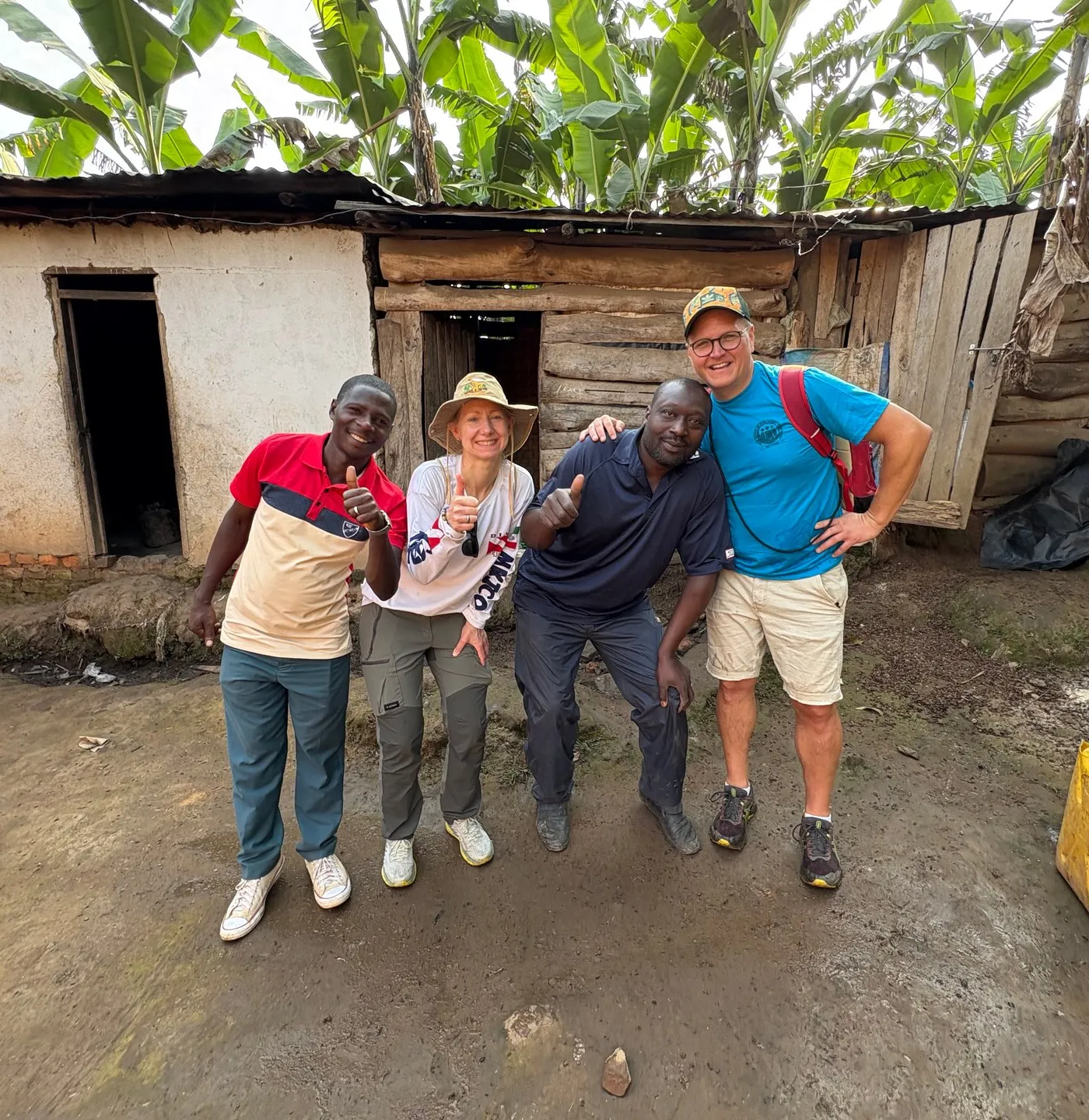
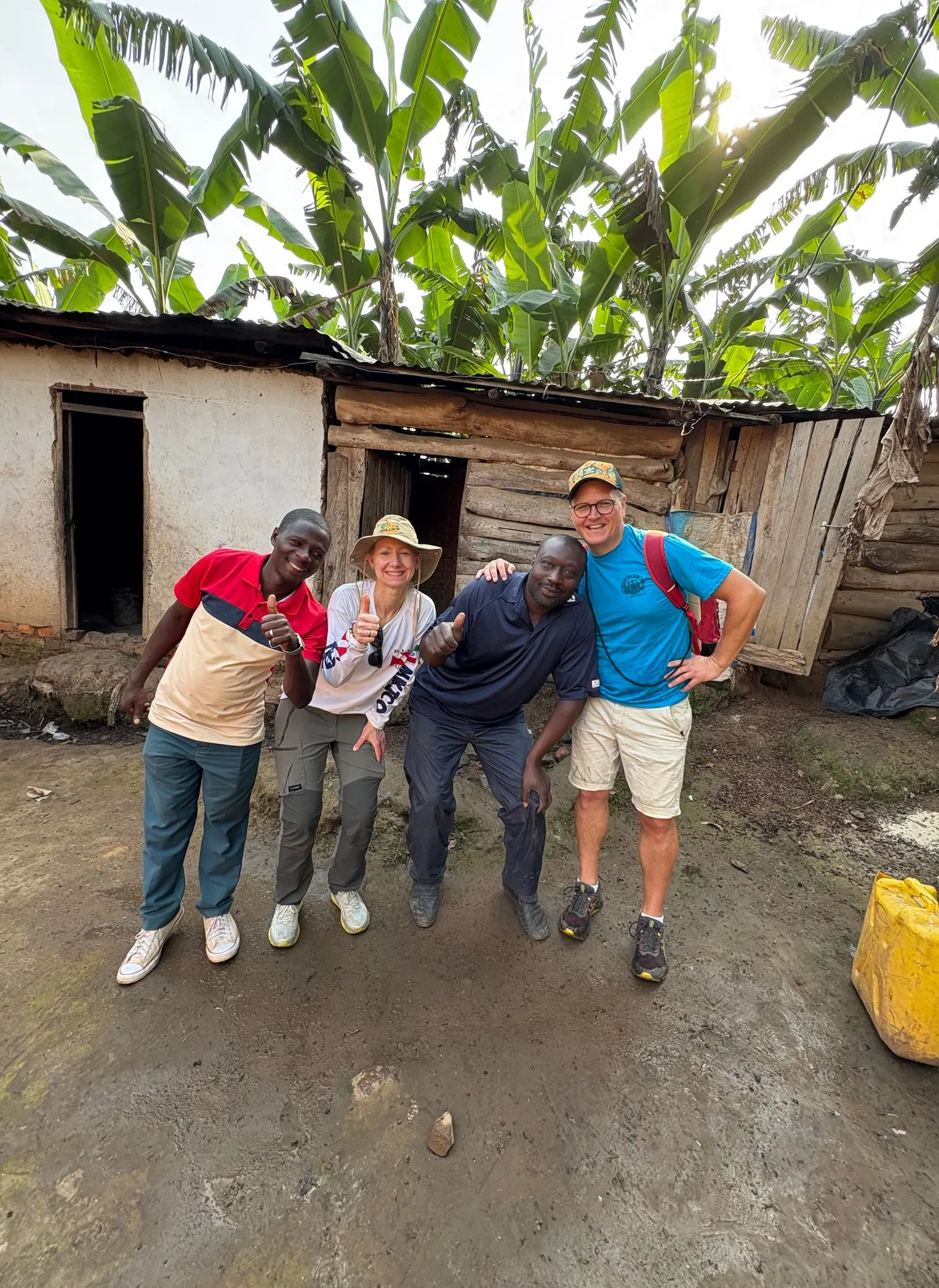
On the morning of 21 June 2026 — just before seven, the forest still wrapped in overnight mist — I found myself standing in a small compound on the edge of Buhoma village, watching a chicken farmer introduce us to his newest batch of chicks. The farmer had built his operation with care: clean enclosures, a clear feeding routine, and a visible pride in what he had created. He lifted one of the chicks with the ease of someone who had held thousands of them, and held it out for us to see. We had come to his farm because we were looking for chickens to buy for the nearby orphanage — some for eggs, some eventually for meat, and a few to raise and sell. When there is chicken for dinner at the orphanage, it is an occasion.
I photographed his farm that morning at GPS coordinates -0.9713°N, 29.6142°E. I mention the coordinates not as a technical footnote but because they are evidence of something that matters: I was physically there, in that compound, in that community, on that date. In a landscape where travel content is often assembled from secondary sources and stock images, the GPS tag is a statement of presence. This guide is written from six visits to Buhoma, including eleven days on the ground in January 2026 and a further stay in June 2026.
I mention the chicken farmer because he illustrates something important about Buhoma that rarely makes it into trekking guides. Buhoma is a village first and a trekking gateway second. The gorilla permit and the UWA gate are the formal entry points to Bwindi. But the village surrounding them — its market, its local businesses, its orphanage and its neighbourhood — is where the texture of the experience actually lives. For a first-time visitor, that context changes everything.
How Fit Do You Actually Need to Be?
The honest answer is: fitter than you might expect, but not as fit as you might fear. Gorilla trekking in Bwindi is not a walk in a managed park. The terrain is steep — genuinely steep, with sections that require both hands at times and long descents where the path narrows to a metre-wide cut through dense vegetation. The forest floor is a combination of compressed leaf litter, exposed roots, and red clay soil that becomes slippery when wet. On drier days the surface is firm and manageable; after rain, the same clay becomes a slide.
What varies enormously — and what no guide can tell you in advance — is how far you will actually have to walk on a given day. Gorillas move, and the trek to find them follows their actual position rather than a fixed route. Some trekking groups reach their assigned family within forty-five minutes and return to the gate before noon. Other groups walk for five or six hours before finding the gorillas. The ranger team tracking the family on the previous day radios in the gorillas' overnight location each morning, which is how the briefing team can give you a rough estimate. But a rough estimate is all it can ever be.
What this means practically: first-time trekkers should plan for a full day and train accordingly. If you can walk for three to four hours on uneven terrain without significant difficulty, you are adequately prepared for an average trek. If you have any doubt, hire a porter. Porters are available at the Buhoma park gate for around USD 15 to 20 per trek. They carry your bag, steady you on steep descents, and provide a second pair of hands on technical sections. Hiring a porter is not a concession to weakness — many experienced and fit trekkers hire one, both because it helps local families economically and because it makes the experience genuinely more enjoyable.
The ranger and guide team is experienced at managing groups of mixed fitness. The objective is to get eight people to the gorillas and back safely, not to set a pace record. Rests are taken when needed, and the guides carry first aid equipment and communication devices. The Uganda Wildlife Authority policy is that if a trekker cannot continue, they are escorted back to the gate while the rest of the group continues — a permit is not forfeited because one person in the group cannot complete the trek.
Gorilla Permits — What They Cover and How to Book
A gorilla trekking permit in Bwindi is issued by the Uganda Wildlife Authority and priced at USD 800 per person for foreign non-residents — this is the standard permit covering the vast majority of treks. The Gold Habitat Experience (GHE) permit at USD 1,500 provides a longer encounter and a smaller group. For most first-time visitors, the standard permit is the appropriate choice.
The permit covers the UWA briefing at the park gate, the services of a ranger and guide for the duration of the trek, the one-hour encounter with the assigned gorilla family, and the park entrance fee. It does not cover transport to or from the park, accommodation, porter hire, or tips for your guide, ranger, and tracker. When budgeting, add USD 20 to 30 for a porter (strongly recommended), USD 30 to 50 in tips for a group of two across the guide and ranger team, and your accommodation costs.
Booking strategy depends on when you are travelling. For July, August, and the Christmas-New Year window, permits can be fully allocated months in advance — three to six months of lead time is appropriate. For the shoulder months (February, June, September, October), lead times vary. For the wet-season low (April, May, November), permits are often available at shorter notice. Booking is done directly through the Uganda Wildlife Authority website or through an accredited tour operator.
Each habituated gorilla family can receive a maximum of eight visitors per day. Bwindi has multiple habituated families across its four sectors — Buhoma, Ruhija, Rushaga, and Nkuringo. When you book, you are allocated a specific family in a specific sector. For a first-time visitor staying in Buhoma, the Buhoma sector families are the natural choice: the park entry point is walkable from most Buhoma lodges and the logistics are straightforward.
What to Pack for Your First Gorilla Trek
The packing list for a gorilla trek in Bwindi is shorter than most multi-day trekking experiences require, because the one-hour encounter limits time in the forest — but the physical conditions of the approach trail mean that the quality of your footwear and waterproofing matters enormously.
Footwear is the single most important decision. Hiking boots with ankle support and a grip sole suited to wet clay are the minimum. Trail runners are adequate on dry-season treks but inadequate in the wet season, when clay sections become genuinely slippery. Rubber boots are useful in wet conditions; some trekkers carry both and switch depending on the terrain. Your lodge or guide team can advise on current trail conditions before you leave.
Long trousers and long-sleeved shirts protect against vegetation — particularly stinging nettles and thorns on the trail margins — and against safari ants, which move in large columns across the forest floor. A lightweight waterproof jacket that packs into a daypack is essential regardless of season. The morning drive or walk to the park gate is often cold at Buhoma's elevation of around 1,500 metres, and the forest interior is consistently cooler than the village.
Lightweight gloves protect against thorns and nettles without adding much weight. Trekking poles are permitted and useful on steep sections; most Buhoma lodges keep a supply available for guests. Additional essentials: one litre of water, snacks or a packed lunch for longer treks, sunscreen, insect repellent, and a camera. Flash photography is not permitted during the gorilla encounter; a camera capable of good natural-light performance is worth considering before you travel.
What the Trek Day Looks Like — From Briefing to Encounter
The briefing takes place at the Uganda Wildlife Authority park gate at 07:30. Arrive on time — the briefing begins promptly and trekking groups are divided and dispatched before eight o'clock. At the briefing, a UWA ranger introduces your gorilla family: its name, the number of individuals, the silverback's name, and the overnight location reported by the tracking team that morning. The ranger describes the approximate difficulty of the day's trek and takes questions.
Porter hire happens at the gate. If you intend to hire one — for a first trek, the default answer should be yes — porters are available at the gate and you can select one before departure. Agree on the fee upfront; tips are separate and genuinely valued.
The trek begins immediately from the gate. The initial terrain is often the steepest — a climb out of the valley floor that many trekkers find is over within twenty minutes and more manageable than it looked from the bottom. The forest closes in quickly. The ranger team uses hand signals once gorilla signs are detected — broken vegetation, fresh dung, the particular quiet that falls when a large animal is nearby.
When the ranger makes contact with the gorillas, you are asked to put on face masks (provided at the gate) and approach to within seven metres — the required minimum distance that protects the gorillas from human respiratory illnesses. The one-hour encounter begins from this point. What happens in that hour is determined entirely by the gorillas. They may be feeding in trees, moving slowly across a clearing, grooming, or nesting. Silverbacks occasionally display — chest beating, short charges — which is alarming the first time and extraordinary every time after. Young gorillas climb on adults with a casualness that suggests they are entirely unimpressed by the presence of eight humans with cameras.
After one hour, the guide signals the end of the encounter and the group returns to the gate. The return trek uses the same path in most cases, though guides sometimes choose a different route to avoid the steepest sections when the group is tired. The return is typically faster than the ascent. Most trekkers are back at the gate by midday to early afternoon.
Buhoma Village — Beyond the Park Gate
For a first-time visitor to southwest Uganda, Buhoma presents a choice that is rarely discussed in trekking guides: whether to treat the village purely as a logistics base for the gorilla trek, or whether to engage with the community that surrounds the park gate. My visits across January and June 2026 — eleven days in the village across multiple stays — have consistently pushed me toward the second approach, and I think the difference in the quality of the experience is substantial.
The chicken farmer visit I described at the opening of this article happened on the morning of a trek day. We drove to his compound along a track above the village, watched how he managed the enclosures, and purchased chicks for the orphanage nearby. He and his family were not a tourist attraction; they were neighbours of the orphanage and part of the informal economic network that keeps the community functioning. That encounter was made possible by being in Buhoma for more than one night and by having established relationships with people who could make the introduction.
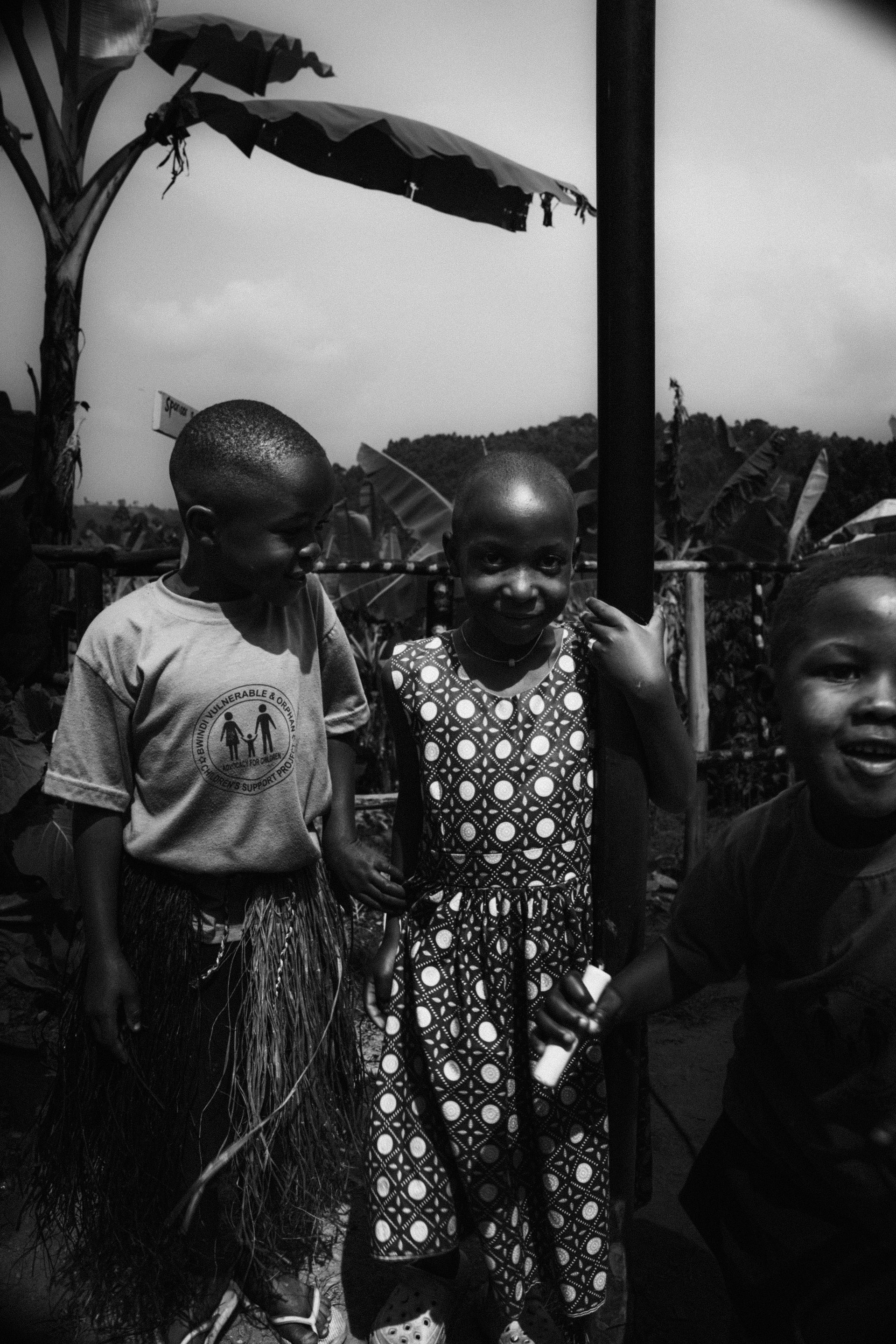
On a separate morning during the same visit, I noticed three children from the orphanage's neighbourhood standing near the entrance — slightly hesitant, their clothes worn, hovering between curiosity and uncertainty. They had been drawn by the sounds of cooking. We invited them in to eat. Moments like this — unremarkable by the standards of the village, but completely outside the experience of a one-night transit visitor — are what make extended stays in Buhoma qualitatively different from a conventional gorilla trekking itinerary.
For first-time visitors, the practical implication is simple: stay at least two nights. One night gives you the trek and nothing else. Two nights gives you an evening before and a morning after — enough time to walk through the village, visit the market, speak with lodge staff, and absorb something of where you are. Buhoma is not a large place, but it has a real character that rewards a slower pace.