A short walk from the orphanage in Buhoma, a local farmer raises chickens for both eggs and meat — and supplies chicks directly to the orphanage when funds allow. During a visit in June 2026 at GPS coordinates -0.9713°S, 29.6142°E, we spent time at his operation, watched how he handles the birds, and bought a number of chicks to take back to the orphanage. This is not a tourist attraction. It is an ordinary part of Buhoma’s village economy — the kind of small-scale enterprise that exists in the gap between gorilla permit revenue and a family’s daily needs.
Quick Facts
- Gorilla permit (2026):
- USD 800 per person
- Park:
- Bwindi Impenetrable National Park
- Mountain gorillas (global):
- Over 1,000 individuals
- Mubare family:
- Habituated since 1993 — Buhoma sector
- Farmer visit (GPS):
- -0.9713°S, 29.6142°E · June 2026
- Orphanage:
- Run by Nicholus & Media, Buhoma
- Revenue sharing:
- 20% of UWA park fees to communities
- Permits sold (FY 2025):
- ~42,960 (3.6% growth YoY)
A Visit to the Farm
The morning we visited the chicken farmer in Buhoma, it was already warm before seven. We drove a short distance from the orphanage along a red-dirt track and pulled up beside a simple compound: a low structure with a corrugated roof, a small yard, and the sound of chicks before we had even opened the door. The farmer was there already, moving quietly among his birds, checking on them with the focused attention of someone who takes the work seriously.
He welcomed us without ceremony and walked us through the setup. The chicks were young — days old in some cases — and kept in conditions that were clean and carefully managed given the resources available. He explained how he moves birds between enclosures as they grow, how he manages feed, and how he separates those destined for egg production from those he will sell for meat. Nothing about this was incidental or casual. This was a man who had built something functional out of very limited capital, and who understood its value precisely because the alternative — no reliable income, no protein for his household — was entirely real.
We have bought chicks from him on multiple occasions. The arrangement is straightforward: we visit, we select healthy chicks, we pay the market price, and we take them to the orphanage. There, depending on age and condition, they are raised for eggs — a reliable, ongoing food source — or eventually for meat. For a household feeding the number of children that Nicholus and Media care for, the difference between having chickens and not having them is not marginal. It is the difference between protein on certain days and no protein at all.
What made this visit worth recording is not the economics — it is the attitude. The farmer treats his birds with a level of care that would be unusual in any context. He knows each batch. He notices when something is wrong quickly enough to act on it. He has built an operation that is genuinely productive not through scale or technology but through attention and consistency. In Buhoma, where capital is scarce and margins are thin, that combination is the only viable business model.
Small-Scale Farming in a Village Like Buhoma
Buhoma is a small village in Kanungu District, southwestern Uganda, positioned at the main entrance to Bwindi Impenetrable National Park. Its economy runs on gorilla tourism — permits, guides, lodges, boda-boda drivers, restaurants, supply chains — and on subsistence farming that continues beneath and alongside the tourism layer. The two are not opposed. They are the same village operating in two modes at once.
The farming that happens in and around Buhoma is predominantly small-scale. Families grow matooke — the green cooking banana that is Uganda’s staple carbohydrate — on the hillsides. They tend kitchen gardens with vegetables, beans, groundnuts. They keep goats and chickens in modest numbers. The land around Bwindi is fertile but steep, and the plots are small. There is no mechanisation. Everything is done by hand, with the knowledge accumulated over generations of farming the same hillsides.
Poultry is particularly important in this context. Chickens require less land than cattle or goats, reproduce relatively quickly, and produce protein in two forms: eggs, which provide daily yield without slaughter, and meat, which can be timed to coincide with household need or a market opportunity. For the chicken farmer we visited, this dual-purpose logic is the backbone of his operation. He is not running a commercial poultry business in any industrial sense. He is running a precision micro-enterprise calibrated to the resources and demand available in a village of this size.
The connection between his farm and the orphanage is one small example of the supply chains that sustain community life in Buhoma at a level that no formal economy fully captures. These relationships operate on trust and repetition. He knows what we need. We know what he produces. The transaction is direct, the margin is fair, and the money stays in the village.
The Orphanage and the Children Next Door
The orphanage in Buhoma is run by Nicholus and his wife Media. It is not a large institution. It is a family, expanded by circumstance, operating on a budget that fluctuates with the generosity of visiting volunteers and the support of organisations like Hope on the Road. The children who live there are cared for in the direct, practical sense: they are fed, they sleep in a dry building, they attend school when fees permit.
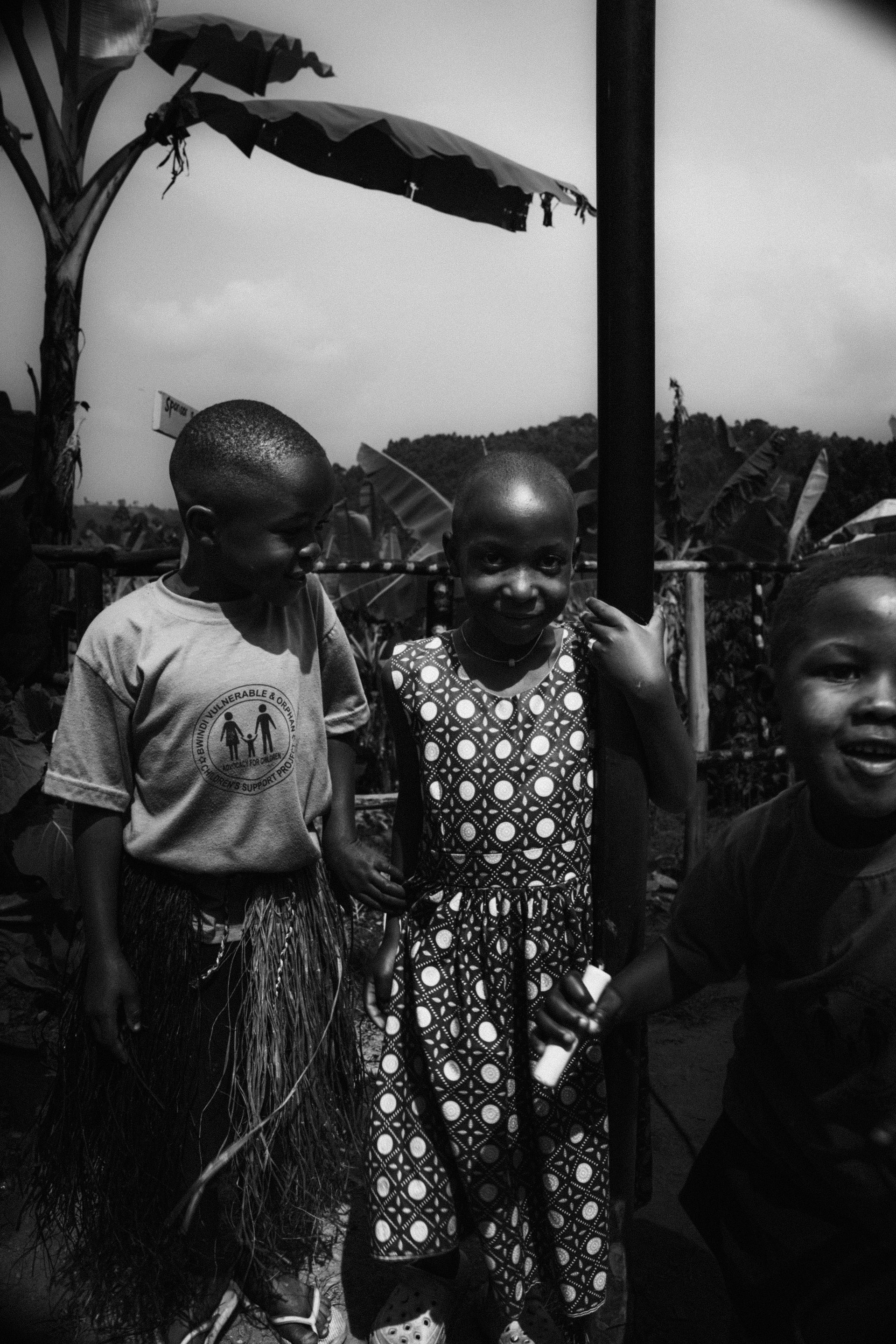
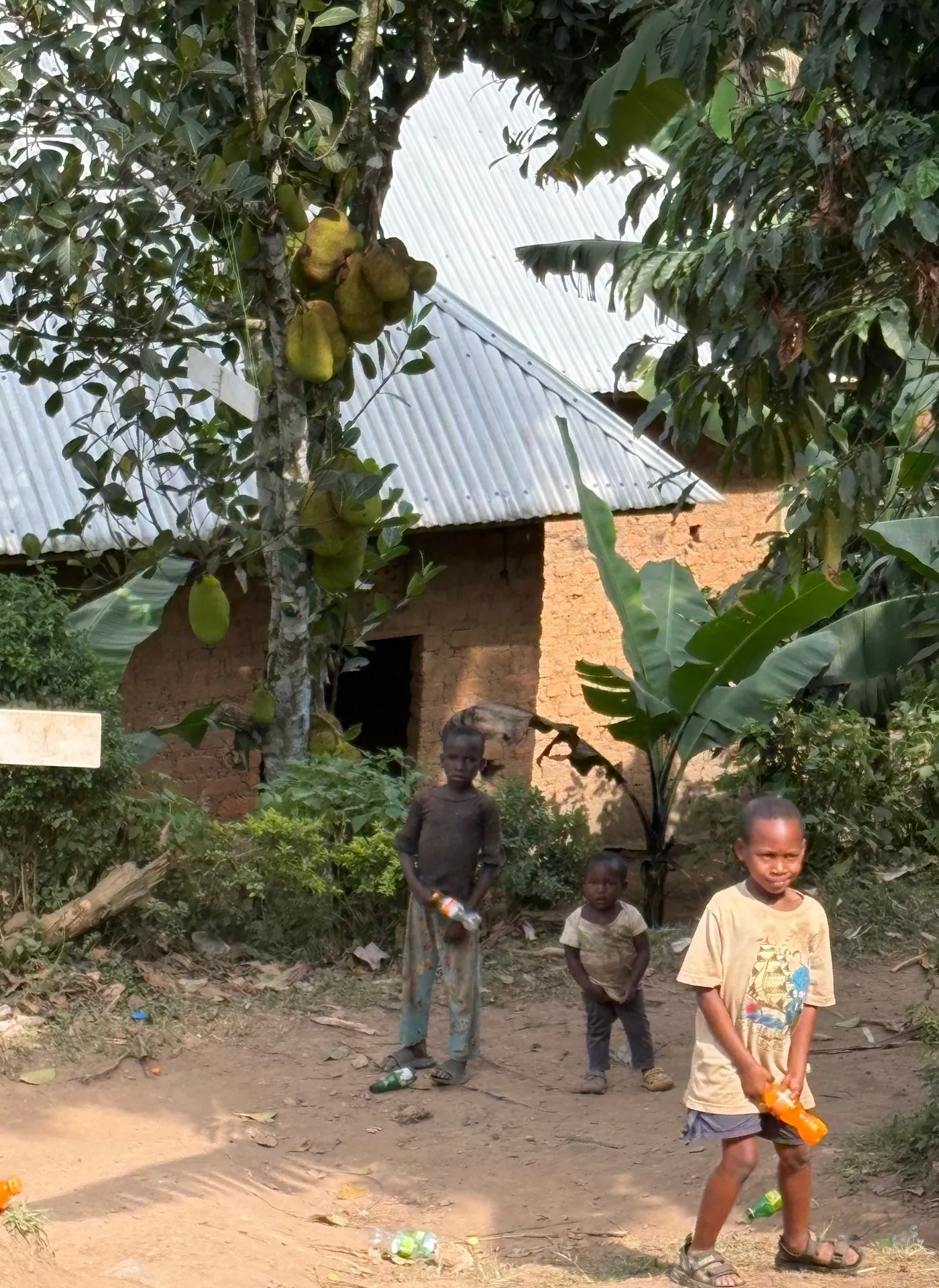
On the same morning we visited the chicken farmer, children from the neighbourhood arrived at the orphanage compound. They were not residents — they were children from nearby households who had heard that food was being prepared. Three in particular caught my attention: they were standing just outside the gate, a little unsure about coming in, their clothes worn, their posture the particular combination of shyness and hunger that is hard to misread once you have seen it. We invited them in immediately. There was enough food.
This is not unusual in Buhoma. The boundaries between the orphanage and the neighbourhood are permeable in exactly this way. The children who live inside the compound know the children outside it. They play together, attend the same school, share the same street. When there is food at the orphanage, it tends to flow outward. This is not a policy — it is the natural logic of a community that knows its own situation clearly and responds accordingly.
The three children photographed that morning — captured at GPS -0.9617°S, 29.6109°E just outside the building — were cautious at first, then relaxed once it was clear they were welcome. The oldest appeared to be eight or nine. Their energy, once the wariness passed, was immediate and completely ordinary: children who wanted to eat, to play, to be part of whatever was happening. That ordinariness is the thing that photographs like this one preserve. It is not a document of suffering. It is a document of a moment.
The chicks we buy from the farmer directly support moments like this. Not dramatically — there is no single purchase that changes a life. But consistently, across multiple visits and multiple batches of birds, the accumulation of small acts of support makes the orphanage’s food security marginally more reliable. That reliability is what matters in a context where unreliability is the baseline condition.
Gorilla Tourism and the Village Economy It Sustains
Buhoma’s village economy exists in the form it does because of gorilla tourism. The connection is not metaphorical — it is direct, measurable, and fragile. A gorilla trekking permit costs USD 800 per person (Uganda Wildlife Authority, 2026 rate). On a day when four tourists trek from Buhoma, the park collects USD 3,200 in permit fees alone. A portion of that — under Uganda Wildlife Authority’s revenue-sharing mechanism — returns to the surrounding community as investment in schools, health infrastructure, and local services. The rest funds park management and ranger salaries, which in turn keeps the forest intact and the gorilla families habituated.
But the most visible economic impact flows outside the formal mechanism. The guide who leads the trek earns a daily fee. He buys lunch at a village restaurant. The restaurant owner buys matooke from a hillside farmer. The boda-boda driver who transferred the tourists from their lodge earns his commission. He buys fuel from the village pump. The fuel is supplied by a truck from Kabale. The truck driver stops for a meal. The economy is circular in the real sense: money enters through tourism and distributes itself through the ordinary transactions of daily life.
The chicken farmer sits inside this circuit. He is not a direct beneficiary of gorilla permit revenue. But the village that sustains his operation — the people who can afford to buy his eggs and chicks, the orphanage that has access to visiting volunteers with purchasing power — exists in the form it does because tourism generates economic activity in Buhoma at a level that would otherwise be impossible for a village this remote and this small.
This connection becomes visible when tourism stops. Norman Noel, a boda-boda driver in Buhoma, described what happened during the 2022 Ebola scare: visitors stopped coming, income evaporated across the village simultaneously, and households that had built routines around the tourism economy found themselves without the cash flows they depended on. The chicken farmer’s operation did not collapse — he still had his birds — but the customers with disposable income to buy eggs or chicks at a fair price were suddenly absent. The whole system runs on the same engine.
The Gorillas That Make This Possible
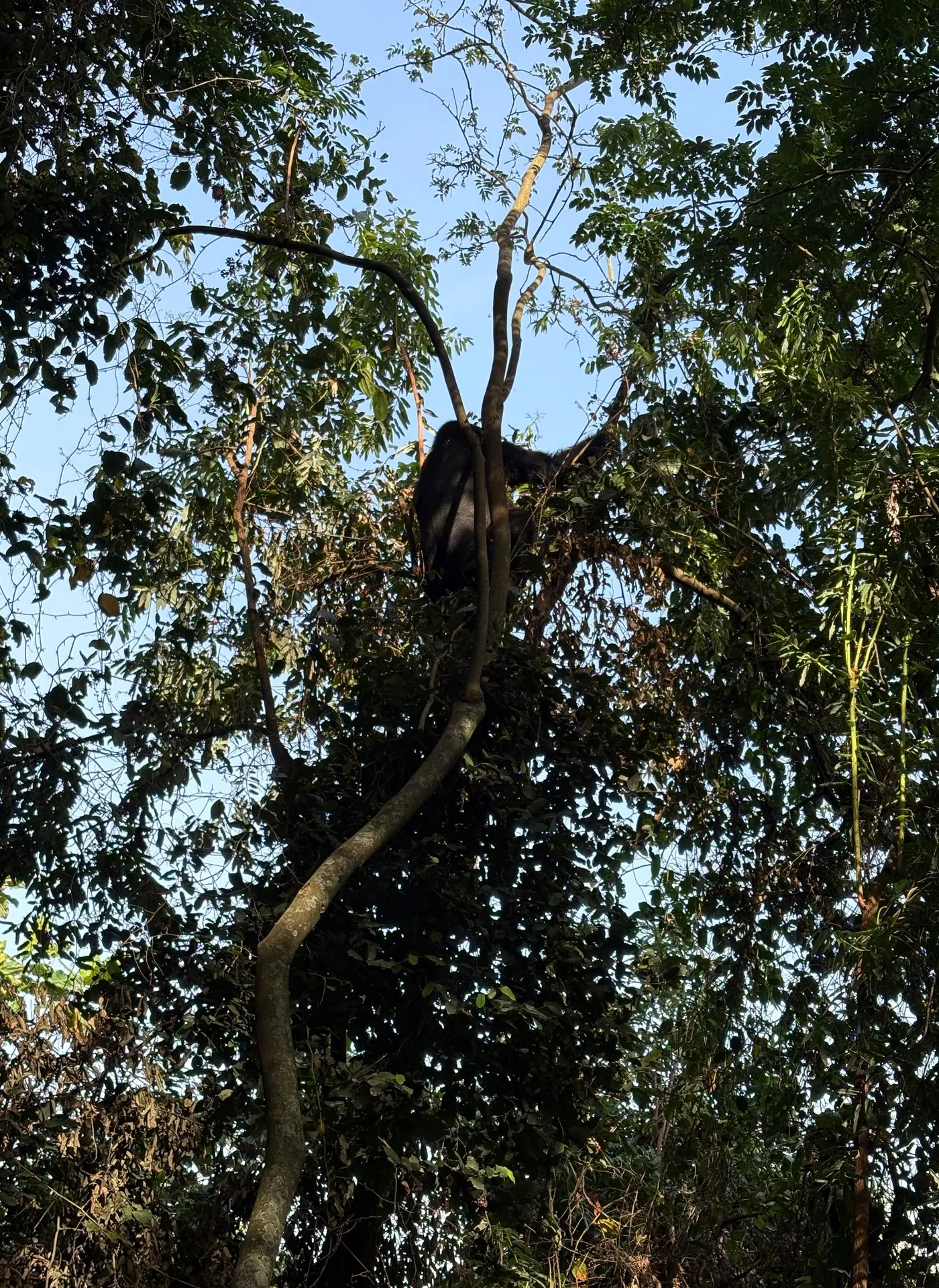
On the same visit to Buhoma in June 2026 — the morning we spent with the chicken farmer, the afternoon we walked through the village — we also completed a gorilla trek inside Bwindi Impenetrable National Park. The first gorilla we encountered was feeding in the tree canopy, sitting in the branches of a large forest tree and pulling leaves toward him with an unhurried deliberateness. I photographed him at GPS -0.9735°S, 29.6281°E. He was perhaps fifteen metres above us, paying the group below no particular attention.
Bwindi Impenetrable National Park holds more than half of the world’s remaining mountain gorillas. The global population is now above 1,000 individuals — a remarkable recovery from the sub-300 counts of the 1980s that prompted emergency conservation intervention. The Buhoma sector, in the northwest of the park, has been the main gateway to gorilla trekking since Uganda Wildlife Authority began opening habituated families to visitors. The Mubare family, habituated since 1993, is among the most established in the park.
Uganda sold approximately 42,960 gorilla permits in the 2025 fiscal year — around 3.6 percent more than the year before. For a village the size of Buhoma, this is not a statistic. It is the number of paying visitors who passed through the gate, hired guides, ate at restaurants, transferred on boda-bodas, and bought eggs from farmers whose operations depend on that spending reaching them, one transaction at a time.
What Visitors Can Do
Most visitors to Buhoma spend one morning gorilla trekking and leave the same afternoon. The permit is the reason to come, and the logistical reality of a long drive back to Kampala or Kigali makes a short stay feel reasonable. But Buhoma rewards the extra day in ways that are entirely different from the park experience — and the village economy benefits significantly from every additional night a visitor spends there.
Community walks, organised through local guides, are the most direct way to encounter the village economy as it actually operates. A guided walk takes visitors through the market, past the fuel station, up the hillsides to farming plots, and sometimes — with the right guide and the right approach — to meet local entrepreneurs like the chicken farmer. These are not staged encounters. They are conversations with people who are doing ordinary things and who are generally happy to explain what those things involve to someone who is genuinely curious.
Buying locally — from the market, from food stalls, from farmers when the opportunity arises — puts money directly into the hands of the people who need it most immediately. It also connects visitors to the texture of village life in a way that no lodge or park experience can. The chicken farmer does not have a sign outside his compound. He is not listed in any guidebook. He is findable through relationships: ask a guide, explain what you are interested in, and the connection happens.
Support for the orphanage, for organisations like Hope on the Road, and for the social projects they run operates on a similar logic of directness. There is no intermediary, no administrative layer between a donation and the chick it buys. This directness is both the vulnerability and the strength of small-scale aid: it depends on sustained personal attention, but it also means that the impact is visible, immediate, and verifiable.
Tourism in Bwindi works best when visitors understand that the gorillas are the reason to come and the village is the reason the gorillas are still there. The communities surrounding Bwindi have been partners in the conservation of the forest since Uganda Wildlife Authority formalised revenue sharing in the early 1990s. The chicken farmer, the orphanage, the children who walked in for lunch that morning — they are all part of the same ecosystem as the gorilla in the canopy. Not metaphorically. Structurally.