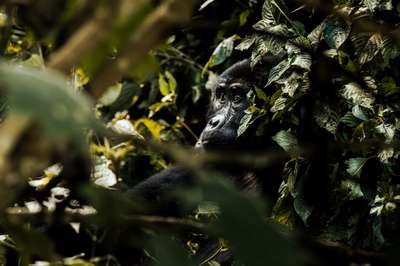
Gorilla trekking in Bwindi means hiking into a UNESCO World Heritage rainforest until rangers locate a habituated gorilla family — then spending one hour with them at close range. The permit costs USD 800 and includes a guide, tracker, trail cutter, and armed ranger. There are four trekking sectors; Buhoma in the north is the most established. Uganda's Bwindi holds 459 gorillas — more than half the world's remaining mountain gorilla population. The encounter takes place at a minimum distance of seven metres. The trek itself lasts one to six hours each way depending on where the family has ranged since the previous day.
Quick Facts
- Standard gorilla permit (2026):
- USD 800
- GHE permit (Rushaga only):
- USD 1,500
- Maximum group size per trek:
- 8 people
- Encounter time (standard):
- 1 hour
- Encounter time (GHE):
- 4 hours
- Trek briefing time:
- 7:30 am daily
- Minimum distance from gorillas:
- 7 metres
- Mountain gorillas in Bwindi:
- 459 (2018–2020 census)
- Trekking sectors:
- 4 (Buhoma, Rushaga, Ruhija, Nkuringo)
- Park altitude range:
- 1,160–2,607 m
- UNESCO World Heritage Site:
- Since 1994
- Permit includes:
- Park entry, guide, tracker, trail cutter, armed ranger
- Trek approach time:
- 1–6 hours walking
The Mountain Gorillas of Bwindi — What You Are Actually Going to See
Mountain gorillas (Gorilla beringei beringei) are, by every measure, among the rarest large animals alive. The most recent census of the Bwindi population, conducted across 2018 to 2020, recorded 459 individuals — 320 adults and 139 juveniles and infants — across the park's four trekking sectors. The combined mountain gorilla population across Bwindi and the Virunga Conservation Area (shared between Uganda, Rwanda, and DRC) exceeds 1,060 individuals. This is the entire world population of the subspecies.
These gorillas have been habituated. This is the critical word in understanding gorilla trekking. A wild gorilla family that has not been habituated will flee from human contact, or — if the silverback decides the group is being threatened — charge. The habituation process takes two to three years of daily patient visits by researchers and rangers, gradually reducing the family's alarm response until human presence is accepted as non-threatening. Only fully habituated families are available for tourist trekking.
In Bwindi's four trekking sectors, approximately twelve gorilla families are currently habituated for tourism, with additional families in habituation for the Gorilla Habituation Experience. Each family is assigned a team of trackers who locate the family each morning before the tourist trekking begins — this is why trek durations vary so much. If the family has ranged uphill overnight, the approach takes longer; if they have moved downhill toward the park boundary, the approach is shorter.
The size of habituated families at Buhoma varies and changes over time as births, deaths, and group splits occur. The Mubare family — the oldest habituated family in Bwindi, accessible since 1993 — has fluctuated over the decades from a peak of around sixteen members to a smaller and more stable group. The Rushegura family, formed from a split with the Habinyanja group in 2002, has historically ranged at lower elevations in the forest and is sometimes encountered on relatively shorter treks. Family composition on any given trek day is confirmed at the morning briefing.
What Gorilla Trekking Actually Involves — The Day in Sequence
The January 2026 trek from Buhoma provides a concrete illustration of what the day looks like. The lodge at Gorilla Bluff provided an early breakfast before six-thirty. The drive from the lodge to the park gate and briefing area took approximately ten minutes. Other trekkers assembled at the briefing point — a covered outdoor area near the main UWA building in Buhoma — until the full group was gathered.
The briefing itself lasted about half an hour. The chief ranger explained the rules: stay together as a group, move quietly when near the gorillas, maintain the seven-metre minimum distance at all times, do not eat or drink in the presence of the gorillas, cough or sneeze into your elbow and away from the animals, do not use flash photography. The guide for the day introduced himself, outlined the assigned family and its approximate current position based on the morning tracker report, and explained roughly where the trek would take them in the forest.
The trek began at the park boundary and immediately entered the forest. The path — cut by rangers and maintained across months of trekking use — runs through vegetation that requires constant physical engagement. You push through overhanging branches, step over roots, use your hands on steeper sections, and follow the guide's line through the undergrowth. The forest is dense enough that visibility ahead of the group rarely extends more than twenty or thirty metres.
After approximately fifty minutes of walking, the guide stopped and signalled silence. The tracker ahead had located the family. A juvenile gorilla was visible in a tree about eight metres from the path, feeding methodically on leaves at roughly head height. The silverback was visible a few seconds later, seated on the forest floor ten metres to the right, watching the group with calm and unhurried attention. The full encounter at GPS coordinates 0.9748°S, 29.6281°E lasted the full allocated hour.
The silverback beat his chest twice during the encounter — a sound that carries through the forest with surprising physical force, less percussive than the name suggests, more like a heavy resonance. He was not alarmed; the chest-beat appeared to be a routine assertion of presence rather than a warning. The guide explained afterward that this was normal behaviour for this particular silverback and occurred on most trekking days.
Several juveniles were active throughout the hour: moving through lower branches, tumbling, approaching and retreating from the group with the distractible energy of young animals. Two adult females were visible at various points in the undergrowth, moving more slowly and pausing to pull foliage.
The return walk took slightly longer than the outward journey. By twelve-thirty, we were back at the briefing point.
The Four Trekking Sectors — Which One to Choose
Bwindi's four trekking sectors each have a distinct character. The choice of sector determines which gorilla families you can be assigned to, which lodges are within practical reach of the briefing point, and what the landscape around the trek looks like.
Buhoma (North)
Buhoma is the most established sector, opened in 1993, and the one with the most developed community and lodge infrastructure around it. Four gorilla families are habituated for trekking here — Mubare, Habinyanja, Rushegura, and Katwe — providing up to 32 permits per day. For first-time visitors and for those who want a base that offers both gorilla trekking and genuine community engagement, Buhoma is the strongest choice. The Buhoma village, with its small shops, church, school, and emerging social infrastructure, surrounds the park gate on three sides.
Rushaga (South) and the Gorilla Habituation Experience
Rushaga has the highest number of habituated gorilla families of any sector — five available for standard trekking, plus one semi-habituated family for the Gorilla Habituation Experience (GHE). The GHE permit costs USD 1,500 and provides a four-hour encounter with a family that is still in the multi-year process of becoming fully habituated. The GHE is only available in Rushaga. For visitors whose primary objective is the most extensive and immersive gorilla encounter possible, Rushaga is the sector to choose.
Ruhija (East)
Ruhija is the highest of the four sectors in elevation — the treks here begin at altitude and move into the high-altitude afro-montane zone. Three gorilla families are available: Bitukura, Oruzogo, and Mukiza. The sector has less accommodation infrastructure than Buhoma or Rushaga and sees fewer visitors, making it the choice for those seeking genuine remoteness. Birding in the Ruhija area is considered exceptional, with several of Bwindi's endemic species most reliably encountered here.
Nkuringo (Southwest)
Nkuringo occupies the southwestern edge of Bwindi at elevations reaching 2,090 metres. The terrain is the most dramatic of the four sectors, with broad views toward the Virunga volcanoes and into the DRC. The treks here are physically demanding, and the landscape rewards the effort. Nkuringo is also the endpoint of the two-day guided walking route from Buhoma via Lake Mutanda — a route that, in dry-season conditions, is one of the most beautiful multi-day walks in East Africa.
The Gorilla Trekking Permit — Everything You Need to Know
The gorilla trekking permit is issued by the Uganda Wildlife Authority. In 2026, the standard permit price is USD 800 per person for foreign non-residents. This figure is occasionally revised; confirm current pricing directly with UWA or your tour operator when booking.
The permit covers: UWA park entry for the trekking day, a trained and UWA-licensed guide for your group, a tracker who locates the gorilla family before the trek begins and guides the group to it in the forest, a trail cutter who manages dense vegetation on difficult sections, and an armed ranger who accompanies the group for safety. The one-hour encounter with the assigned gorilla family is included.
The permit does not cover: transport to or from the park gate, lodge accommodation, the optional porter hire that is strongly recommended for steeply-routed treks, tips for the guide and ranger team, or any additional activities.
Permits are sector-specific — a permit issued for Buhoma cannot be used for a Rushaga trek, and vice versa. This means the sector must be decided before booking. The permit is also date-specific and is non-refundable in most standard booking arrangements; some tour operators offer cancellation protection as an add-on.
For peak months — July, August, and the Christmas-New Year window — booking three to six months ahead is a realistic minimum. For low season months (April, May, November), permits are often available with two to four weeks' notice. Book through the UWA website directly or through an accredited Ugandan tour operator.
Preparing for the Trek — What Actually Matters
The packing and preparation advice for gorilla trekking is remarkably consistent from every source that has actually done the trek: sturdy hiking boots with ankle support, long trousers and long sleeves for vegetation protection, a packable waterproof layer, gardening gloves for pushing through dense undergrowth, a small day pack, and insect repellent. Gaiters are particularly useful in wet-season conditions to prevent mud from entering boot tops.
Fitness matters but within a wide range. Gorilla trekking is not a technical climb; it does not require specialist equipment or training. What it requires is the capacity for sustained walking on steep, uneven ground in humid conditions for one to six hours. For visitors whose fitness is uncertain, hiring a porter at the departure point is strongly recommended — the porter carries your pack, helps with balance on difficult sections, and makes the physical experience significantly more manageable. The cost is modest and the income goes directly to the porter and their family.
Health protocols are strictly enforced. Trekkers who are visibly sick with cold, flu, or any respiratory illness are required to stand back from the gorillas or may be turned away from the trek entirely. Gorillas are highly susceptible to human respiratory diseases — a cold transmitted to a gorilla family can spread rapidly and kill juveniles or infants. The seven-metre minimum distance rule exists for this reason, not for visitor safety. Coughing or sneezing in the presence of gorillas should be done into your sleeve, away from the animals, and the guide should be informed.
Photography is permitted without flash. A telephoto lens (at minimum 200mm, preferably 300–400mm) is useful for frame-filling photographs at the seven-metre minimum distance, though the forest light is often low and a fast lens with strong autofocus is more important than raw focal length. Tripods are impractical in dense undergrowth. A monopod or image stabilisation in lens and body provides the most useful support.
Bwindi vs. The Virunga — Uganda's Two Gorilla Ecosystems Compared
Uganda offers gorilla trekking in two distinct ecosystems: Bwindi Impenetrable National Park in the Bwindi-Kayonza-Sarambwe forest corridor, and Mgahinga Gorilla National Park in the Virunga volcanic chain. They are ecologically distinct, with different gorilla populations that diverged thousands of years ago and are separated by approximately fifty kilometres of transformed landscape.
Bwindi has twelve or more habituated gorilla families across four sectors, a well-developed tourism and accommodation infrastructure, and the widest range of permit availability. It is the right choice for most visitors to Uganda, particularly first-time gorilla trekkers.
Mgahinga has a single habituated family — the Nyakagezi group, with eleven members including two silverbacks — that moves regularly between Uganda, Rwanda, and DRC. Mgahinga permits can only be booked a maximum of two weeks in advance due to this mobility. But Mgahinga adds volcanic landscape, golden monkey habituation experiences, and summit treks on three volcanoes — activities that are not available at Bwindi. For visitors who can leave their Mgahinga date flexible and who want the gorilla experience alongside the Virunga landscape, visiting both parks on one itinerary is entirely feasible.
Both parks charge the same permit fee: USD 800 per person in 2026. Both are managed by the Uganda Wildlife Authority. The encounter structure — seven-metre minimum distance, one hour with the family, maximum group of eight — is the same in both parks.