
Matooke is Uganda's national staple food: unripe green cooking bananas steamed or boiled and mashed into a dense, mild-flavoured dish. It is served at nearly every meal across the country — from roadside stalls in Kampala to the villages surrounding Bwindi Impenetrable National Park. Understanding matooke means understanding Ugandan daily life.
Quick Facts
- Main Ingredient:
- East African Highland Bananas (Musa AAA-EA group)
- Preparation Time:
- 45 to 90 minutes (traditional steaming)
- Served With:
- Groundnut stew, beans, meat, smoked fish
- Season:
- Available year-round throughout Uganda
What Matooke Is and Why It Matters
The first time you arrive in a Ugandan home for a meal, the centrepiece of the table is almost always the same: a firmly wrapped parcel of banana leaves, opened to reveal a pale-yellow, earthy-smelling mash that carries an entire culture within its simplicity. Matooke is not merely a food in Uganda — it is an institution. It anchors weddings, funerals, hospital visits and ordinary Tuesday dinners with equal authority. For most Ugandan households, particularly in the west and south of the country, a day without matooke would feel genuinely incomplete.
The word "matooke" refers both to the raw cooking banana and to the finished dish. The bananas belong primarily to the East African Highland Banana group, a set of cultivars developed over centuries in the Great Lakes region and found in extraordinary diversity across Uganda's hillsides. Unlike the sweet bananas sold in supermarkets elsewhere in the world, these varieties remain starchy and almost savoury even when ripe. They are harvested green — before any sweetness develops — and are never eaten raw. The transformation happens through heat: steam slowly breaking down the starch into a soft, scoopable mass that pairs naturally with legumes, meat and the richer flavours of groundnut or tomato sauces.
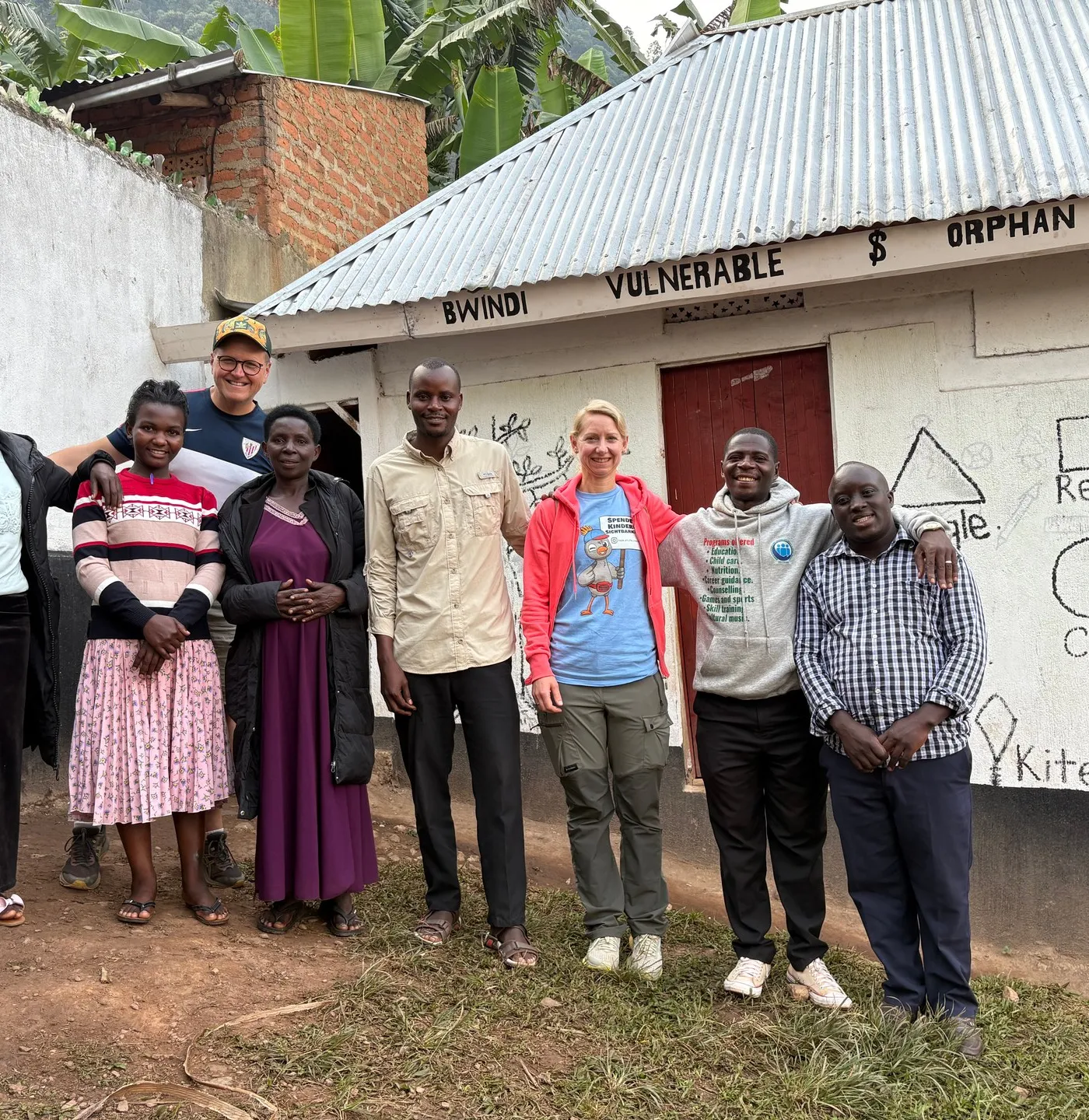
During my visits to the Buhoma area — first in October 2024, and then across longer stays in January 2026 and June 2026 — matooke appeared on the table at nearly every meal prepared for the community at the orphanage we support. It required no special occasion and no announcement. It simply arrived, wrapped, steamed and dependable.
The Traditional Matooke Recipe: Step by Step
Preparing matooke the traditional way is not complicated, but it is unhurried. The process calls for specific banana leaves for steaming, patience, and an understanding that the dish reveals itself slowly rather than all at once.
Ingredients (serves 4 to 6):
- 8 to 12 fingers of green cooking bananas (matooke variety)
- Banana leaves for wrapping (softened over an open flame or in hot water)
- Water for steaming
- A heavy pot with a lid or a traditional steaming vessel
Begin by peeling the green bananas. Unlike ripe bananas, the skin of cooking bananas clings stubbornly and can stain your hands — a small bowl of water with a squeeze of lemon helps. Some cooks use a cloth to grip and pull the skin back in sections. Once peeled, keep the bananas submerged in cold water to prevent discolouration while you prepare the rest.
Soften the banana leaves by passing them quickly over an open flame or dipping them in boiling water. This makes them pliable and releases a faint grassy fragrance that will perfume the cooking bananas as they steam. Line the pot with a generous layer of softened leaves, allowing them to overhang the sides.
Arrange the peeled bananas in a single compact layer on top of the leaves. Fold the overhanging leaves firmly over the top to create a sealed parcel. Add enough water to the base of the pot to generate steam — roughly two to three centimetres — without touching the banana bundle directly.
Cover the pot tightly and steam over a medium flame for 45 minutes. Check occasionally to ensure water has not evaporated completely. Many cooks add a second layer of leaves on top of the lid for additional heat retention. After 45 minutes, test the bananas with a skewer: they should offer no resistance. If still firm, continue steaming for another 20 to 30 minutes.
Once fully cooked, unwrap the parcel carefully — the steam trapped inside is extremely hot. Mash the bananas directly inside the banana leaf wrapping using a wooden pestle or heavy spoon. The goal is a smooth, uniform consistency with no lumps. Traditionally, the mashing happens while the package is still wrapped, preserving moisture and creating the characteristic steamed-banana aroma that rises when the leaf is finally opened at the table.
Matooke is served hot, typically with a groundnut stew (also called groundnut sauce), a bean curry, beef or goat stew, or smoked tilapia. In Buhoma and the surrounding Bwindi area, you will find it accompanied by a simple tomato and onion stew seasoned with curry powder — a straightforward preparation that lets the earthy quality of the banana speak for itself.
Matooke in the Villages Around Bwindi: From Farm to Table
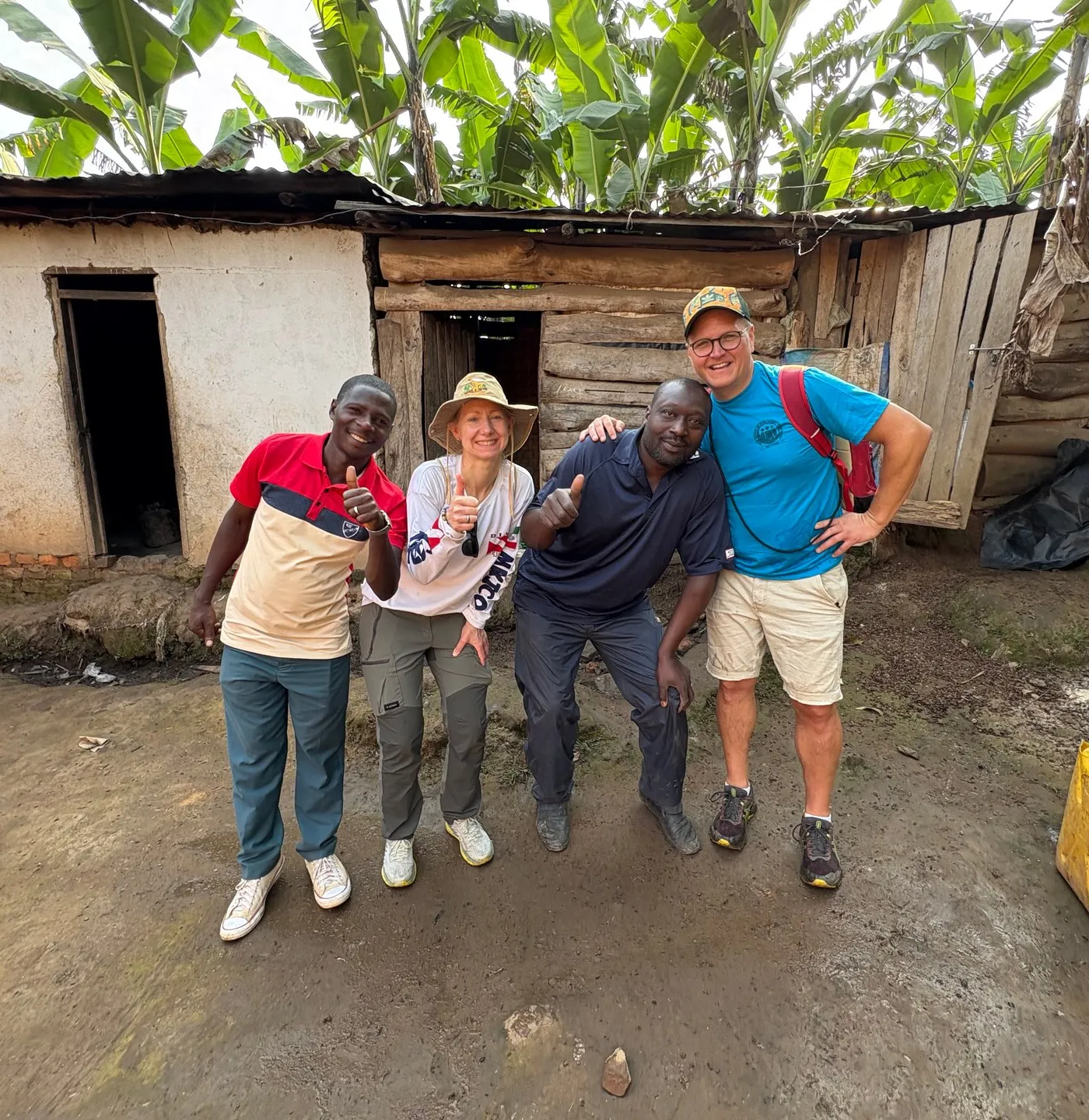
On the morning of 21 June 2026, I walked with a small group from the orphanage in Buhoma to visit a local chicken farmer who operates near the settlement at approximately GPS -0.9713, 29.6142. We had made this trip several times before — the farmer supplies chicks that are raised at the orphanage for both eggs and, when the flock grows large enough, meat. What struck me again on that visit was how deliberately interconnected the food systems are in this part of western Uganda. Nothing is abstract. The eggs collected each morning go directly into the meals prepared for the children. The matooke served alongside them was grown on the steep slopes visible just beyond the compound fence.
This is the food economy of Buhoma in its most immediate form. Subsistence agriculture and small-scale local enterprise interlock at the level of individual meals. The banana plants that produce matooke in this region grow on family plots often no larger than a quarter of a hectare, tended by women who have managed the same cultivars for generations. Bunches are harvested green, carried on the head or by bicycle to the homestead, and processed within a day or two of cutting. There is no cold chain, no packaging, no intermediary. The distance from soil to table is measured in footsteps.
For travellers visiting Buhoma for gorilla trekking, this proximity to food production is one of the quiet revelations of the village. You are not in a resort bubble. The matooke on your plate at a local guesthouse was grown within walking distance of where you are sitting. The groundnut sauce beside it came from nuts ground by hand that morning. This is not a marketing claim — it is simply how food works here.
The chicken farmer we visited that June morning was notably attentive to his birds. He tracked the chicks individually, kept careful records of which had been sold to which household and for what purpose, and spoke with evident pride about the quality of care he provided. That level of intentionality in a small-scale operation is not unusual in the Buhoma area. The community has a long relationship with practical self-sufficiency, shaped by geographic isolation and reinforced by the limited market access that characterises much of the Kigezi highlands.
The History and Cultural Significance of Matooke
East African Highland Bananas arrived in the Great Lakes region through a long process of selection and adaptation that unfolded over many centuries. The cultivars that became the foundation of matooke cuisine were developed by Bantu-speaking agricultural communities who settled the fertile volcanic soils of present-day Uganda, Rwanda and the eastern Democratic Republic of Congo. These communities identified and preserved varieties suited to high-altitude cultivation — tolerant of cool nights, capable of producing large bunches on steep hillsides, and stable enough to serve as a reliable year-round staple rather than a seasonal crop.
By the time European explorers documented the agricultural landscape of western Uganda in the nineteenth century, banana cultivation was already deeply embedded in the cultural and economic life of the great kingdoms of the region. The banana plant occupied a symbolic as well as nutritional role: the number of banana plants in a man's garden was a rough index of his wealth and social standing. Banana leaves served as plates, wrapping material, roofing material and ceremonial decoration. The juice of certain banana varieties was fermented into banana beer — a beverage with its own social codes and occasions.
Today matooke remains a key component of Uganda's consumer price index, reflecting how central it is to household food expenditure across the country. Price fluctuations in matooke are a sensitive economic indicator — a poor harvest or a disrupted supply chain from the growing regions in the south-west affects household budgets in ways that ripple through urban and rural communities alike. In the Buhoma area, where most families produce some of their own food, the banana garden is both larder and insurance policy.
The cultural weight of matooke also expresses itself in social rituals. Bringing a bunch of cooking bananas to a new mother, a sick relative or a bereaved family is a standard gesture of care across many Ugandan communities. The act of preparing matooke for a large group — a wedding, a community meeting, a funeral gathering — carries meaning beyond nutrition. It is a demonstration of hospitality and capability, and the quality of the matooke served is noted and remembered.
What to Eat With Matooke — and Where to Find It Near Buhoma
Matooke is rarely eaten alone. Its mildness and density make it a natural complement to strongly flavoured accompaniments, and Ugandan cooks have developed a rich repertoire of sauces and stews designed to pair with it.
Groundnut stew (groundnut sauce, or g-nut sauce as it is known locally) is the most common pairing. Roasted groundnuts are ground into a smooth paste, then cooked down with tomatoes, onions and sometimes green leafy vegetables into a rich, amber-coloured sauce with a nutty depth. Served over a generous portion of matooke, it is filling, affordable and genuinely satisfying.
Bean stew — made from kidney beans or small red varieties — appears at almost every meal as a protein source. The beans are cooked until very soft, seasoned with onion, tomato and salt, and spooned beside or over the matooke. In Buhoma, beans are often grown on the same small plots as bananas, intercropped to fix nitrogen in the soil and diversify the household harvest.
Smoked tilapia from Lake Edward or smaller lakes further north is a regular feature of meals in the Bwindi region. The fish is intensely flavoured from the smoking process and serves as a seasoning as much as a protein — a small amount distributed through a vegetable stew transforms the entire dish.
For visitors to Buhoma, the most direct way to eat matooke is at one of the simple local guesthouses or community canteens in the village centre. These establishments typically offer a set lunch that follows the traditional pattern: matooke, one or two sauces, perhaps a green vegetable. Prices are low by any international standard. The food is made fresh each day and served at the hour it is ready, not to a menu with fixed timings.
Some of the lodges catering to gorilla trekking visitors also incorporate matooke into their menus — often prepared to a higher standard and served alongside more familiar international options. If you want the authentic village experience, ask your guide or lodge staff to arrange a meal at a local home. This is a more intimate encounter with the dish and with the household that prepared it, and in our experience over multiple visits since October 2024, the cooks are rightly proud of what they produce.