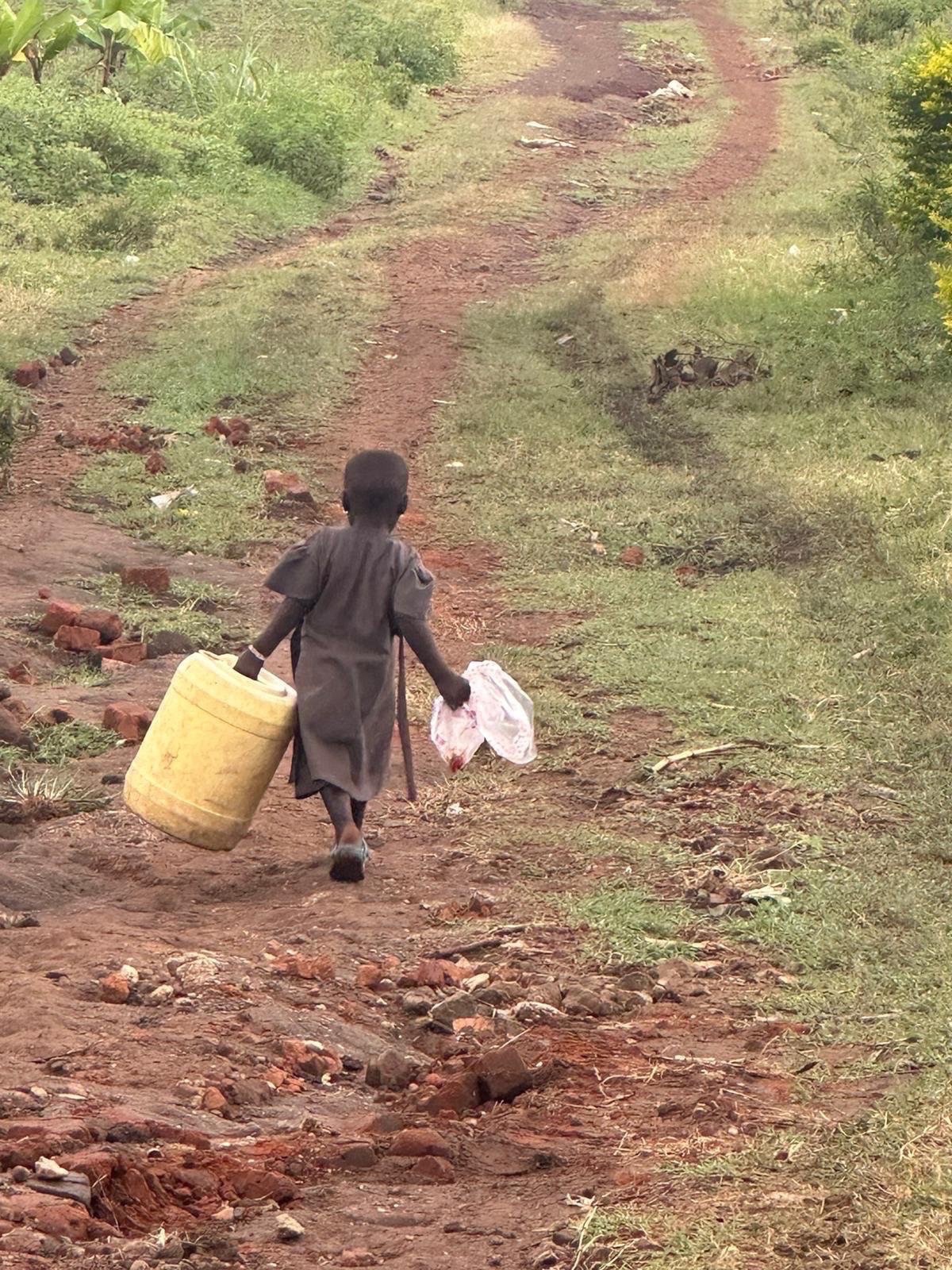
Norman is a boda-boda rider in Buhoma — one of the motorcycle taxi drivers who connect visitors, locals, and supplies across the steep hillsides of southwestern Uganda. During the 2022 Ebola outbreak in Uganda, visitors stopped arriving, permits went unsold, and drivers like Norman found themselves without income from one week to the next. This is his story, and the story of a village whose economy runs on a single engine.
Quick Facts
- Gorilla permit (2026):
- USD 800 per person
- GHE permit (2026):
- USD 1,500 per person
- Ebola crisis (Uganda):
- September–November 2022
- Boda-boda fatalities (Kampala):
- 50% of road deaths (2023)
- Boda-boda serious injuries:
- 61% of total (Kampala, 2023)
- Main national park:
- Bwindi Impenetrable NP
- Author visits (GPS-verified):
- October 2024, January 2026
- Masaka Highway renovation:
- Scheduled from 2026
The Road That Connects Everything
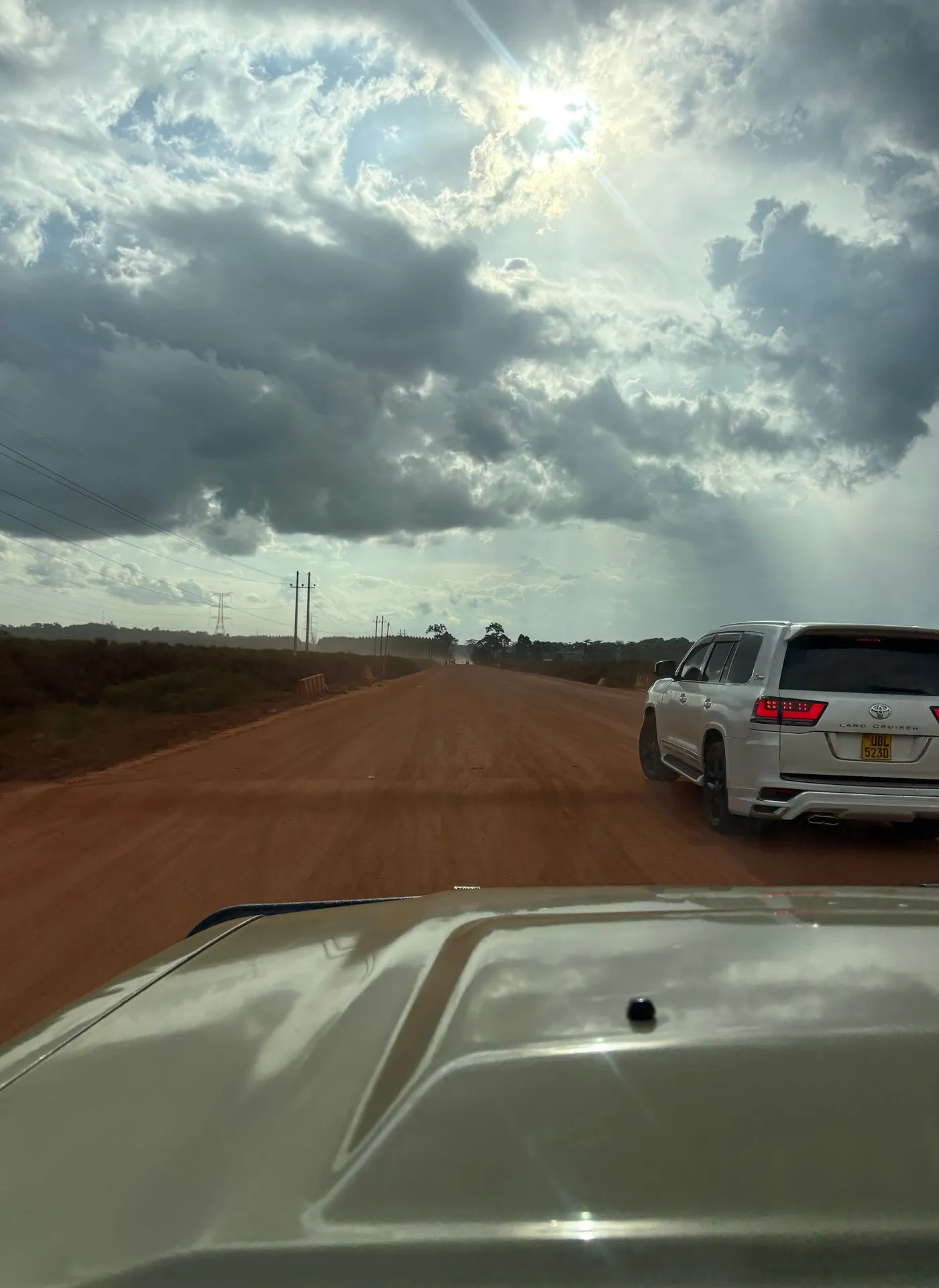
In January 2026, we drove the Masaka Highway with our driver through the flat, green countryside of Butambala district. It is a long road — dusty red laterite for much of its length, the surface ridged and corrugated after the long rains. Ahead of us, a white safari jeep followed a local rider along the same track, the dust rising in thin plumes against a sky where the sun was just beginning to push through the afternoon cloud cover. We photographed the scene at GPS 0.1019°N, 32.1645°E. The image says more about Ugandan road travel than any itinerary can: the vehicle behind, the rider in front, the long straight track disappearing into the horizon, and the dramatic light of a sky that still hasn’t decided what kind of day it wants to be.
The Masaka Highway, according to our driver, was scheduled to go into major renovation from 2026 onward. It is a long project and will take time to complete. For now, the road remains as it has been for decades — an artery through rural Uganda that the country’s boda-boda riders know intimately: every pothole, every soft shoulder after rain, every corner where oncoming trucks take their half of the road from the middle. On routes like this one, the rider’s knowledge of the surface is not incidental to the job. It is the job.
Norman operates at the other end of Uganda’s road network, in the extreme southwest. Buhoma is a village at the northern entrance to Bwindi Impenetrable National Park in Kanungu District — remote by the standards of any map, but intensely connected by boda-boda to every lodge, trailhead, and market in the surrounding hills. He spoke to us about his work in June 2026, a conversation recorded as a WhatsApp audio and used here with his knowledge. What emerged was not a simple account of hardship. It was a portrait of someone navigating a profession that Uganda’s cities have made notorious for its dangers — but which in a place like Buhoma is also the infrastructure that makes ordinary life possible.
When Ebola Came to Buhoma
In September 2022, Uganda confirmed an outbreak of Ebola Sudan — a strain of the virus that had not circulated in the country since 2000. The outbreak was declared in Mubende District, roughly 250 kilometres northeast of Buhoma, and spread over the following weeks to several more districts before containment. Uganda’s health authorities moved quickly. The outbreak was declared over in November 2022, after 55 deaths and 142 confirmed cases.
For Buhoma, the epidemiological reality was that the virus never arrived. But the tourism marketing reality was devastating. International travel advisories, embassy warnings, and traveller media coverage treated “Ebola in Uganda” as a single, undifferentiated threat. Gorilla permits that had already been sold went unused. Group bookings for late 2022 and early 2023 evaporated. Lodges that had been recovering from the COVID-19 years found themselves facing another interruption before the recovery was complete.
For Norman and Buhoma’s other boda-boda riders, the effect was immediate. Boda-boda income in a village like Buhoma is tied directly to visitor arrivals. The riders who transfer guests from the park gate to lodges, who carry guides and rangers along the hillside tracks, who collect supplies from the market and deliver them to lodge kitchens — all of that activity depends on people being present. When the visitors stop coming, the transfers stop happening. The money that would have changed hands across dozens of transactions each day simply does not enter the local economy.
Norman described the atmosphere during those weeks. The usual rhythm of the village — jeeps arriving before dawn for early permit treks, guides gathering at the park gate, riders waiting at the trailhead — was replaced by a quiet that felt wrong. Not the quiet of a dry Tuesday in low season, when things are simply slow. A different kind of quiet, one that comes from uncertainty about when things will return to normal and whether “normal” will look the same when they do.
The parallel with other crises is hard to miss. Uganda’s gorilla trekking economy has been interrupted repeatedly: by Rwanda border closures, by COVID-19, by Ebola in 2018 and again in 2022. Each time, the macro-level headline is the same — “tourism drops” — but the lived experience inside villages like Buhoma is considerably more granular. It is Norman parked at the trailhead with no one to transfer. It is a lodge kitchen buying half its usual quantity from local suppliers. It is a ranger whose patrol bonus doesn’t arrive because the park’s visitor fee income is down. The cascade of a single travel advisory through a small, tourism-dependent village is not an abstraction.
Riding in Uganda: A Profession With Real Stakes
To understand Norman’s position fully, it helps to understand the position of boda-boda riders in Uganda more broadly. In Kampala, motorcycle taxis account for roughly 50 percent of all road traffic fatalities and 61 percent of all serious injuries. Cyclists, for comparison, account for about 3 percent of road deaths. These are striking figures, and they reflect a profession that operates at the intersection of high demand, inadequate infrastructure, and economic pressure to keep moving regardless of conditions.
The dangers that characterise boda-boda riding in Kampala — high speeds on deteriorating tarmac, dense mixed traffic, insufficient helmet use, overloaded passenger loads — are partly different in character from the hazards facing a rider in Buhoma. The rural southwest has no urban traffic density, but it has its own set of challenges: steep laterite tracks that become deeply rutted in the rains, sharp descents with limited sight lines, and cargo loads — jerry cans, produce sacks, building materials — that challenge stability on gradients no urban rider encounters.
Norman, like most boda-boda riders who operate out of Buhoma, knows these routes the way a pilot knows an approach: not through instruments but through accumulated experience of exactly what the surface will do at exactly that point, in this weather, at this speed. That knowledge is the product of years, not weeks. It is also, in practical terms, the only qualification that gets checked in a profession where formal licensing enforcement is inconsistent and where the economic logic of taking the booking now — rather than declining and losing the income — is always present.
This is not a critique of Norman or of boda-boda riders generally. It is a description of a structural situation that Uganda’s road safety community has been grappling with for years. The riders who make up that 50 percent statistic in Kampala are not reckless by nature. They are doing a job that the economy needs done, under conditions that the economy has not yet made safe. The Masaka Highway, with its planned renovation from 2026, is one small part of a very large infrastructure response that is slowly underway.
Buhoma’s Recovery and What It Means for Riders
By early 2023, gorilla trekking bookings for Buhoma were recovering. The Ebola outbreak had been contained and declared over. Travel advisories were lifted. Visitors who had postponed trips began rescheduling. The lodge occupancy figures that are the invisible heartbeat of a village like Buhoma started moving in the right direction.
For Norman and his colleagues, the recovery was felt in the specific texture of daily work returning to something familiar: the predawn transfer runs, the collections from the Buhoma market area, the park gate arrivals when incoming groups need to get from a dropped vehicle to the trailhead quickly. Boda-bodas are not picturesque transport in Buhoma. They are essential infrastructure. The narrow hillside tracks that connect lodges, community facilities, and the park entrance are often impassable by four-wheel vehicles after rain — or simply too steep for a standard vehicle to manage with any efficiency. A skilled rider on a motorbike gets through.
Uganda Wildlife Authority sold approximately 42,960 gorilla permits in fiscal year 2025 — a rise of around 3.6 percent on the year before. Buhoma is one of the four main trekking sectors in Bwindi. Each permit sold at Buhoma means an arrival, a transfer, a person who needs to move through the village and who will spend money there. Norman’s income is a function of that permit counter, even though his name appears nowhere in the official statistics.
Gorilla trekking in 2026 costs USD 800 per person for a standard permit. The Gorilla Habituation Experience (GHE), which allows visitors to spend up to four hours with a family group rather than one hour, costs USD 1,500 per person. Not all of that revenue reaches the village directly. But Uganda Wildlife Authority’s community revenue-sharing mechanism returns a portion of park fees to surrounding districts, and the spending that visitors make locally — on accommodation, food, guide fees, and transport — distributes further income. The boda-boda rider is at the far end of that chain, but he is on it.
A Village and Its Moving Parts
What Norman’s story illustrates, finally, is the interconnectedness of everything that sustains Buhoma. The gorillas make the permits possible. The permits generate the visitor flow. The visitors generate the transfers, the lodge bookings, the restaurant orders, the market purchases. The riders, the guides, the farmers, the lodge staff — they are all sustained by the same engine. When the engine stops, even briefly, every person downstream feels it.
It would be possible to read that as a precarious arrangement — and it is. A single disease outbreak, a border closure, a natural disaster, a shift in travel advisories, and the whole system stalls. But it is also, in the context of a remote village in southwestern Uganda, the most functional economic model that exists. The alternative — a village with no tourism, no gorilla economy, no external income — is not more stable. It is simply poorer.
Norman chose this work because it provides income in a place where formal employment is scarce. He knows the tracks around Buhoma better than most. He knows which season makes which route impassable. He knows which lodges need early transfer runs and which guests prefer a later departure. That knowledge is years in the making. It is also what the village’s visitors, whether they realise it or not, are depending on every time they need to get somewhere in Buhoma that a four-wheel drive cannot reach.
On our visit in January 2026, driving the Masaka Highway in the late afternoon, I thought about what it means to work a road like that every day. The dust. The potholes that appear without warning. The dramatic light when the sun breaks through the cloud cover in that particular way it does over the Ugandan interior. The driver next to me knew the road. He had driven it many times. His calm was not indifference — it was competence. It was the same competence that Norman has built up on the tracks around Buhoma, and that every boda-boda rider who works a regular route possesses in the same quiet, practical way. Not glamorous. Not documented. Absolutely essential.