Cultural tourism Uganda at its most substantive is not a performance arranged for visitors — it is contact with communities on their own terms, in places where the economic and historical context is legible rather than staged. Uganda has genuine cultural assets: a chimpanzee sanctuary shaped by conservation decisions, a gorilla trekking revenue model that directly funds community infrastructure, fishing villages on Lake Victoria that have operated for generations, and an urban museum culture rooted in the colonial and independence period. What follows is a guide to engaging with these assets honestly.
Quick Facts
- Uganda National Museum:
- Established 1908 — oldest in East Africa, Kiira Road, Kampala
- Kasubi Tombs:
- UNESCO World Heritage Site — 4 Buganda kings
- Ngamba Island:
- ~95 ha forest, Chimpanzee Trust, Lake Victoria
- Bujagali Falls:
- Submerged ~2012 by dam (~250 MW)
- Jinja rafting:
- White Nile Rafting / Adrift — 125-195 USD / day
- Gorilla Conservation Coffee:
- Gorilla Conservation Café, Portal Road, Entebbe, 2018
- Amajambere Iwacu:
- Community camp, 1994, Buhoma — 2 min from UWA gate
- Mabira Forest:
- Over 300 km² — largest surviving lowland forest near Kampala
Starting Point: A Food Store in Buhoma
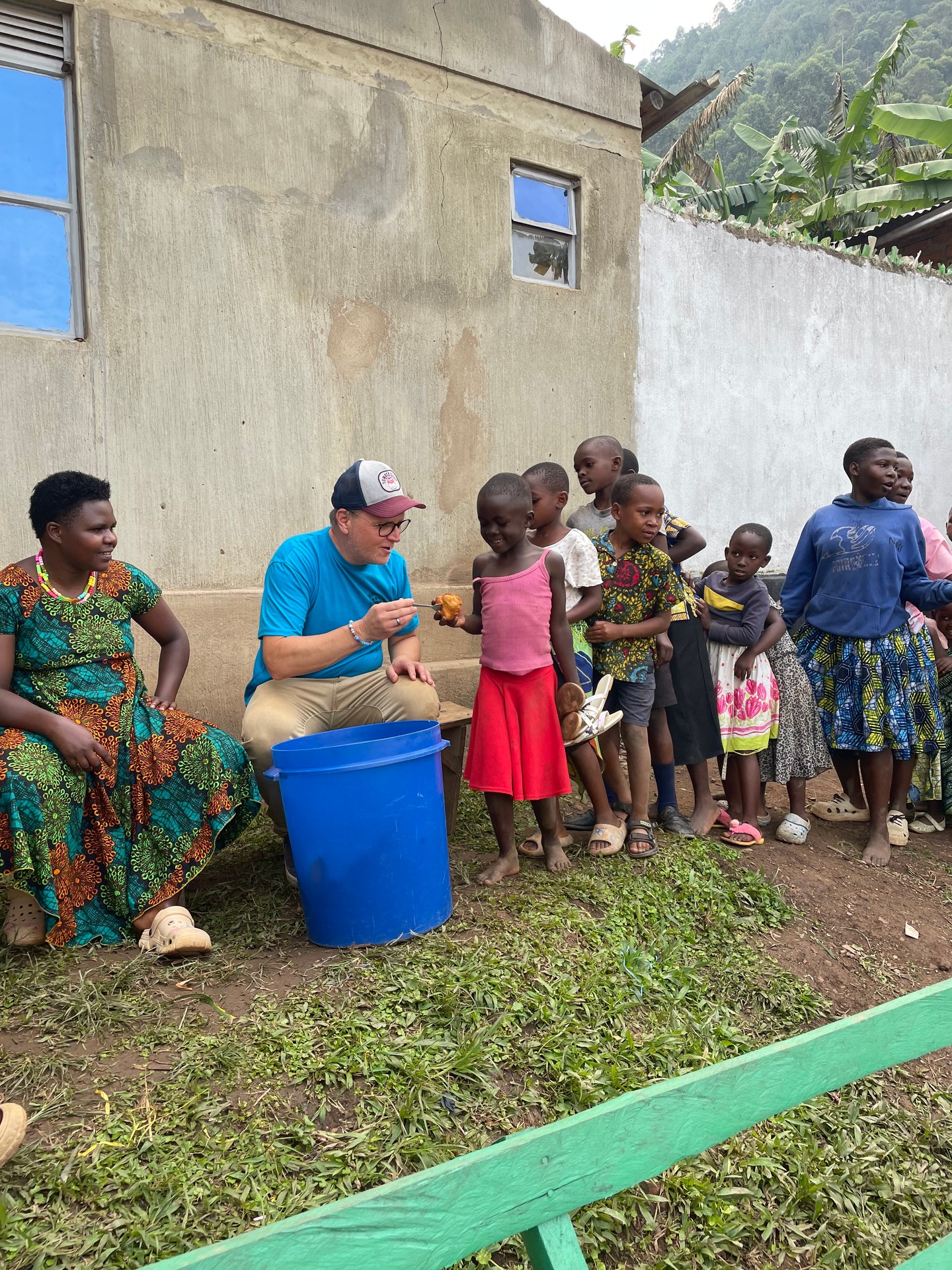
In January 2026, during a visit to a children's home in Buhoma village, we walked through a food storage room containing approximately one week's supply of staples — beans, maize flour, cooking oil, salt — for all the children in the home. The store was methodically organised, with every item accounted for, because there was no reserve. When the supply ran out, there would be nothing until the next donation arrived.
This is one version of cultural tourism Uganda rarely shows in its marketing: not the artisan weaving cooperative with its photogenic products and its transparent price list, but the children's home director calculating how long the food will last. Both are authentic. Both exist in the same village, within a short walk of the gorilla trekking gate. The question for any visitor is not which one to engage with — it is how to engage with both without making either a performance.
What Responsible Cultural Tourism Actually Means
The term "responsible tourism" has been so thoroughly used in marketing that it has lost most of its informational content. A more useful frame: responsible cultural tourism generates genuine economic benefit for local residents, not just visibility for visitors.
Practically, this means: buy directly from producers rather than intermediaries. The African Crafts Village near the National Theatre in Nakasero, Kampala, allows direct purchase from craft producers — wood carvers, bark cloth artists, weavers — with better margin retention than hotel gift shops permit. Gorilla Conservation Coffee, whose Gorilla Conservation Café opened on Portal Road in Entebbe in 2018, connects Bwindi-area coffee farmers directly to retail buyers. The Kilombera Weaving cooperative near Bujagali is an example of a community-managed production cooperative where visitor purchases create direct household income.
Orphanage tourism — visiting children's homes as a tourist activity — is well-documented as harmful to children's development, even when individual intentions are good. Research by Save the Children, UNICEF, and Lumos has established that the economic incentives created by donor and tourist visits to orphanages drive family separation, with children placed in homes that can attract funding rather than remaining with extended family. This applies in Uganda as elsewhere. The children's home in Buhoma that we visited in January 2026 is a genuine local welfare institution run by a community member, Nicholas, for children who genuinely lack family support. It is not a tourist attraction and should not be treated as one.
The practical test is straightforward: after the visit, who is better off? If the answer is primarily the visitor — enriched by a photogenic experience, emotionally satisfied by the encounter — and the community is left with little or nothing of lasting value, the activity is extractive regardless of how it is labelled.
Bujagali Falls: A Case Study in Tourism Assets Lost to Development
Bujagali Falls, on the Nile approximately 8 kilometres downstream from Jinja, was one of Uganda's most visited natural attractions before approximately 2012. A series of dramatic white-water rapids provided the setting for East Africa's most active adventure tourism economy: white-water rafting (Grade 4 to 5), commercial kayaking, a bungee platform, and a cluster of budget lodges and campsites whose clientele was predominantly independent travellers.
The Bujagali Dam (approximately 250 MW) submerged the falls. The reservoir now sits where the rapids ran. Operators who had built businesses around the natural feature — White Nile Rafting, Nalubale Rafting (formerly Adrift) — relocated to sections of the Nile above and below the reservoir. Full-day rafting trips from Jinja still run at 125 to 195 USD per person. But the original site, and the economic ecosystem built around it, no longer exists.
Bujagali is the clearest Ugandan example of a tourism asset permanently destroyed by infrastructure development. It is also the context within which the debate over Murchison Falls — where a proposed dam has been shelved but not permanently ruled out — takes place. Cultural and natural tourism assets in Uganda are not stable; they depend on policy decisions that can be reversed.
Ngamba Island and Lake Victoria's Fishing Communities
Ngamba Island Chimpanzee Sanctuary, managed by the Chimpanzee Trust, occupies approximately 100 hectares in Lake Victoria, of which roughly 95 hectares are forested chimpanzee habitat. The island was established as a permanent home for orphaned and confiscated chimpanzees that cannot be returned to the wild — individuals that arrived from the bushmeat trade, from illegal pet keeping, or from habitat destruction across Central and East Africa.
A visit to Ngamba Island — accessible by boat from Entebbe in approximately 45 minutes, GPS for the island perimeter -0.1010°N, 32.6532°E — includes observation of the twice-daily feeding session and, for a higher fee, a closer encounter with individual chimpanzees on the forest edge. The sanctuary's model is conservation-first rather than tourism-first, which gives the visit a different character from a zoo or a habituated-primate trek. The animals are not performing for visitors; visitors are watching animals that have been provided a permanent habitat because their original one no longer exists.
Lake Victoria's fishing villages, visible from the eastern shore near Entebbe, represent an older and more complex cultural tourism Uganda context. During an October 2024 visit to a fishing community at GPS -0.0847°N, 32.6508°E, the village was active with boat maintenance, net repair, and the processing of the morning catch. The Nile perch fishery that sustained these communities for decades has been significantly affected by water hyacinth coverage, overfishing, and climate-related changes in Lake Victoria's ecology. Cultural tourism that engages with these villages is engaging with communities in transition, not with a preserved traditional economy.
Batwa Cultural Integration and the Bwindi Conservation Model
The Batwa — the forest-dwelling community whose ancestral territory included Bwindi Impenetrable Forest before the park's gazettement in 1991 — are the community for whom "cultural tourism" carries the most complicated history in Uganda. Their displacement from the forest ended a way of life that had persisted for generations. The conservation model that displaced them was, and is, also responsible for protecting the mountain gorillas that are Bwindi's primary tourism asset.
The organisations working on Batwa integration include the Action for Batwa Empowerment Group, the Batwa Development Organisation, the Bwindi Batwa Development Association, and the Batwa Development Programme. The Bwindi Mgahinga Conservation Trust provides a funding mechanism that channels tourism revenue toward Batwa livelihood and education programmes.
The Batwa Trail — a guided forest experience led by Batwa community members in and around Bwindi — is the most direct form of cultural tourism engagement with this community that is currently available. It is not entertainment; it is a narrated account of displacement and adaptation told by the people who experienced it. The experience is available from the Buhoma sector gate and takes approximately 3 hours.
Visitors to the Batwa Trail consistently report that the experience is unlike any other they have had in Uganda. It is not comfortable in the way that a lodge veranda is comfortable. But it is honest in a way that few tourist activities in a national park setting manage to be.
Museums, Heritage Sites and Kampala Cultural Infrastructure
The Uganda National Museum, established in 1908 on Kiira Road approximately 3 kilometres from Kampala's city centre, is the oldest museum in East Africa. Its collections cover natural history, archaeology, ethnography, and cultural material spanning Uganda's pre-colonial, colonial, and independence periods. The museum is regularly undervisited by international tourists who pass through Kampala en route to national parks without stopping — which is a genuine missed opportunity. February, when national museum visitor numbers are at their annual low, is also the most relaxed time to visit.
Kasubi Tombs, a UNESCO World Heritage Site, hold the burial sites of four Buganda kings and remain an active religious site for the Buganda kingdom. The site was partially destroyed by fire in 2010 and has been undergoing reconstruction; current access conditions should be confirmed before visiting. The Kigali Cultural Village in Rwanda — referenced in planning documents as a model of constructed cultural heritage — provides a contrast to Uganda's approach: a purpose-built "cultural village" planned for opening in 2019 represents a different philosophy of cultural tourism than the organic community engagement that Uganda's gorilla trekking model has evolved over three decades.