The 2018 Ebola outbreak in the Democratic Republic of Congo — concentrated in North Kivu province, roughly 150 kilometres from Buhoma — caused gorilla tourism bookings in Bwindi to collapse, even though the park itself was never in a risk zone. Guides went without treks, boda-boda drivers had no transfers to make, and farmers who supplied lodge kitchens found their buyers gone overnight. During visits to Buhoma in October 2024, January 2026, and June 2026, the memory and structural consequences of that period were still clearly present in how the community talked about economic stability and external risk.
Quick Facts
- Gorilla permit (2026):
- USD 800 per person
- GHE permit (2026):
- USD 1,500 per person
- Park:
- Bwindi Impenetrable National Park
- 2018 DRC outbreak duration:
- August 2018 – June 2020
- Distance: North Kivu to Buhoma:
- approx. 150 km
- Uganda gorilla permits (FY 2025):
- approx. 42,960
- Revenue sharing to communities:
- 20% of UWA park fees
- Author visits to Buhoma:
- Oct 2024, Jan 2026, Jun 2026
- Farmer visit (GPS):
- -0.9713°S, 29.6142°E · June 2026
A Village Economy Visible From the Chicken Farm
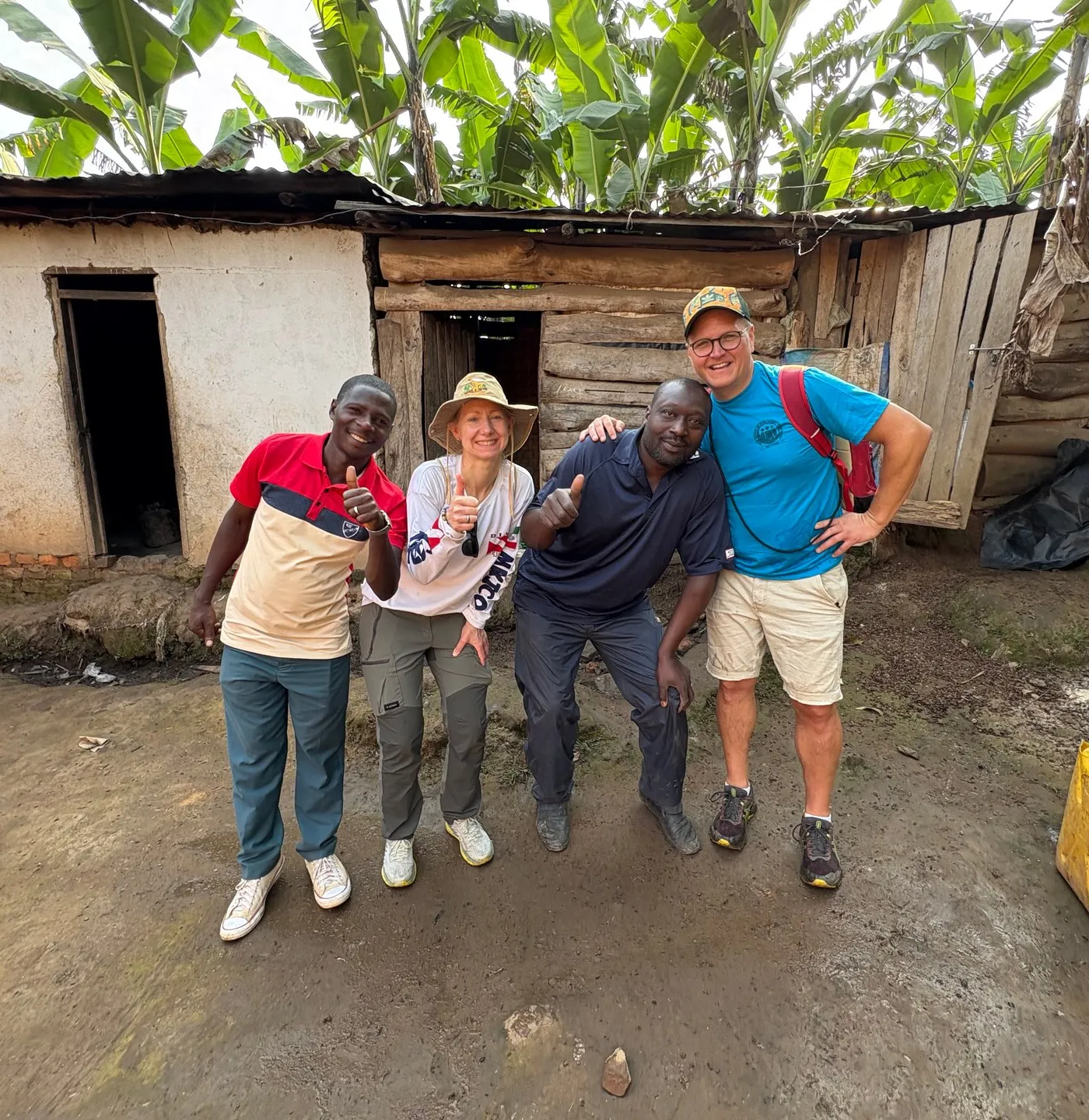
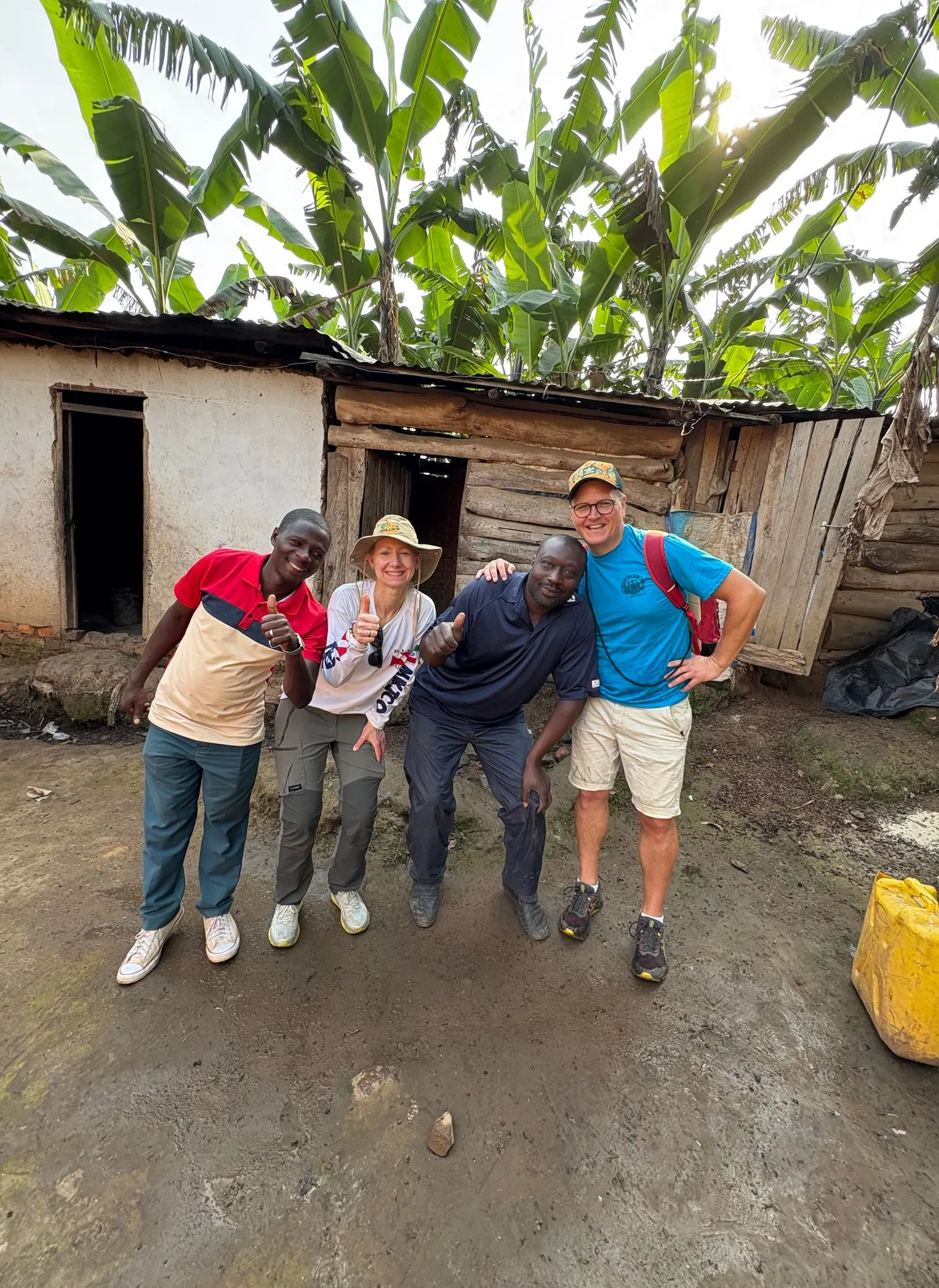
In June 2026, at GPS coordinates -0.9713°S, 29.6142°E, we spent a morning with a chicken farmer on the edge of Buhoma village. He keeps his birds in simple but clean enclosures, moves them between spaces as they grow, and manages the whole operation with the focused, low-drama competence of someone who has no margin for error. We have bought chicks from him on several visits. They go to the orphanage in Buhoma — raised there for eggs, some eventually eaten, some sold when numbers allow. Meat is rare enough at the orphanage that it functions as a small celebration when it appears on the table.
The reason this matters to an account of Ebola and tourism is direct. This farmer’s market — the people with the purchasing power to buy his eggs and chicks at a price that covers his costs — is the same market that gorilla tourism creates. Lodge kitchens that want fresh eggs. Visitors who buy food at market stalls. Guides and drivers whose daily wages circulate back into the village as ordinary spending. When tourism stops, the whole circuit stops with it. The chicken farmer does not lose his birds, but he loses the buyers who made the enterprise viable at a village scale.
In 2018, that is exactly what happened. And no one in Buhoma had any control over the reason.
The 2018 Ebola Outbreak and Uganda’s Invisible Border Problem
The Ebola outbreak that began in the Democratic Republic of Congo in August 2018 was the second-largest in recorded history. It was concentrated in the North Kivu and Ituri provinces of eastern DRC, in an active conflict zone that made containment extraordinarily difficult. By the time it was declared over in June 2020, more than 2,200 people had died, and the outbreak had been classified as a Public Health Emergency of International Concern.
Uganda shares a long border with eastern DRC. The relevant section — running along the Albertine Rift from Ishasha southward to the Virunga volcanoes — puts southwestern Uganda geographically close to the outbreak zone. Buhoma lies within this broader region, though at a substantial distance from the actual outbreak areas. For international tour operators and their clients, this distinction was largely invisible. Uganda was adjacent to DRC, DRC had Ebola, and Uganda’s marketing position collapsed regardless of epidemiological reality.
The mechanism of the tourism collapse was not a single event. It was an accumulation of cancellations, withheld bookings, and revised travel advisories from Western governments that steadily drained forward reservations from Uganda’s gorilla tourism sector. Lodges that had bookings for late 2018 and early 2019 saw them disappear. Tour operators in Kampala reported that international partners were unwilling to confirm Uganda itineraries while the DRC outbreak remained active and under international emergency declaration. The gorilla permit revenue that funds Uganda Wildlife Authority’s park management, ranger salaries, and community revenue sharing continued to flow — but at dramatically reduced volume.
In June 2019, Uganda recorded its first confirmed Ebola cases from the DRC outbreak: three members of the same family who had crossed from DRC, including a five-year-old child who died in Kasese District. Uganda’s response was rapid and technically competent — contact tracing was effective and the outbreak did not spread beyond the initial cluster. But the cases confirmed, in international media coverage, the perception that Uganda and Ebola were directly connected. Bookings that had not yet been cancelled were now cancelled.
What Economic Collapse Looks Like Inside Buhoma Village
When the tourists stopped coming, the working day in Buhoma simply stopped for entire categories of people. There were no airport transfers to make, no rides from the park gate to the lodges, no errands to run for visitors who needed supplies from the nearest town. Income that had been built around the reliable cycle of tourist arrivals and departures went to zero. People were not laid off. They were simply no longer needed, with no timeline for when that might change.
This pattern repeated across every economic layer of the village. Uganda Wildlife Authority rangers were still on salary and still managing the park. But the guides who had freelance arrangements based on trek bookings had no treks to lead. Lodge workers whose employers kept them on during lean periods were among the fortunate; those in casual or seasonal employment found themselves without income at all. The market vendors who sold goods to visiting travellers — water, snacks, crafts — had no market. The restaurants that depended on the lunch trade generated by tourist movements saw their customers disappear.
What the 2018 crisis exposed, more clearly than anything before it, was the degree to which Buhoma’s economy had been built on a single, externally controlled revenue stream. Gorilla tourism is almost entirely dependent on international visitors from Europe and North America who book trips months in advance through tour operators in their home countries. When a government travel advisory changes, or when international media makes Uganda synonymous with disease risk in the minds of potential travellers, the bookings stop long before any real threat materialises locally. The community has no ability to influence or counteract this dynamic.
The farming households in and around Buhoma were the most insulated from the immediate income shock, precisely because they had never fully integrated into the tourism economy. A family growing matooke on the hillside above the park did not lose customers in the same way a guide did. But the cash income that had been supplementing agricultural livelihoods — eggs sold to lodges, vegetables bought by restaurants serving visitors, occasional labour hired by lodges during construction — dried up as quickly as the tourist flow itself.
Bwindi Impenetrable National Park: The Conservation Stakes Behind Every Tourist
The reason Buhoma’s dependency on gorilla tourism matters at a global scale is that the gorillas themselves depend on the same revenue stream. Bwindi Impenetrable National Park protects more than half of the world’s remaining mountain gorillas. The global population is now over 1,000 individuals — an extraordinary conservation achievement after sub-300 counts in the 1980s prompted emergency international intervention. The park’s position in southwestern Uganda, at the edge of the Albertine Rift biodiversity hotspot, makes it one of the most ecologically significant protected areas in Africa.
Maintaining Bwindi as an intact forest requires sustained investment: ranger patrols, anti-poaching operations, veterinary care for habituated gorilla families, and habitat monitoring. The primary source of funding for this investment is gorilla permit revenue. A standard trekking permit costs USD 800 per person; a Gorilla Habituation Experience permit costs USD 1,500. When permit sales collapse, the funding pipeline for park management narrows, and budget constraints translate directly into reduced patrol capacity.
This is why the 2018 crisis was not merely an economic problem for Buhoma’s residents. It was also a conservation pressure. Communities that had been integrated into the tourism economy as guides, suppliers, and service providers had strong reasons to protect the gorillas and the forest that generated their income. When that income disappeared without warning and for reasons entirely outside their control, the economic logic of conservation — that the community benefits from the presence of the gorillas — was visibly weakened.
Recovery, Repetition, and What Has Not Changed
The 2018 Ebola crisis in DRC was eventually resolved. The outbreak was declared over in June 2020. By that point, however, the global COVID-19 pandemic had produced a further and total collapse of international tourism on top of the Ebola-related decline. Bwindi’s lodges were empty through 2020 and most of 2021 for entirely different reasons. Recovery, when it came, was gradual and uneven.
When I visited Buhoma for the first time in October 2024, the tourism economy was functioning again. Lodges had guests, the park gate was processing permits, guides were working. But conversations during that visit and during a longer stay in January 2026 made clear that the memory of the 2018 to 2021 period had not been forgotten — it had been filed as a permanent risk. People who had built businesses around tourism had done so with a specific awareness that the external triggers of a collapse were entirely beyond their control.
A further Ebola outbreak in Uganda in late 2022 — the Sudan strain, appearing in Mubende and Kassanda districts in central Uganda, over 200 kilometres from Bwindi — produced a new, smaller wave of cancellations and upgraded travel advisories. The villages around Bwindi were again not in any genuine risk zone. The perception damage was real regardless. Guides described a sharp drop in group sizes and an increase in last-minute cancellations through the final months of 2022. Recovery took months.
The structural vulnerability has not changed. Gorilla tourism in Bwindi depends on international visitors who make booking decisions months in advance and who respond to government travel advisories and media coverage that may bear little relationship to conditions on the ground in Buhoma. Any disease outbreak, security incident, or political event in a broad region that includes Uganda can trigger a booking collapse that is felt immediately and disproportionately by the people most dependent on tourism income. The farmer selling chicks to the orphanage, the boda-boda driver, the freelance guide — they absorb the shock that originates in a decision made in London or Berlin or New York.
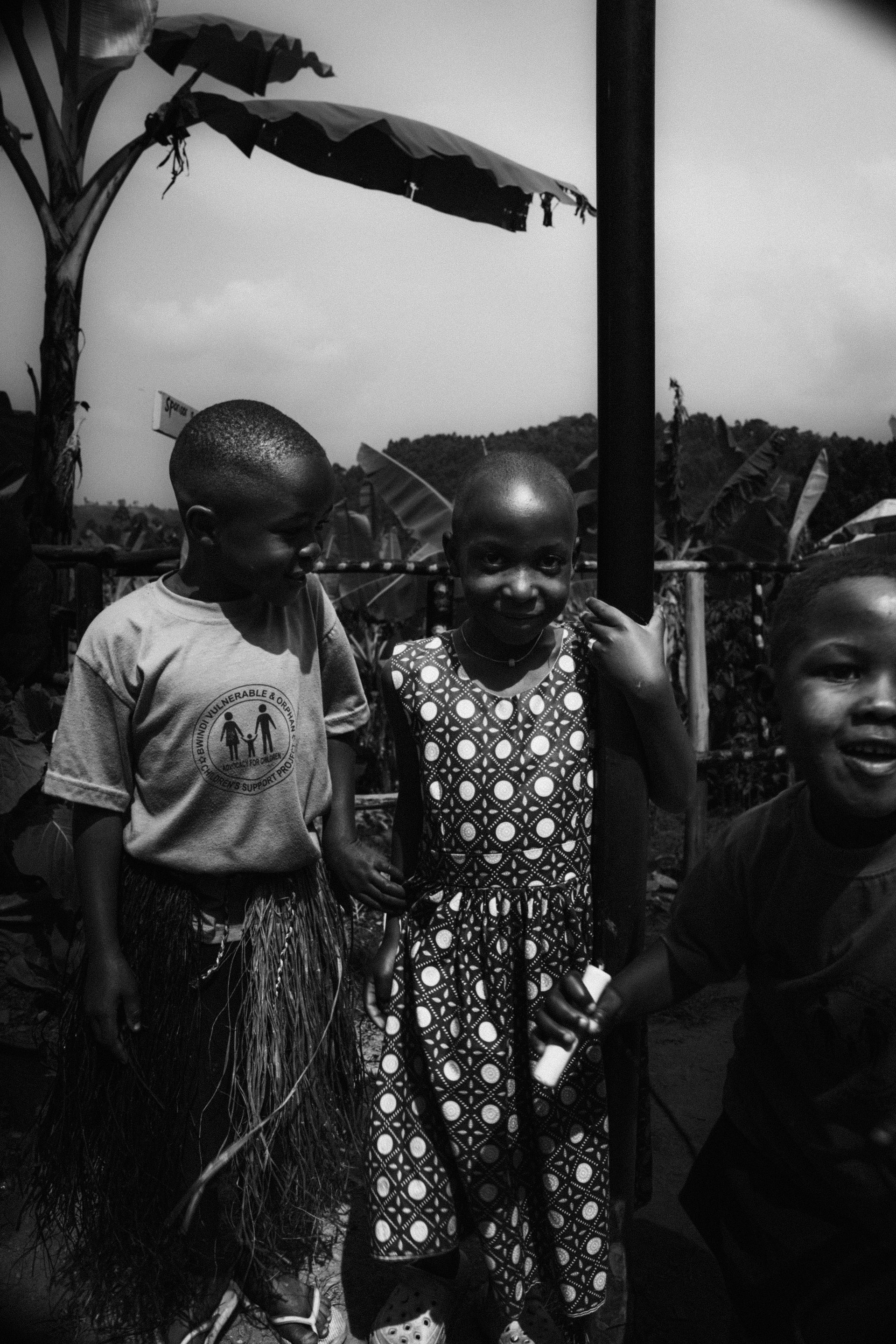
During the June 2026 visit, at GPS -0.9617°S, 29.6109°E near the orphanage in Buhoma, we encountered three neighbourhood children standing at the edge of the compound. They had come because food was being prepared. Their clothing and bearing were indicators of the kind of cumulative, quiet pressure that does not generate headlines — the pressure of households that have been through multiple economic shocks and are managing the consequences invisibly. We invited them in immediately. There was enough food. The chicken farmer’s chicks, across many visits and many batches of birds, had made that particular morning marginally more certain.
Whether gorilla tourism in Bwindi becomes more resilient over time — through market diversification, community savings mechanisms, or more explicit conservation finance structures that buffer against tourism volatility — is an open question. The conversation is ongoing within Uganda Wildlife Authority, among NGOs working in the region, and among the communities themselves. Whether that conversation produces structural change before the next external shock arrives is another matter entirely.