Buhoma gorilla trekking is safe for healthy adults when conducted through Uganda Wildlife Authority (UWA) with licensed guides and armed rangers. The primary risks are physical — steep muddy terrain, altitude, and sustained exertion — rather than security-related. Following the mandatory park rules and coming physically prepared keeps both visitors and gorillas protected.
Quick Facts
- Permit Price:
- USD 800 (standard) / USD 1,500 (GHE)
- Trek Duration:
- 2–6 hours on trail + 1 hour with gorillas
- Group Size:
- Max. 8 visitors per family per day
- Elevation:
- 1,600–2,400 m above sea level
- Min. Age:
- 15 years
- Gorilla Population:
- Approx. 459 in Uganda (2018–2020 census)
- Operator:
- Uganda Wildlife Authority (UWA)
- Best Seasons:
- June–Sept, Dec–Feb
The Moment That Changes Everything — And Why Safety Makes It Possible
After three hours of pushing through dense rainforest on a January morning in 2026, our small group emerged into a clearing less than eight meters from a gorilla family. The silverback was resting on his side, unbothered. A juvenile wrestled with a branch. A mother sat cradling her infant. The encounter lasted one hour and felt, in a way that is difficult to articulate, like stepping into a world that had always existed entirely without us.
What makes a moment like this possible — and what keeps it safe for both visitors and gorillas — is a system of rules, trained professionals, and conservation infrastructure that Uganda Wildlife Authority has developed over decades. Buhoma gorilla trekking is the primary point of entry into this system for visitors approaching Bwindi from the north. Understanding how that system works is not just practical preparation; it is the difference between a genuinely life-changing experience and a dangerous or ecologically damaging one.
During my stay in Bwindi in January 2026, photographed and GPS-verified at coordinates -0.9725N, 29.6213E, I spent several days observing how the safety protocols actually operate in practice. What I found was both more rigorous and more human than I had expected.
Rangers and Guides: Your Safety Team on the Trail
Every trekking group departing from Buhoma is accompanied by at least one UWA-certified ranger guide and two armed rangers. On our January 2026 trek, we had exactly this configuration — one guide who led the group and managed the gorilla encounter, and two rangers who flanked us and monitored the perimeter throughout the morning.
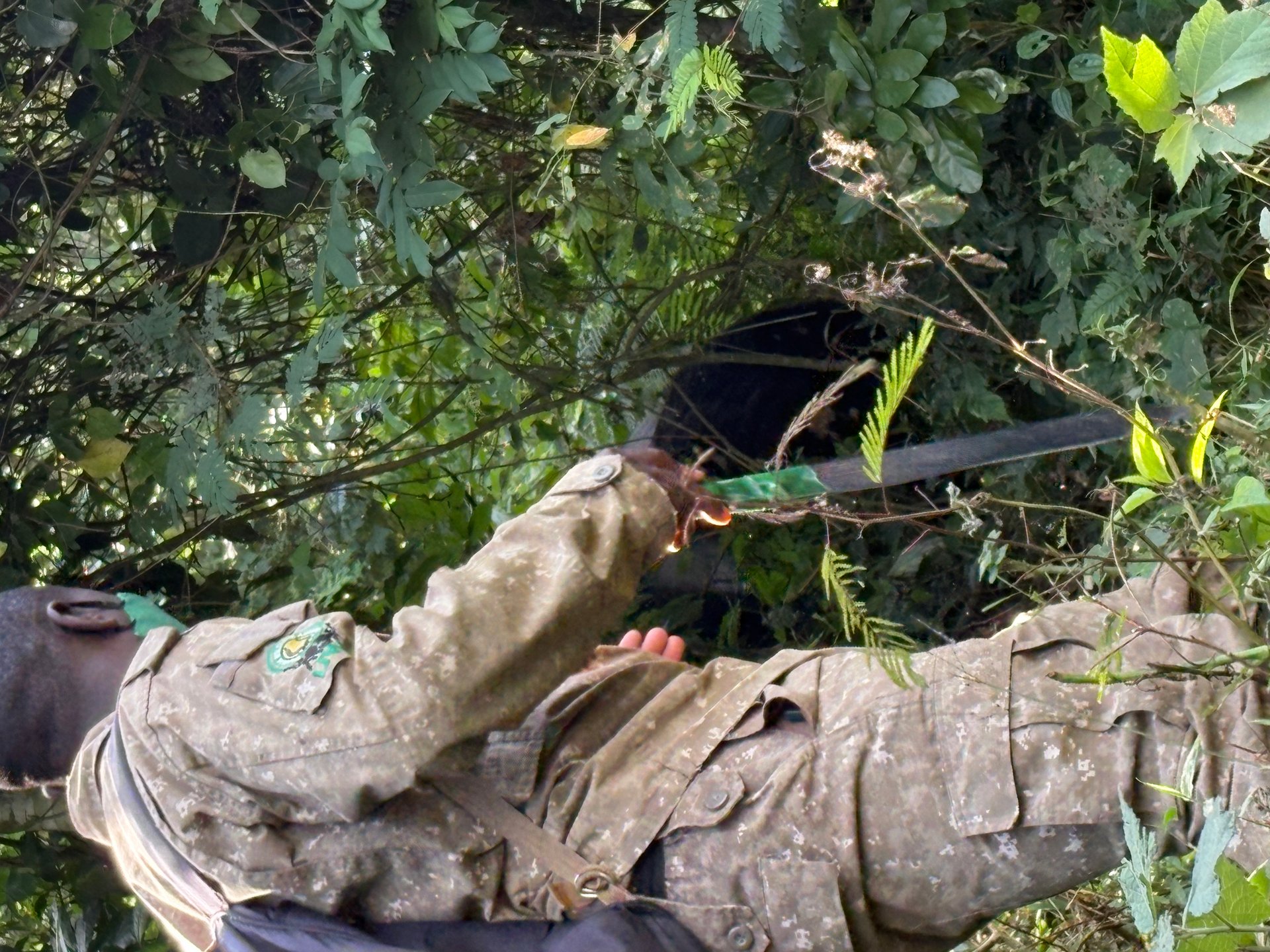
The presence of armed rangers surprises many first-time visitors. The weapons are not pointed at the gorillas; they serve as a deterrent against forest buffalo and other large wildlife that a trekking group might inadvertently encounter. The guns are also part of the anti-poaching mandate that rangers carry at all times. On our trek, one of the rangers also doubled as a trail cutter, using a machete to clear vegetation on steeper sections — a physically demanding task performed with practiced efficiency. The rangers were relaxed, helped struggling group members on difficult ascents without being asked, and appeared genuinely pleased when a gorilla sighting went well. Their presence is not a sign that trekking is dangerous; it is precisely why it is not.
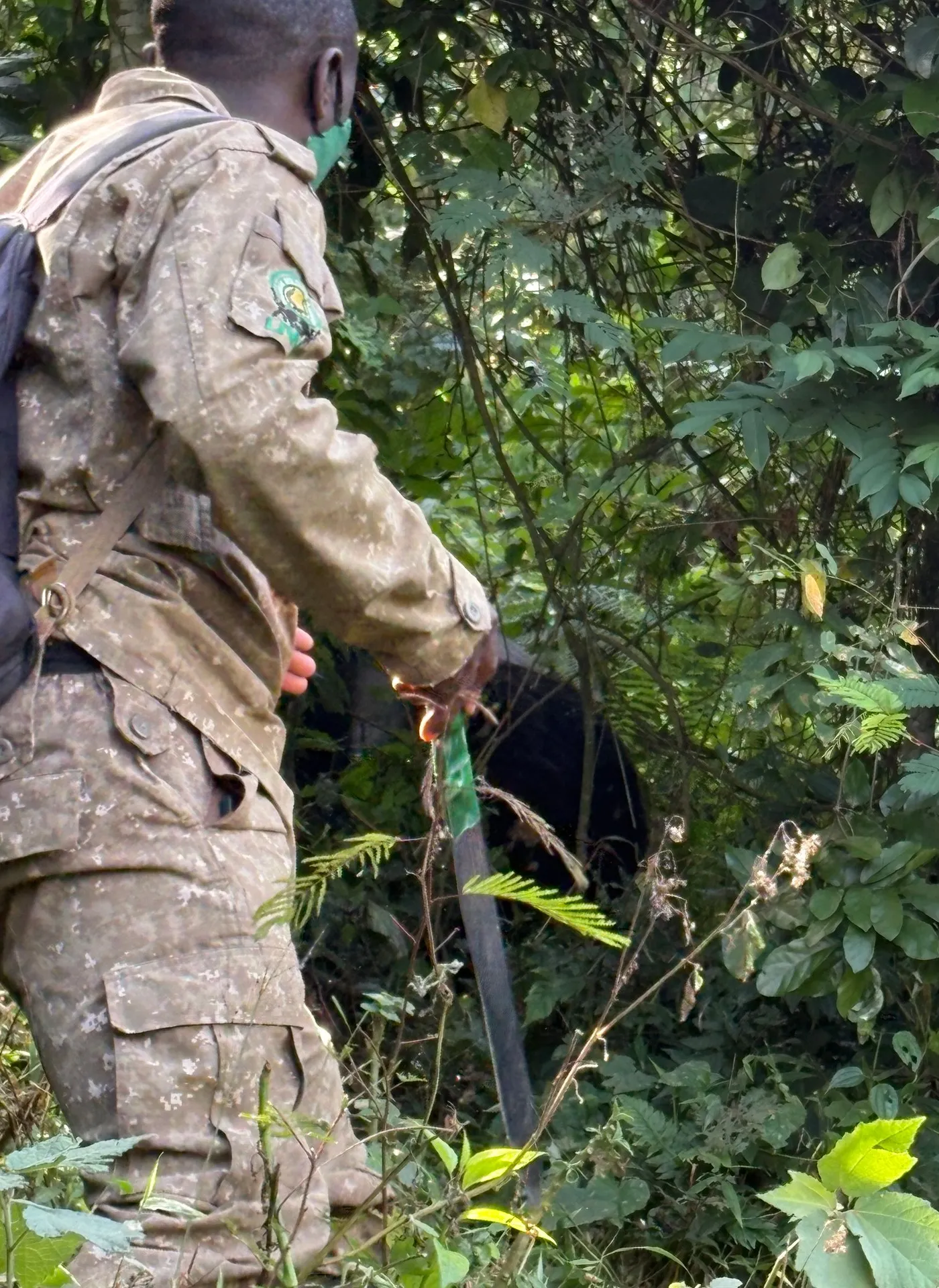
The ranger guide briefed the group thoroughly at the trailhead before departure: maintain a seven-meter distance from the gorillas at all times, do not hold sustained direct eye contact with the silverback, crouch or sit if you are taller than the gorillas, never block a gorilla's path, and follow every instruction immediately without discussion. These rules are not formalities. They have been shaped by experience with habituation and by behavioral research of primatologists who have studied these specific family groups over years.
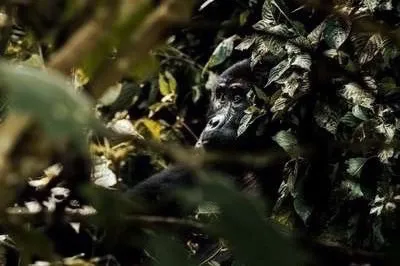
Bwindi is home to approximately 459 mountain gorillas in Uganda — a substantial share of the global population. The habituation process that allows visitors to approach these animals without triggering aggression or flight responses takes several years and requires daily presence by research teams and rangers. The gorillas who receive visitors at Buhoma are accustomed to humans, but they are not tame. The distinction matters enormously for safety.
Physical Demands: The Real Safety Challenge
The honest answer to the question of safety is that the greatest risk for most visitors is not gorillas, poachers, or remoteness. It is the terrain. Bwindi's forests grow across steep mountain ridges in southwestern Uganda, and the trail from Buhoma headquarters into the forest climbs relentlessly. On a day when the gorilla family has moved to higher ground, the ascent can take three to four hours before the first sighting. On a good day during our January 2026 visit, we encountered our first gorilla within ninety minutes — a large male sitting in a tree canopy, feeding quietly on leaves about fifteen meters above the forest floor.
The footing changes constantly. Dry sections feel manageable; wet sections after rain become slick clay that can send a boot sliding sideways without warning. UWA provides walking sticks at the Buhoma trailhead, and experienced visitors are unanimous: use them. They cost a small hire fee and transform the experience for anyone not accustomed to steep, muddy terrain. Gardening gloves are equally underrated — many guides mention them only once, and visitors who ignored the advice tend to regret it by the second hour.
The elevation at Buhoma sits at roughly 1,600 meters, and the forest extends to over 2,400 meters in some sections. Visitors arriving from sea level or with cardiovascular conditions should discuss fitness requirements with their doctor before booking. UWA rangers do their best to match groups to gorilla families in locations that suit the group's fitness level, but there is no guarantee of a short or flat trek on any given day.
On our June 2026 visit, trail conditions were considerably drier than January, which made the ascent easier. Travel season matters for the physical experience. January falls within a short dry season and is generally favorable. The long rainy season from March to May brings heavier precipitation and muddier trails, but also lush greenery and fewer visitors.
Health Precautions: Protecting Visitors and Gorillas Alike
Uganda Wildlife Authority has implemented health protocols specifically to protect mountain gorillas, who share approximately 98 percent of human DNA and are susceptible to many of the same respiratory and infectious diseases. Visitors with symptoms of cold, flu, or gastrointestinal illness are not permitted to trek on that day. This is non-negotiable — a ranger guide assesses the group at the pre-trek briefing and will remove anyone who appears symptomatic. If a permit is denied on health grounds, UWA will typically offer a reschedule, though this depends on availability.
Visitors should in any case avoid coughing or sneezing directly toward the gorillas and keep voices low near the family. Masks may be required during periods of elevated disease risk; it is worth checking current UWA health requirements before arrival, as these protocols evolve. Personal hygiene products with strong fragrances should be left behind, as unfamiliar scents can disturb the gorillas.
For the trek itself, the essential kit includes: waterproof ankle-support hiking boots, long trousers and long-sleeved shirt (vegetation scratches constantly), waterproof jacket or poncho, gardening gloves, at least two liters of water per person, energy snacks, insect repellent, and a small daypack. Cameras without flash are permitted. Leave valuables at the lodge — the trail demands full attention.
Community Infrastructure and Emergency Preparedness
Buhoma serves as the park's main administrative hub for Bwindi's northern sector, and the UWA park headquarters are located within the village itself. In the event of a medical emergency on the trail, rangers carry basic first aid supplies and maintain communication with the park headquarters. The nearest hospital with surgical capability is in Kabale, approximately 65 kilometers away via roads that vary significantly in quality. Serious medical evacuation is possible but not rapid. Visitors with underlying health conditions should carry relevant medication, a copy of their medical history in English, and must ensure their travel insurance explicitly covers helicopter or ambulance evacuation from remote mountainous terrain.
The community around Buhoma is integrated into the park's management model in ways that directly affect the safety environment. Revenue from gorilla permits — USD 800 per person for a standard permit, USD 1,500 for a Gorilla Habituation Experience — is partially redistributed to surrounding communities. This economic stake in conservation means that the communities around Bwindi have strong incentives to protect both the park and the visitors who come to it.
During our stay at Gorilla Bluff Lodge in January 2026 — a lodge built into the steep hillside above Buhoma, GPS-verified at -0.9794, 29.6168, with wooden staircases connecting the guest rooms to the main house — the connection between lodge infrastructure and park access was immediately clear. Every morning began with coffee and African tea on the private terrace before the day's activities. The lodge's position places it within easy walking distance of the park trailhead, and the entire rhythm of the village is structured around early morning departures for gorilla treks.
Before one of our treks, we stopped at a small general store in Buhoma village — roughly twenty square meters, run by a woman who sold water, snacks, and basic supplies through a metal grille. We bought water for the trail and sweets for children we met outside. These small transactions are part of the same ecosystem: permit revenue flows through UWA, a portion returns to communities, and those communities maintain the social fabric that keeps gorilla trekking safe and sustainable over the long term. The recovery of Bwindi's mountain gorilla population since the early 1990s is not incidental to this model — it is the result of it.
The Rules During the Encounter
Uganda Wildlife Authority has established specific behavioral rules for visitors during the one-hour encounter with a gorilla family. These rules are explained at the pre-trek briefing and enforced by the ranger guide throughout the visit. A ranger will end an encounter and escort the group back if rules are repeatedly ignored.
- 1. Maintain seven meters distance. Always keep at least seven meters between yourself and any gorilla. The ranger guide measures this actively and will reposition the group if the distance narrows — for instance, if a gorilla moves toward the group or if the terrain compresses options.
- 2. No direct sustained eye contact with the silverback. Prolonged direct eye contact is read as a challenge. Observe, photograph, admire — but avoid fixing your gaze on the silverback in a way that could register as confrontational.
- 3. Crouch or sit if you are taller than the gorillas. Standing at full height can seem threatening, particularly to the silverback and to younger animals. Rangers may ask visitors to crouch during close approaches. This is one of the less intuitive rules and one of the most important.
- 4. Never block a gorilla's path. If a gorilla moves toward the group, step aside immediately. The gorillas have right of way in their own forest. Be prepared to move quickly when the guide instructs it.
- 5. No flash photography. Flash is prohibited entirely. It can startle the gorillas and has been documented to cause distress in habituated groups. Bring a camera with strong low-light performance rather than relying on flash.
- 6. Keep noise and movement low. Speak in low voices. Avoid sudden movements. The calm that makes a gorilla encounter remarkable depends on the group maintaining an environment that does not alarm the animals.
- 7. Do not eat near the gorillas. Consuming food during the encounter can attract the animals. Save snacks for the trail before or after.
Mock Charges: What They Are and How to Respond
A mock charge is a display behavior that silverbacks perform when the group has come too close, moved too abruptly, or made a sound that registers as threatening. The silverback rises to full height, may beat his chest, vocalizes loudly, and runs or lunges toward the group — then stops short. It is alarming when it happens. It is not an attack.
The correct response is to remain still, crouch slightly, avert your eyes, and wait. Your ranger guide will manage the situation. Under no circumstances should any visitor run — running triggers a pursuit instinct. A mock charge that is responded to calmly almost always ends without contact. Maintaining the prescribed seven-meter distance, avoiding direct eye contact, and not blocking gorilla paths are the primary ways to prevent a display from occurring in the first place. The presence of experienced rangers, who recognize the early signs of agitation in a group, is the most reliable safety measure.
Photography: Rules and Practical Guidance
Gorilla photography in Bwindi is simultaneously extraordinary and technically demanding. The forest is dense, the light is frequently low, and the animals move unpredictably through heavy vegetation. A camera with strong low-light performance is significantly more valuable than one with a high-resolution sensor but a small aperture. Mirrorless systems with fast lenses (f/2.8 or wider) perform well; entry-level smartphones typically do not in forest conditions.
Flash is prohibited — this cannot be negotiated or adjusted by permits. The seven-meter rule means telephoto lenses produce better isolation than wide-angle approaches. A 100–400mm zoom range covers most situations. Video recording is permitted and many visitors find it captures behavioral sequences — juveniles playing, the silverback repositioning, social grooming — more effectively than stills.
The best frames come from moments of rest rather than movement: adults feeding in clearings, juveniles wrestling in more open areas, a silverback pausing to observe the group. Patience during the hour matters more than continuous shooting. The animals produce extraordinary images without manipulation; the task is to be ready when the moment happens.